
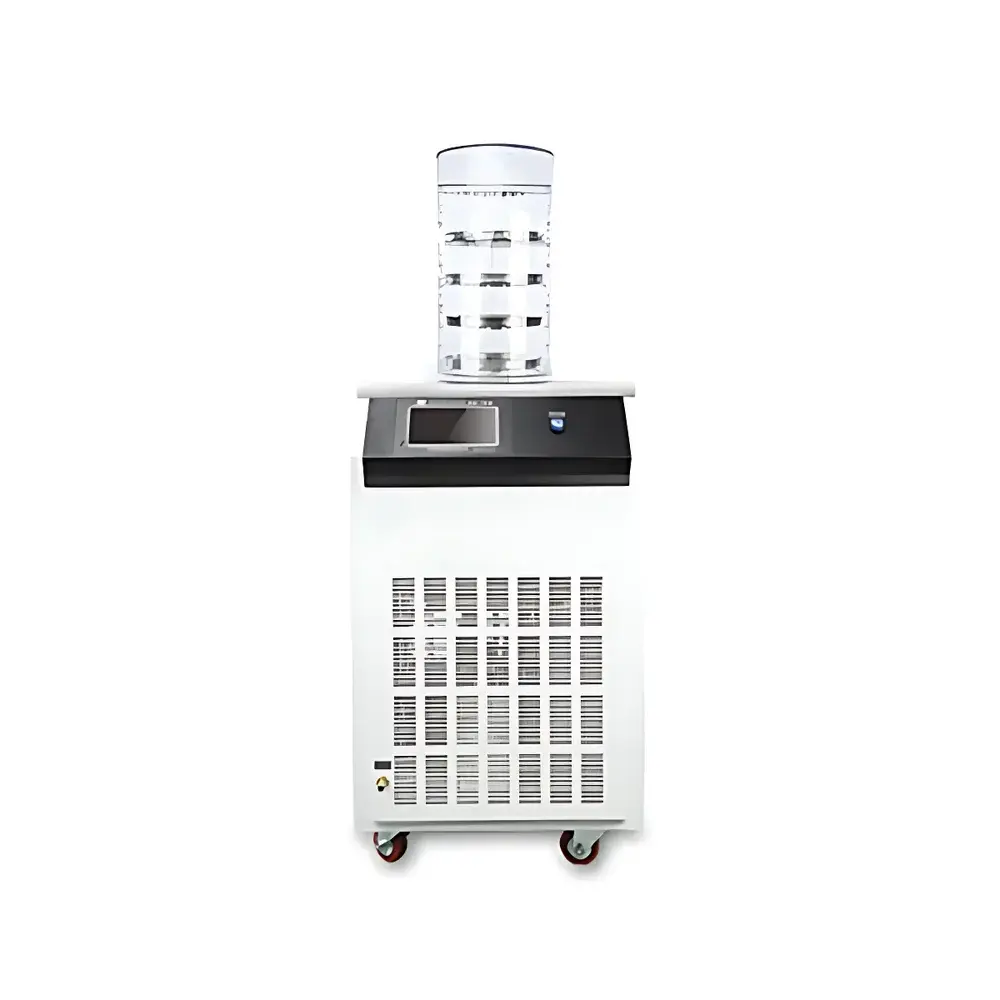
Ningbo Scientz SCIENTZ-18ND/A Benchtop Shelf-Type Freeze Dryer with Heated Manifold
| Brand | Scientz |
|---|---|
| Origin | Zhejiang, China |
| Manufacturer Type | Direct Manufacturer |
| Instrument Type | Shelf-Type (Heated Manifold) Freeze Dryer |
| Application Scope | Laboratory R&D and Process Development |
| Lyophilization Area | 0.09 m² |
| Ultimate Vacuum (No Load) | ≤5 Pa |
| Condensate Capacity (24 h) | 6 kg/24 h |
| Cold Trap Temperature (No Load) | ≤−56 °C |
| Dimensions (L×W×H) | 670 × 525 × 910 mm + 480 mm (Manifold Height) |
Overview
The Ningbo Scientz SCIENTZ-18ND/A is a benchtop shelf-type freeze dryer engineered for precision lyophilization in academic, governmental, and early-stage biopharmaceutical laboratories. It operates on the fundamental principle of sublimation under deep vacuum—where ice transitions directly from solid to vapor without passing through the liquid phase—preserving structural integrity, biological activity, and chemical conformation of thermolabile samples. Designed for process development rather than high-throughput production, this unit supports empirical optimization of critical parameters including shelf temperature ramping profiles, primary drying endpoints, and secondary drying conditions. Its compact footprint (under 0.35 m² floor space) integrates a heated manifold system, enabling controlled, uniform thermal input to vials or flasks while maintaining vacuum integrity across multiple ports. The system complies with core physical principles defined in ISO 22055:2021 (Lyophilization Process Validation) and aligns with Good Laboratory Practice (GLP) documentation requirements for traceable parameter logging.
Key Features
- Shelf-type architecture with electrically heated silicone rubber heating plates (36 V safety-rated), delivering precise PID-controlled temperature regulation (±0.5 °C stability) and eliminating thermal overshoot during ramp phases.
- Imported high-efficiency refrigeration compressor with dual-stage cascade configuration; standard cold trap reaches ≤−56 °C (no load); optional −80 °C upgrade available for low-eutectic-point formulations.
- 7-inch full-color capacitive touchscreen interface running an industrial-grade embedded OS, supporting real-time display of cold trap temperature, chamber pressure, shelf temperature, and vacuum status.
- Automated data logging with timestamped storage of complete lyophilization cycles (including setpoints, actual values, alarms); exportable via USB to external PCs for post-run analysis using third-party software.
- Optically transparent polycarbonate drying chamber—single-piece injection-molded, corrosion-resistant, vacuum-tight, and fully observable—enabling visual monitoring of ice sublimation and cake morphology development.
- Intelligent vacuum management: pump activation delayed until cold trap reaches preset temperature (e.g., −45 °C), extending pump service life and reducing oil backstreaming risk; optional oil mist filter and auto differential-pressure valve included.
Sample Compatibility & Compliance
The SCIENTZ-18ND/A accommodates standard 10–22 mm OD lyophilization vials (up to 8 positions), compatible with internationally recognized stopper-sealed formats (e.g., Schott Type I glass). It supports aqueous, buffer-based, and low-conductivity formulations common in protein therapeutics, nucleic acid vaccines, microbial cultures, botanical extracts, and environmental matrices (soil, sludge, plant tissue). The system meets essential mechanical and operational benchmarks referenced in ASTM F2375–22 (Standard Guide for Lyophilization Process Development) and supports audit-ready documentation for GLP and pre-IND study environments. While not certified for GMP manufacturing, its deterministic control architecture and full parameter traceability make it suitable for Stage 1–2 process characterization per ICH Q5C and Q8(R2).
Software & Data Management
All operational parameters—including shelf temperature setpoint and feedback, cold trap temperature, chamber pressure (via Pirani sensor), and elapsed time—are sampled at 1-second intervals and stored internally with cyclic overwrite protection. Historical runs are retrievable by date/time stamp or user-defined batch ID. Data export is supported via FAT32-formatted USB drives in CSV format, enabling integration with statistical process control (SPC) platforms or Excel-based drying kinetics modeling. The interface includes configurable alarm thresholds (e.g., ambient temperature >35 °C triggers audible/visual alert), event log with cause-and-timestamp (e.g., “Vacuum pump enabled at −52.3 °C”), and freeze-drying curve overlay functionality for comparative analysis across batches.
Applications
This instrument serves as a validated platform for lyophilization method development across diverse domains:
- Biopharmaceutical R&D: Stabilization of monoclonal antibodies, recombinant enzymes, viral vectors, and mRNA-LNP formulations prior to analytical characterization.
- Agricultural & Food Science: Preservation of probiotic strains, enzymatic extracts, volatile flavor compounds, and pesticide-spiked reference materials for residue analysis.
- Environmental Testing: Preparation of soil, sediment, and wastewater sludge samples for elemental speciation (ICP-MS), organic contaminant quantification (GC-MS), and metagenomic DNA extraction.
- Academic Research: Structural biology workflows requiring intact protein crystals or membrane complexes; cryo-EM sample preparation support; long-term archiving of clinical isolates and fungal cultures.
- Material Science: Drying of nanosuspensions, aerogel precursors, and catalytic metal-organic frameworks (MOFs) where solvent removal must avoid particle aggregation or pore collapse.
FAQ
What is the maximum sample volume per batch?
The 0.09 m² shelf area supports up to 6 kg of ice-equivalent load under optimized conditions; typical vial loading assumes 5–15 mL fill volume per container depending on formulation collapse temperature.
Does the system support automated cycle programming?
Yes—up to 32 programmable steps per cycle (ramp/hold combinations), each with independent shelf temperature, vacuum setpoint, and duration parameters.
Is the cold trap condenser accessible for manual defrosting?
The unit features an integrated electric defrost function; no disassembly is required—defrost cycle initiates automatically after drying completion or manually via touchscreen.
Can the system be integrated into a networked lab environment?
Local Ethernet connectivity is not provided; however, exported CSV files are compatible with LIMS and ELN systems via manual upload or scripted ingestion pipelines.
What vacuum pump options are recommended?
Dual-stage oil-lubricated rotary vane pumps (e.g., Edwards RV8, Agilent DS-202) rated ≥4 m³/h pumping speed and ≤1 × 10⁻³ mbar ultimate vacuum are routinely deployed with this model.



