
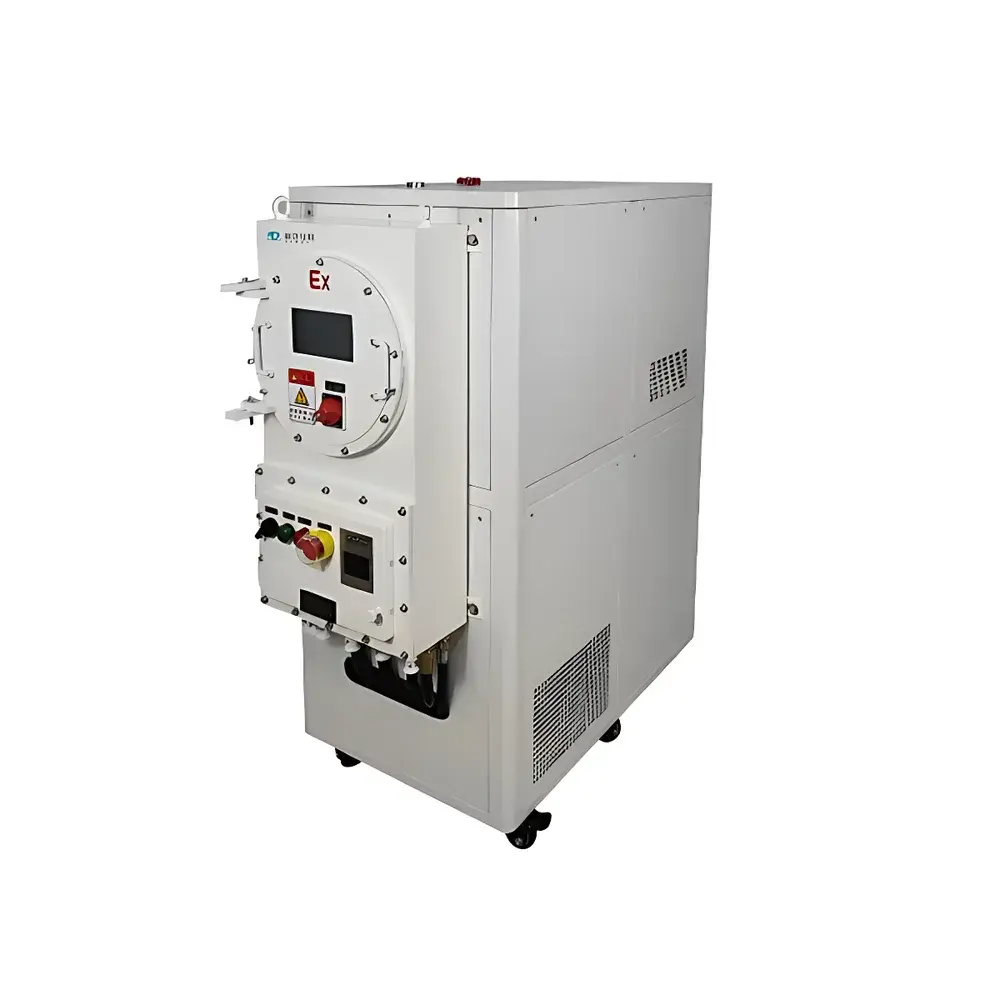
Scientz L15-12 Series Cryogenic-to-High-Temperature Circulating Temperature Control System (–120 °C to +70 °C)
| Brand | Scientz |
|---|---|
| Origin | Zhejiang, China |
| Manufacturer Type | Direct Manufacturer |
| Product Origin | Domestic (China) |
| Model | L15-12 Series |
| Temperature Range | –120 °C to +70 °C |
| Temperature Accuracy (Bath Medium) | ±0.5 °C |
| Temperature Accuracy (Process Material) | ±1.0 °C |
| Control Algorithm | PID Fuzzy Logic |
| Communication Protocol | MODBUS RTU over RS-485 |
| Bath Medium Temperature Range | –25 °C to +200 °C |
| HMI | 7-inch Color Touchscreen with Real-time Temperature Curve Display & Logging |
| Control Modes | Dual-mode selection — bath outlet temperature control or process material temperature control (with external PT100 sensor) |
| ΔT Control | Adjustable and programmable differential temperature control between jacket and material |
| Programmability | Up to 5 programs, each with up to 30 segments |
| Temperature Feedback Points | Three independent PT100 inputs — unit internal temperature, bath outlet temperature, and external process temperature |
| Safety Protections | Compressor overload protection, high-pressure switch, thermal overload relay, high-temperature cut-off, low-fluid-level detection, sensor fault detection, self-diagnostic system |
| System Design | Fully sealed closed-loop circulation — prevents oil mist generation at high temperatures and moisture ingress at cryogenic temperatures |
Overview
The Scientz L15-12 Series Circulating Temperature Control System is an engineered solution for precise, stable, and wide-range thermal management in demanding life science, chemical synthesis, and advanced materials testing applications. Operating across an exceptional temperature span from –120 °C to +70 °C, the system employs a dual-stage cascade refrigeration architecture combined with electric heating and high-efficiency heat exchanger design to deliver rapid ramp rates and exceptional thermal stability. Its core function is to maintain accurate, reproducible temperature conditions for externally connected equipment—including jacketed reactors, microchannel reactors, environmental test chambers, and battery thermal test fixtures—by circulating a single, thermally stable heat transfer fluid through a fully sealed loop. Unlike open-bath systems, this closed-loop configuration eliminates vapor loss, oxidation, moisture absorption, and pressure surges during extreme thermal transients—ensuring long-term fluid integrity and operational safety under GLP/GMP-aligned laboratory practices.
Key Features
- PID fuzzy logic control algorithm ensures dynamic response to load changes while minimizing overshoot and stabilizing temperature within ±0.5 °C at the bath outlet and ±1.0 °C at the process point.
- 7-inch color touchscreen HMI supports real-time multi-channel temperature curve visualization, historical data playback, and intuitive program editing—including up to five independent protocols, each configurable with 30 discrete time–temperature segments.
- Dual-sensor feedback architecture integrates three PT100 inputs: internal unit temperature, bath outlet temperature, and externally mounted process temperature—enabling intelligent ΔT control between reactor jacket and reaction mass.
- MODBUS RTU communication via RS-485 enables seamless integration into centralized lab automation networks, SCADA systems, or LIMS platforms for remote monitoring and audit-trail-compliant operation.
- Comprehensive safety suite includes compressor overload protection, high-pressure cut-off, thermal relay tripping, low-fluid-level detection, redundant high-temperature sensors, and automatic fault diagnostics with on-screen alarm codes.
- Structural housing fabricated from cold-rolled steel with electrostatic powder coating provides mechanical robustness and corrosion resistance in shared laboratory environments.
Sample Compatibility & Compliance
The L15-12 series is compatible with standard silicone oils, synthetic hydrocarbons, and low-freezing-point glycol–water mixtures—validated for continuous operation between –25 °C and +200 °C in the circulation loop. It interfaces directly with jacketed glass or stainless-steel reactors (e.g., 1–50 L capacity), microstructured flow reactors, calorimetric cells, and automotive component test fixtures requiring simultaneous multi-zone thermal conditioning. The system conforms to IEC 61000-6-2 (immunity) and IEC 61000-6-4 (emissions) standards. Its programmable logging functionality—capturing timestamped temperature values at user-defined intervals—supports compliance with FDA 21 CFR Part 11 when deployed with validated electronic signature workflows and audit-trail-enabled software extensions.
Software & Data Management
Onboard firmware stores all temperature logs internally with non-volatile memory retention (≥30 days at 1-second sampling). Data export is supported via USB flash drive in CSV format for post-processing in MATLAB, Python, or Excel. Optional Scientz LabLink software (Windows-based) provides extended capabilities: remote control via TCP/IP, synchronized multi-unit coordination, automated report generation (PDF/Excel), and configurable alarm notifications via email or SNMP traps. All logged parameters—including setpoint, actual bath temperature, process temperature, ΔT deviation, and system status flags—are time-stamped with millisecond resolution and support traceability requirements under ISO/IEC 17025 and ASTM E2500.
Applications
- Chemical Process Development: Precise exotherm management in nitration, sulfonation, hydrogenation, and photochemical reactions using jacketed reactors and microreactors—enabling safe scale-up from lab to pilot plant.
- Pharmaceutical R&D: Controlled crystallization, polymorph screening, and lyophilization cycle development where narrow thermal windows and reproducible cooling ramps are critical.
- Advanced Materials Testing: Thermal cycling of battery cells, power electronics modules, and composite laminates under simulated automotive or aerospace environmental profiles per ISO 16750-4 and SAE J2380.
- Bioprocess Support: Temperature stabilization for enzymatic assays, cell culture bioreactor jackets, and chromatography column ovens requiring sub-zero start conditions or elevated holding stages.
- Calorimetry Integration: Coupling with reaction calorimeters (e.g., RC1, CPA) for accurate heat-flow quantification across broad enthalpy ranges.
FAQ
What heat transfer fluids are recommended for operation at –120 °C?
Scientz recommends certified low-viscosity synthetic hydrocarbon fluids (e.g., Therminol VP-1 analogues) or specialized perfluoropolyether (PFPE) oils rated for continuous use below –100 °C. Fluid compatibility must be verified against pump seals and heat exchanger metallurgy.
Can the system maintain temperature stability during rapid exothermic events?
Yes—the dual-stage refrigeration circuit and high-flow-rate pump (up to 35 L/min) enable dynamic heat extraction capacity exceeding 8 kW at –40 °C, supporting stable control even during sudden 5–10 °C/min exotherms in 20-L reactor volumes.
Is external PT100 sensor calibration traceable to NIST standards?
The system accepts standard 2-, 3-, or 4-wire PT100 sensors; end-user calibration using NIST-traceable reference probes is required for metrological compliance—no built-in calibration certificate is supplied.
Does the unit support 21 CFR Part 11 compliance out-of-the-box?
The base hardware supports audit-trail-capable data logging; full Part 11 compliance requires deployment with validated third-party software (e.g., LabArchives, Empower) and documented SOPs covering electronic signatures, role-based access, and data integrity controls.
What maintenance intervals are recommended for the cascade refrigeration system?
Compressor oil analysis every 2,000 operating hours; refrigerant leak check annually; heat exchanger cleaning every 6 months in high-particulate environments; full service inspection recommended every 12 months by authorized Scientz field engineers.
Related Products




