
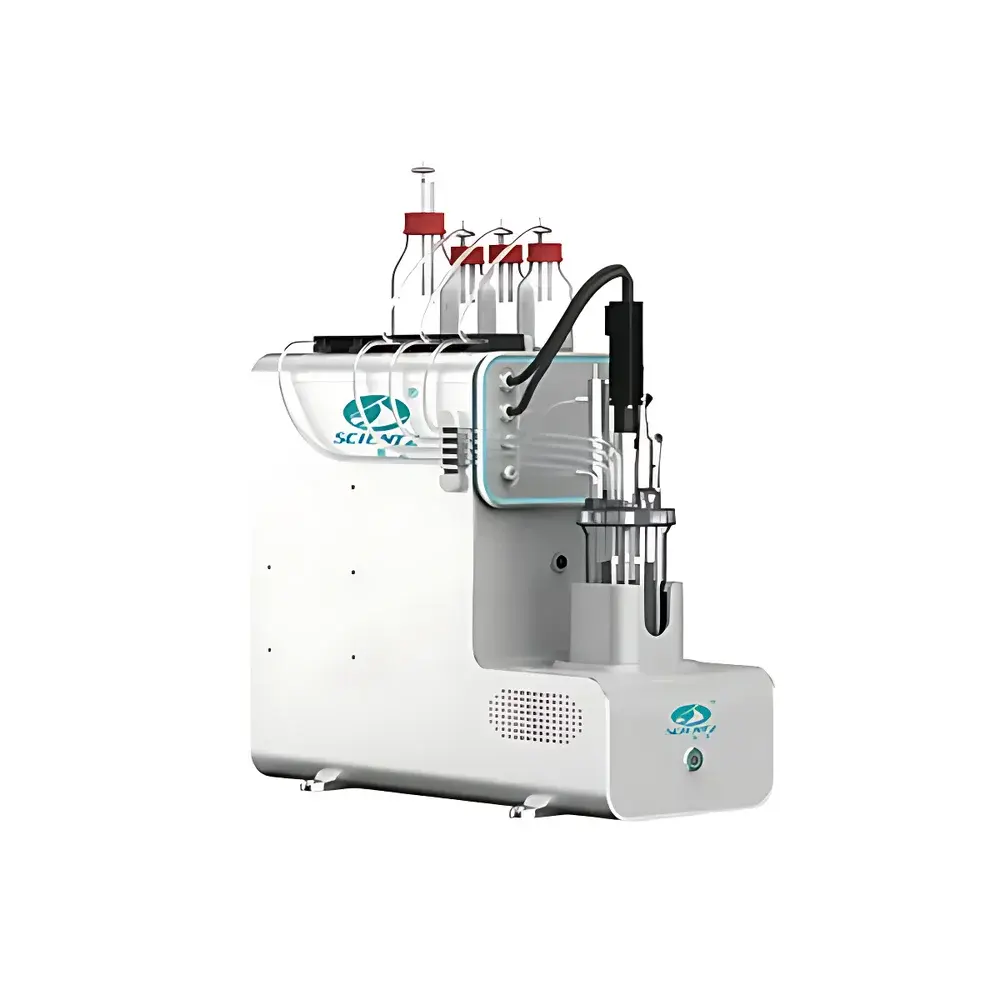
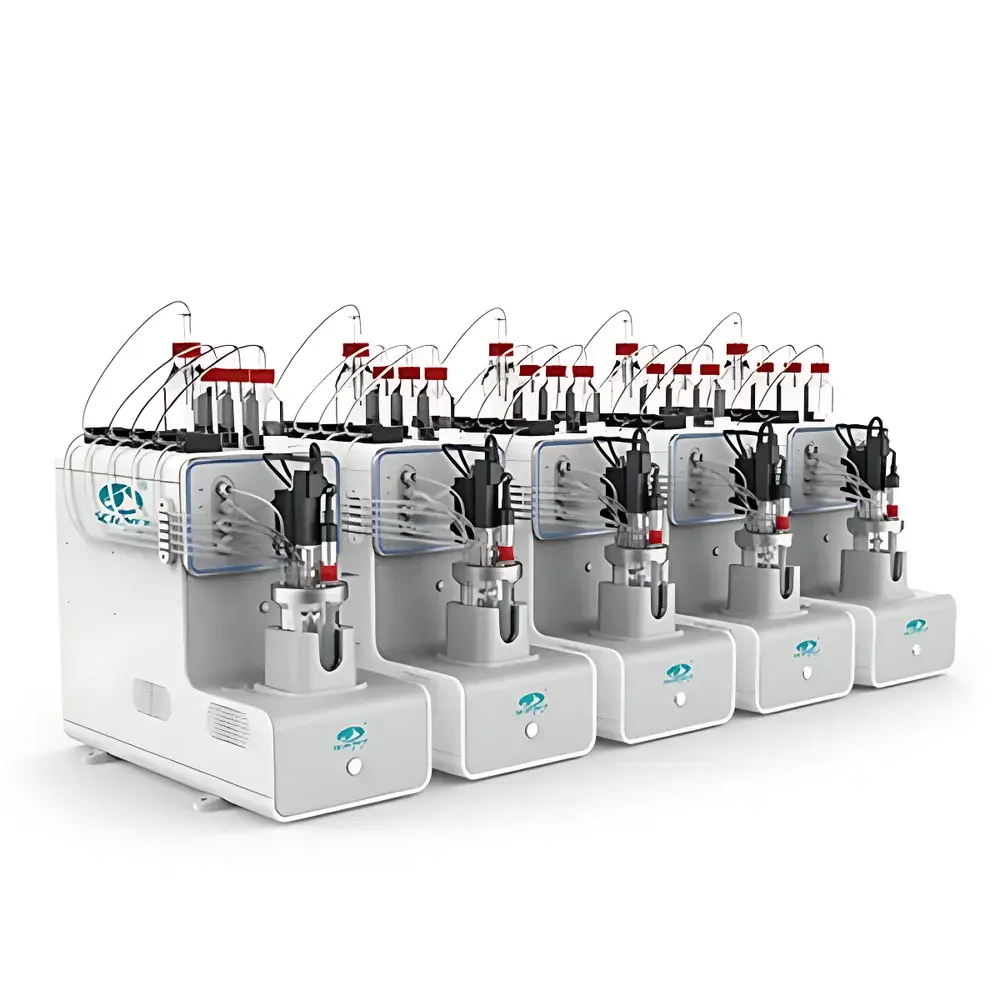
Scientz MPB1-500 Parallel Cell Culture Reactor System
| Brand | Scientz |
|---|---|
| Origin | Zhejiang, China |
| Manufacturer Type | Direct Manufacturer |
| Product Category | Domestic |
| Model | MPB1-500 |
| Quotation | Upon Request |
| Temperature Range | 4–60 °C (±0.2 °C) |
| Working Volume per Vessel | 500 mL |
| Scalable Vessel Count | Unlimited |
Overview
The Scientz MPB1-500 Parallel Cell Culture Reactor System is an engineered platform for high-throughput, controlled bioprocess development in mammalian, microbial, and insect cell culture applications. Built upon Couette-type stirred-tank reactor geometry and validated thermal-fluid dynamics principles, the MPB1-500 delivers precise, reproducible control over critical process parameters—including temperature, dissolved oxygen (DO), pH, agitation speed, and feeding profiles—across multiple independent vessels operating in parallel. Each 500 mL working-volume vessel replicates key hydrodynamic and mass-transfer characteristics of larger-scale production bioreactors, enabling robust scale-down modeling for process characterization, strain evaluation, and media optimization. The system is designed to support Quality-by-Design (QbD) workflows compliant with ICH Q5, Q8, and Q9 frameworks, facilitating seamless transition from lab-scale discovery to pilot- and manufacturing-scale implementation.
Key Features
- Modular, expandable architecture supporting unlimited parallel vessels—scalable from 1 to >24 reactors within a single networked control environment.
- High-precision temperature regulation (4–60 °C ±0.2 °C) via Peltier-based heating/cooling modules with dual-sensor feedback and adaptive PID control.
- Integrated DO and pH sensing with real-time auto-calibration; configurable cascade control loops linking agitation, gas blending (air/O₂/N₂), and antifoam dosing.
- Unified software interface enabling synchronized or independent parameter scheduling across all vessels—including timed feed profiles, ramp/hold temperature sequences, and dynamic DO setpoint modulation.
- Patented ergonomic layout: left-side tubing manifold with color-coded connectors, right-side electronic interface panel, and full-ring status illumination for rapid operational state recognition.
- Embedded HD camera module per vessel for time-lapse imaging and remote visual monitoring via secure TLS-encrypted web interface.
Sample Compatibility & Compliance
The MPB1-500 accommodates suspension-adapted mammalian cells (e.g., CHO, HEK293), bacterial strains (E. coli, Bacillus spp.), yeasts (S. cerevisiae, P. pastoris), and filamentous fungi under aerobic or microaerobic conditions. All wetted materials comply with USP Class VI biocompatibility standards; vessel bodies are constructed from borosilicate glass with silicone-free, autoclavable seals. The system supports GLP- and GMP-aligned operation through audit-trail-enabled software (21 CFR Part 11-compliant user authentication, electronic signatures, and immutable data logging). It meets ISO 13485 design control requirements for medical device-related bioprocess development and is compatible with ASTM E2500-13 (Good Automated Manufacturing Practice) validation protocols.
Software & Data Management
The Scientz BioControl Suite provides a unified digital environment for experimental design, execution, and analysis. Users define fermentation or cell culture protocols using drag-and-drop workflow editors, then deploy them across selected vessels with one-click activation. The system captures timestamped, high-frequency sensor data (≥1 Hz resolution) and stores it in structured HDF5 format with embedded metadata (strain ID, media lot, operator, calibration history). Cloud synchronization enables cross-site collaboration and centralized data governance. Advanced analytics include soft-sensor estimation (e.g., viable cell density, metabolic rate), multivariate PCA trend analysis, and automated anomaly detection based on historical batch fingerprints. All raw and processed datasets export natively to CSV, MATLAB (.mat), or Python-compatible formats for integration into enterprise LIMS or AI-driven bioprocess modeling platforms.
Applications
- Fermentation process optimization: systematic DoE studies evaluating interactions among temperature, pH, DO, and feeding strategies to maximize titer, productivity, or product quality attributes (e.g., glycosylation profile).
- High-throughput strain screening: parallel assessment of genetically engineered variants under identical process constraints to identify clones with superior growth kinetics or expression stability.
- Media formulation and raw material qualification: comparative testing of commercial basal/media components, feed supplements, or buffer salts across multiple lots to establish specification limits and ensure supply chain consistency.
- Scale-down model verification: correlation of MPB1-500 performance metrics (kLa, mixing time, shear stress estimates) with data from 50–2000 L production bioreactors to de-risk tech transfer.
- Process robustness testing: deliberate introduction of parameter perturbations (e.g., ±2 °C temperature excursions, ±10% DO deviation) to assess impact on critical quality attributes and define proven acceptable ranges (PARs).
FAQ
Can the MPB1-500 be integrated with third-party laboratory automation systems?
Yes—the system provides open TCP/IP and Modbus RTU interfaces, along with SDK documentation for Python and LabVIEW, enabling bidirectional communication with robotic liquid handlers, sample storage systems, and central LIMS platforms.
Is remote access supported for real-time monitoring and intervention?
Yes—secure HTTPS-based web interface allows authenticated users to view live sensor trends, adjust setpoints, trigger sampling, and review camera feeds from any location with internet connectivity.
What validation documentation is provided with the system?
Each unit ships with Factory Acceptance Test (FAT) reports, IQ/OQ templates aligned with ASTM E2500, and traceable calibration certificates for all primary sensors (temperature, pH, DO). Custom PQ support is available upon request.
How is sterility maintained during multi-day runs with automated sampling?
The integrated peristaltic sampling pump uses single-use, gamma-irradiated tubing sets with sterile break connectors; all fluid paths are validated for SIP (Steam-in-Place) compatibility up to 121 °C for 30 minutes.
Does the system support fed-batch and perfusion modes?
Yes—programmable multi-channel peristaltic pumps enable complex feed schedules (exponential, linear, or event-triggered), while optional hollow-fiber or acoustic settling modules support continuous perfusion configurations.




