
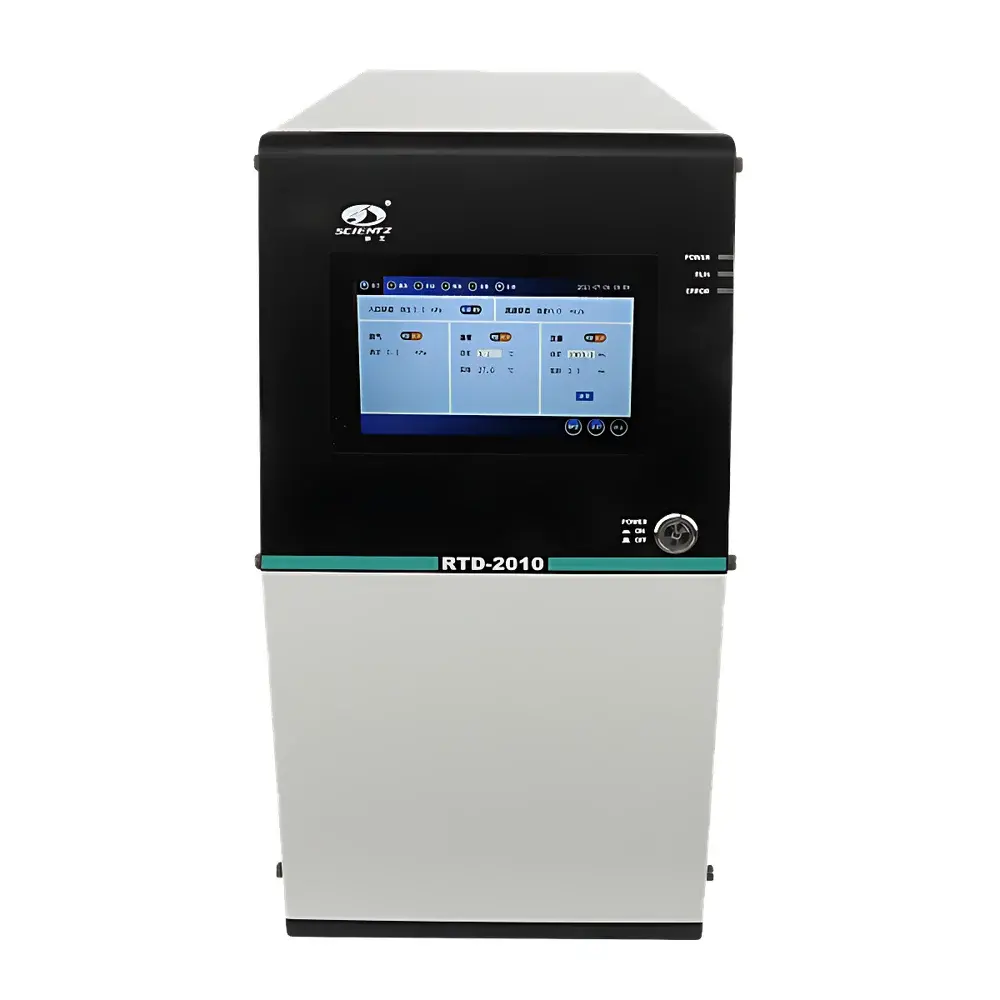
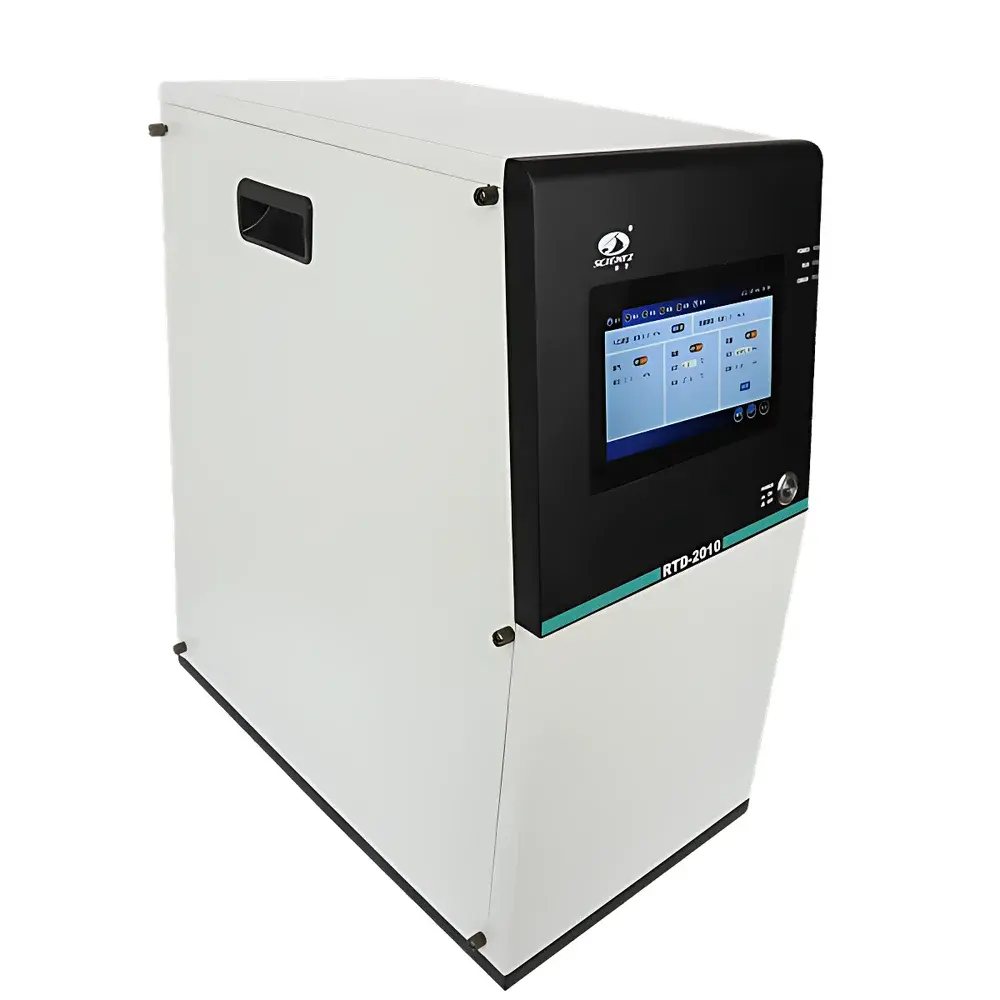
Scientz RTD-2010 Real-Time Temperature-Controlled Membrane Degasser
| Brand | Scientz |
|---|---|
| Model | RTD-2010 |
| Technology | Hydrophobic Hollow-Fiber Vacuum Membrane Degassing |
| Temperature Control Range | Ambient to 45 °C (±0.5 °C) |
| Degassing Efficiency | >95% dissolved O₂ removal |
| Flow Rate | Up to 2.0 L/min |
| Capacity | 1000 mL per cycle (±1% volumetric accuracy) |
| Compliance | Meets ChP <0901> for Dissolution Medium Preparation |
| Data Integrity | Audit Trail Enabled |
| Interface | 7-inch TFT Color Touchscreen with Local Log Storage |
| Power Supply | 220 V AC, 50/60 Hz |
Overview
The Scientz RTD-2010 Real-Time Temperature-Controlled Membrane Degasser is an engineered solution for the precise, reproducible, and compliant preparation of deaerated dissolution media in pharmaceutical quality control and formulation development laboratories. It operates on the principle of hydrophobic hollow-fiber membrane degassing—a physical separation process wherein dissolved gases (primarily O₂, CO₂, and N₂) diffuse selectively across a porous polypropylene membrane under vacuum, while liquid phase remains impermeable due to surface tension and membrane hydrophobicity. Unlike thermal or sonication-based methods, this technique avoids volatile component loss, pH shift, or thermal degradation of sensitive APIs and excipients. Integrated real-time temperature regulation ensures media are delivered at a user-defined setpoint (ambient to 45 °C) immediately post-degassing—critical for maintaining thermodynamic equilibrium in USP Apparatus I–IV dissolution testing. The system is designed for direct integration with automated dissolution testers and media dispensing workstations, supporting continuous or batch-mode operation.
Key Features
- Triple-function architecture: simultaneous vacuum draw, precise temperature control, and closed-loop recirculation—enabling complete gas removal within ≤8 minutes per 1000 mL cycle
- High-fidelity volumetric delivery: automated quantitative aspiration, pre-heating, degassing, and dispensing; achieves ±1% accuracy at 1000 mL per ISO 8655-1 calibrated piston displacement
- Intelligent fluid path management: pressure-sensing module enables automatic switching between self-priming (suction) and externally pressurized (pump-fed) inlet modes
- Regulatory-ready interface: 7-inch capacitive touchscreen with multilingual UI, configurable parameter locking, and timestamped event logging
- Robust construction: all-wetted parts fabricated from USP Class VI-certified materials (316L SS, PTFE, and medical-grade silicone); no leachable metals or organics
Sample Compatibility & Compliance
The RTD-2010 is validated for use with aqueous dissolution media including purified water, distilled water, buffer solutions (e.g., phosphate, acetate), surfactant-containing media (e.g., SDS, polysorbate 80), and organic-aqueous mixtures up to 20% v/v ethanol or isopropanol. It complies with Chinese Pharmacopoeia (ChP) General Chapter <0901> “Preparation of Dissolution Media” and aligns with ICH Q5C stability guidance for oxygen-sensitive biologics. System design supports GLP and GMP environments: audit trail functionality meets FDA 21 CFR Part 11 requirements for electronic records and signatures when paired with validated LIMS or CDS platforms. All calibration and maintenance activities are traceable via internal log export (CSV format) with operator ID, timestamp, and action type.
Software & Data Management
The embedded firmware provides local storage of ≥10,000 operational events—including start/stop times, temperature profiles, vacuum levels, dispense volumes, and error codes—with automatic overwrite protection and manual export via USB 2.0 port. No cloud connectivity or external software dependency is required; however, optional RS-485 Modbus RTU interface enables integration into centralized lab automation systems (e.g., DeltaV, LabWare LIMS). User access levels (Operator, Supervisor, Administrator) enforce role-based parameter modification rights. All critical settings—including temperature setpoint, vacuum threshold, and volume calibration offsets—are password-protected and logged upon change.
Applications
- Pharmaceutical QC labs performing USP <711>, Ph. Eur. 2.9.3, and JP 17 dissolution testing
- Formulation development teams optimizing media composition for poorly soluble compounds
- Bioavailability/bioequivalence studies requiring strict control of dissolved oxygen to prevent oxidative degradation
- Reference standard preparation where baseline absorbance or fluorescence must remain unaffected by air bubbles
- Automated dissolution systems (e.g., Hanson SR8-Plus, Distek 2500) requiring inline, temperature-stabilized media feed
FAQ
Does the RTD-2010 require periodic membrane replacement?
Yes—hollow-fiber cartridges are consumables with a typical service life of 6–12 months under continuous operation; replacement intervals depend on total processed volume and particulate load.
Can it handle viscous media such as 0.5% methylcellulose solutions?
Yes, provided viscosity remains below 10 cP at operating temperature; higher viscosities may reduce flow rate and require extended degassing time.
Is validation documentation available for IQ/OQ/PQ protocols?
Scientz provides a comprehensive Validation Support Package (VSP), including URS templates, FAT/SAT checklists, and test scripts aligned with ASTM E2500 and Annex 15.
What vacuum level does the integrated pump achieve?
The dual-stage diaphragm vacuum pump maintains a stable operating range of 5–15 kPa absolute pressure, adjustable via firmware.
How is temperature uniformity verified across the heating zone?
Calibration is performed using NIST-traceable PT100 probes at three axial positions; thermal gradient across the heat exchanger is ≤0.3 °C at 37 °C steady state.



