
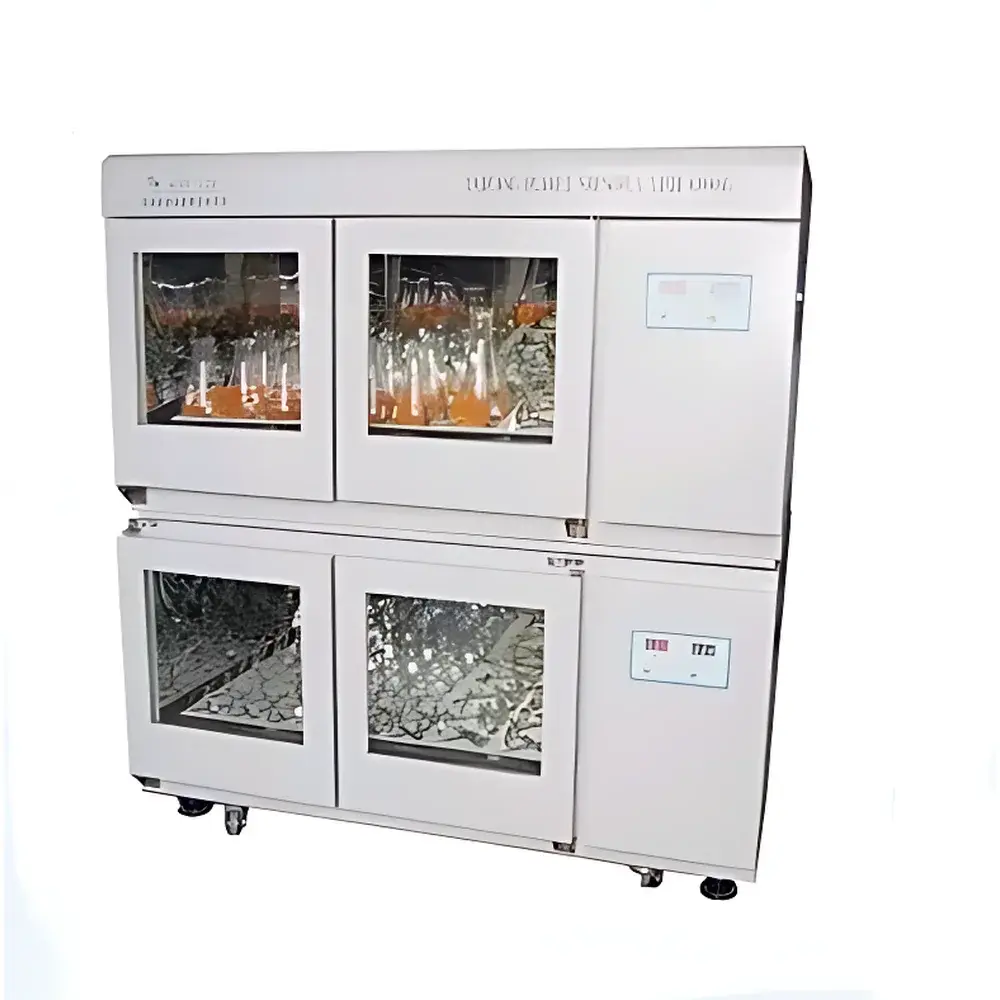
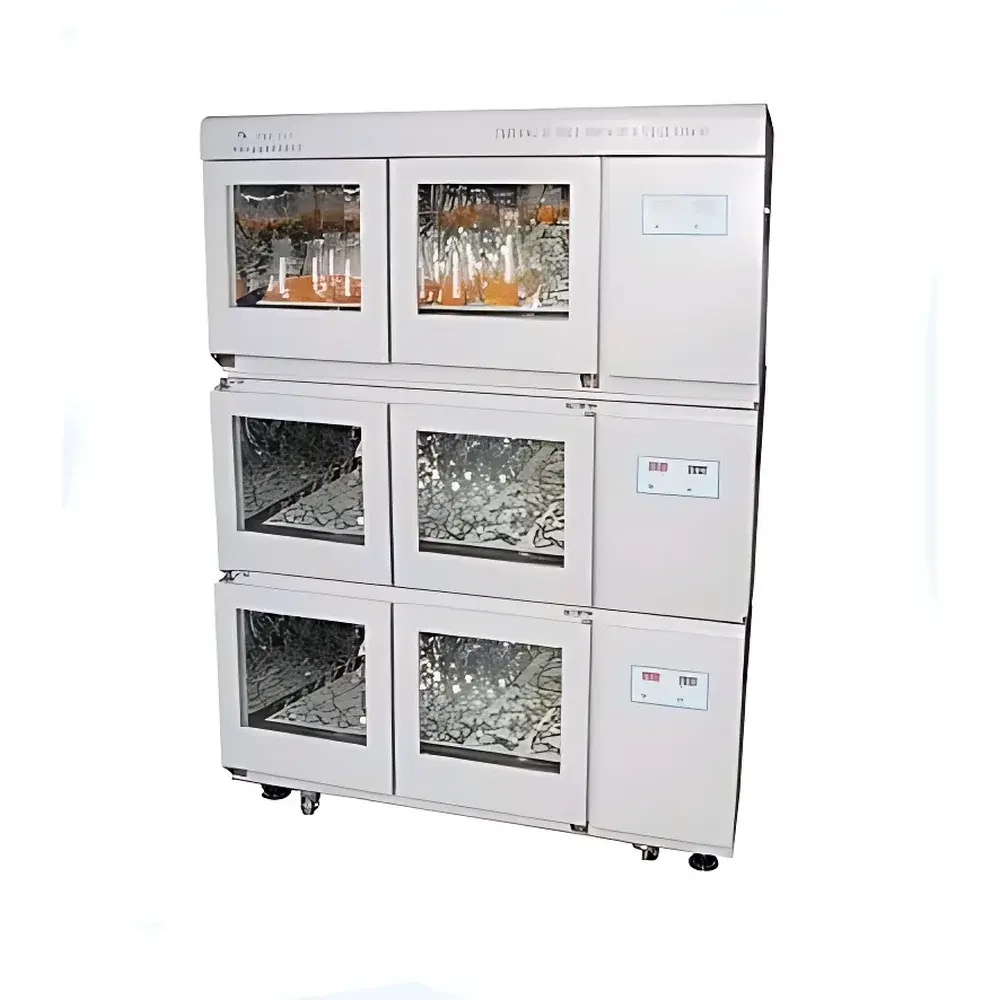
Taicang HYG-C Dual-Zone Dual-Speed Multifunctional Incubator Shaker
| Origin | Jiangsu, China |
|---|---|
| Manufacturer Type | Distributor |
| Origin Category | Domestic |
| Model | HYG-C |
| Instrument Type | Multi-layer Incubated Orbital Shaker |
| Timer Range | 0–999 min |
| Oscillation Frequency | 40–280 rpm |
| Orbit Diameter | 26 mm |
| Temperature Range | 5–60 °C (at 25 °C ambient) |
| Temperature Accuracy | ±0.1 °C |
| Temperature Uniformity | ±0.5 °C |
| Shelf Count | 2 independent temperature- and speed-controlled layers |
| Tray Dimensions | 800 × 500 mm |
| Capacity per Shelf | 15 × 1000 mL, 28 × 500 mL, or 45 × 250 mL Erlenmeyer flasks |
| Power Input | 1000 W |
| Voltage/Frequency | 220 V, 50 Hz |
| Illumination | 20 W LED |
| Overall Dimensions (W×D×H) | 1350 × 750 × 1840 mm |
| Net Weight | 500 kg |
| Display | LED digital interface |
Overview
The Taicang HYG-C Dual-Zone Dual-Speed Multifunctional Incubator Shaker is an engineered solution for laboratories requiring simultaneous, independent control of temperature and orbital agitation across two vertically stacked shelves. Designed for microbiological culture expansion, cell suspension maintenance, enzyme reaction kinetics, and aerobic fermentation studies, the system operates on the principle of precise orbital shaking—generating uniform, low-shear motion with a fixed 26 mm orbit diameter—to ensure consistent oxygen transfer and suspension homogeneity without compromising sensitive biological samples. Its dual-zone architecture enables parallel experiments under distinct thermal and mechanical conditions—for instance, maintaining one shelf at 30 °C for E. coli growth while running another at 37 °C for mammalian cell expansion—eliminating cross-contamination risks associated with shared chamber environments.
Key Features
- Dual independent control zones: Each of the two shelves features separate PID-regulated temperature control (5–60 °C) and adjustable oscillation frequency (40–280 rpm), enabling true multi-parameter experimental design.
- High-stability thermal performance: Achieves ±0.1 °C temperature accuracy and ±0.5 °C uniformity across each shelf, validated per ISO 17025-compliant calibration protocols for reproducible incubation outcomes.
- Robust mechanical architecture: Heavy-duty steel frame (500 kg net weight) supports high-capacity loading (up to 15 × 1000 mL flasks per shelf) while minimizing vibration transmission to adjacent instrumentation.
- LED digital interface with intuitive menu navigation: Provides real-time display of setpoints, actual values, elapsed time, and alarm status; supports timer operation from 0 to 999 minutes with auto-shutdown functionality.
- Integrated LED illumination (20 W): Facilitates visual monitoring of cultures without opening doors or disrupting thermal equilibrium.
- Energy-efficient 1000 W heating/cooling system: Optimized for continuous operation in ambient environments up to 25 °C, compliant with IEC 61000-3-2 harmonic emission standards.
Sample Compatibility & Compliance
The HYG-C accommodates standard laboratory vessels—including 250 mL, 500 mL, and 1000 mL Erlenmeyer flasks—on its 800 × 500 mm stainless-steel trays with optional spring-loaded clamping grids or universal mesh platforms. Its structural design meets CE marking requirements for electrical safety (EN 61010-1) and electromagnetic compatibility (EN 61326-1). While not certified for GMP manufacturing use, the unit supports GLP-aligned workflows through stable, documented thermal and mechanical performance, making it suitable for preclinical R&D, academic research, and QC testing in biopharma and food safety labs. It is compatible with common sterilization protocols including 70% ethanol wipe-downs and UV surface decontamination between runs.
Software & Data Management
The HYG-C operates as a standalone instrument with no proprietary software dependency. All operational parameters are configured locally via the front-panel LED interface. For laboratories requiring audit trails or electronic records, integration with external data loggers (e.g., Omega OM-DAQPRO or Testo Saveris 2) is supported via analog voltage outputs (0–5 V) for temperature and RPM signals. The system does not include FDA 21 CFR Part 11-compliant user authentication or electronic signature capabilities; however, its deterministic behavior and calibrated stability allow inclusion in validated processes when paired with appropriate procedural controls and periodic verification per ASTM E2500 or ISO/IEC 17025 guidelines.
Applications
- Microbial cultivation: Aerobic growth of bacteria, yeast, and fungi under controlled oxygen transfer rates and thermal profiles.
- Mammalian and insect cell suspension culture: Maintenance of CHO, HEK293, and Sf9 cells during transfection, expression, and harvest phases.
- Biochemical assay development: Optimization of enzymatic reactions requiring defined agitation and thermal incubation (e.g., lipase activity, protein refolding).
- Environmental microbiology: Soil slurry enrichment, biodegradation studies, and wastewater microbial community analysis.
- Pharmaceutical stability testing: Accelerated degradation studies under agitated, temperature-controlled conditions per ICH Q1A(R2).
- Bioprocess screening: Parallel evaluation of media formulations, inoculum densities, and feeding strategies in early-stage process development.
FAQ
Is the HYG-C suitable for sterile applications?
Yes—its sealed chamber design, smooth stainless-steel interior surfaces, and compatibility with alcohol-based disinfectants support aseptic technique. However, it is not classified as a Class II biosafety cabinet and must be used within a cleanroom or laminar flow hood for sterile manipulations.
Can I operate only one shelf while leaving the other idle?
Yes—the dual-zone control allows independent activation or deactivation of each shelf’s heating and shaking functions without affecting the other zone.
What is the maximum flask fill volume recommended per shelf?
For optimal mixing efficiency and thermal uniformity, total liquid volume per shelf should not exceed 70% of the aggregate flask capacity (e.g., ≤10.5 L for 15 × 1000 mL flasks).
Does the unit include a CO₂ control option?
No—CO₂ regulation is not integrated. For CO₂-dependent cultures, external gas blending systems with chamber inlet ports must be implemented separately.
Is remote monitoring possible?
Not natively—but analog output signals enable connection to third-party SCADA or LabVIEW-based monitoring systems for real-time parameter logging and alarm notification.
Related Products




