
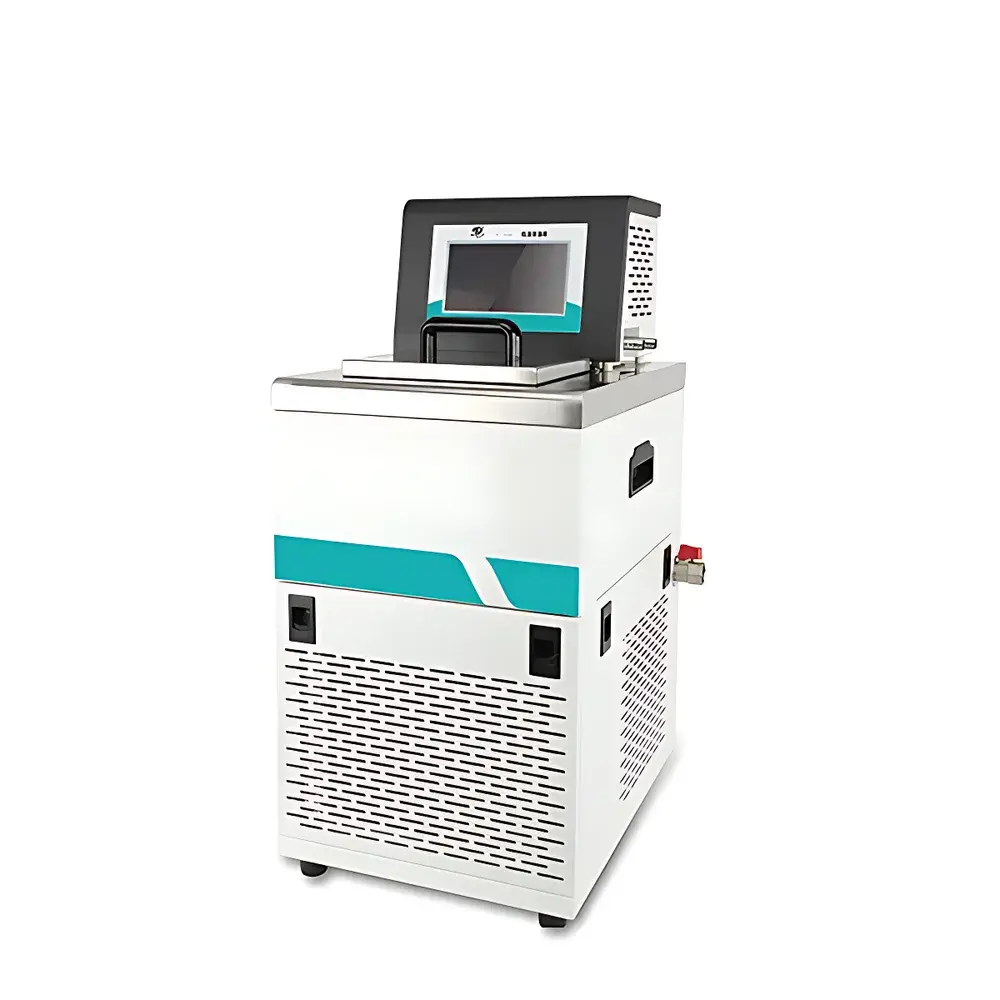
Ningbo Scientz DC-1006 Low-Temperature Constant-Temperature Bath
| Brand | Ningbo Scientz |
|---|---|
| Origin | Zhejiang, China |
| Manufacturer Type | Direct Manufacturer |
| Product Category | Domestic |
| Model | DC-1006 |
| Instrument Type | Circulating Constant-Temperature Bath |
| Circulation Mode | Internal & External |
| Temperature Control | Refrigeration & Heating Combined |
| Bath Dimensions (L×W×H) | 260 × 200 × 140 mm |
| Temperature Range | −10 °C to +100 °C |
| Temperature Stability | ±0.05 °C |
| Display | 7-inch TFT Touchscreen |
| Pump Flow Rate | 0–20 L/min (DC Speed-Controlled), Max Head: 5 m |
| Refrigeration System | Eco-friendly Non-CFC Compressor-Based |
| Safety Features | Overtemperature Alarm (adjustable upper/lower limits), Auto-Delay Restart (3 min after power interruption), Overheat & Overload Protection, Self-Tuning PID Control, Fuzzy Logic Ambient Compensation |
Overview
The Ningbo Scientz DC-1006 Low-Temperature Constant-Temperature Bath is an engineered thermal management system designed for precision temperature control in laboratory and industrial R&D environments. It operates on a closed-loop refrigeration-heating principle, integrating a non-chlorofluorocarbon (non-CFC) compressor-based cooling circuit with a high-efficiency resistive heating element. This dual-mode architecture enables seamless transition between sub-zero and elevated temperature setpoints — from −10 °C to +100 °C — with exceptional thermal homogeneity and long-term stability of ±0.05 °C under steady-state conditions. The bath’s stainless-steel tank (260 × 200 × 140 mm internal volume) supports both internal immersion applications and external circulation via a brushless DC-driven pump, making it suitable as either a primary thermal conditioning platform or a secondary heat/cold source for auxiliary equipment such as spectrophotometer jackets, viscometer baths, or reaction calorimeters.
Key Features
- Eco-compliant refrigeration: Uses environmentally sustainable refrigerants and sealed rotary compressors compliant with international ozone-layer protection standards (Montreal Protocol Annexes).
- Intelligent thermal regulation: Combines fuzzy logic ambient compensation with self-tuning PID algorithms to dynamically optimize power delivery based on real-time load, ambient drift, and setpoint deviation.
- 7-inch capacitive TFT touchscreen interface: Provides intuitive parameter entry, graphical trend display, and multi-level user access control (operator / engineer / administrator).
- Dual-circulation capability: Supports internal temperature uniformity (via built-in stirrer) and external fluid transfer (0–20 L/min, max head 5 m) for remote thermal coupling — ideal for jacketed reactors or flow-cell systems.
- Comprehensive safety architecture: Includes adjustable high/low temperature alarms, automatic thermal cutoff, compressor overheat protection, electrical overload sensing, and 3-minute auto-delay restart following mains interruption to prevent compressor stress.
Sample Compatibility & Compliance
The DC-1006 accommodates aqueous solutions, silicone oils, ethylene glycol/water mixtures, and other low-volatility, non-corrosive heat-transfer fluids compatible with 304 stainless steel and EPDM seals. Its design adheres to general-purpose laboratory equipment safety norms per IEC 61010-1:2010 (Ed. 3.0) and electromagnetic compatibility requirements per EN 61326-1:2013. While not certified for Class I Div 1 hazardous locations, it meets CE marking criteria for use in non-explosive environments. For GLP/GMP-regulated workflows, the unit supports audit-ready operation through timestamped alarm logs and user-accessible configuration history — though full 21 CFR Part 11 compliance requires integration with validated third-party data acquisition software.
Software & Data Management
The onboard firmware stores up to 10,000 timestamped temperature readings (sampled at 1-second intervals) with configurable export via USB flash drive in CSV format. Real-time monitoring and remote parameter adjustment are achievable via optional RS485 Modbus RTU communication (addressable as slave device). No proprietary cloud platform is embedded; all data remains locally resident unless interfaced with external SCADA or LIMS systems. Firmware updates are performed manually using signed binary files distributed through Scientz’s official technical support portal — ensuring traceability and version control for regulated users.
Applications
This bath serves critical roles across analytical, materials, and life science laboratories: maintaining thermal equilibrium during UV-Vis absorbance measurements; stabilizing detector temperatures in HPLC autosamplers; calibrating thermistors and RTDs per ASTM E1137/E230; supporting controlled-rate crystallization studies; enabling viscosity profiling across temperature gradients (e.g., ISO 2555, ASTM D1084); and providing stable thermal sinks/sources for semiconductor characterization fixtures. Its −10 °C capability makes it suitable for cold-stage simulation in polymer rheology (ASTM D3835), while its +100 °C upper limit supports accelerated aging tests per IEC 60068-2-2.
FAQ
What types of heat-transfer fluids are compatible with the DC-1006?
Deionized water, 30%–50% ethylene glycol/water blends, and silicone oils with flash points above 150 °C are recommended. Avoid halogenated solvents, strong acids/bases, or fluids with vapor pressure >10 kPa at 25 °C.
Can the DC-1006 be integrated into automated test sequences?
Yes — via Modbus RTU over RS485, enabling bidirectional communication with PLCs or LabVIEW-based controllers for synchronized thermal ramping and event-triggered actions.
Is external calibration verification supported?
The unit accepts external Pt100 probe input for reference comparison; however, factory calibration certificates (traceable to NIM, China) are provided only upon request and require separate documentation protocol.
Does the pump support continuous operation at maximum flow rate?
Yes — the brushless DC motor is rated for indefinite duty cycle at 20 L/min, provided fluid viscosity remains below 50 cP and inlet temperature stays within −5 °C to +85 °C.
How is temperature uniformity validated inside the bath chamber?
Scientz specifies axial/radial uniformity of ≤±0.1 °C at 25 °C (measured per ISO 17025-accredited internal procedure using nine-point platinum resistance thermometer array).



