
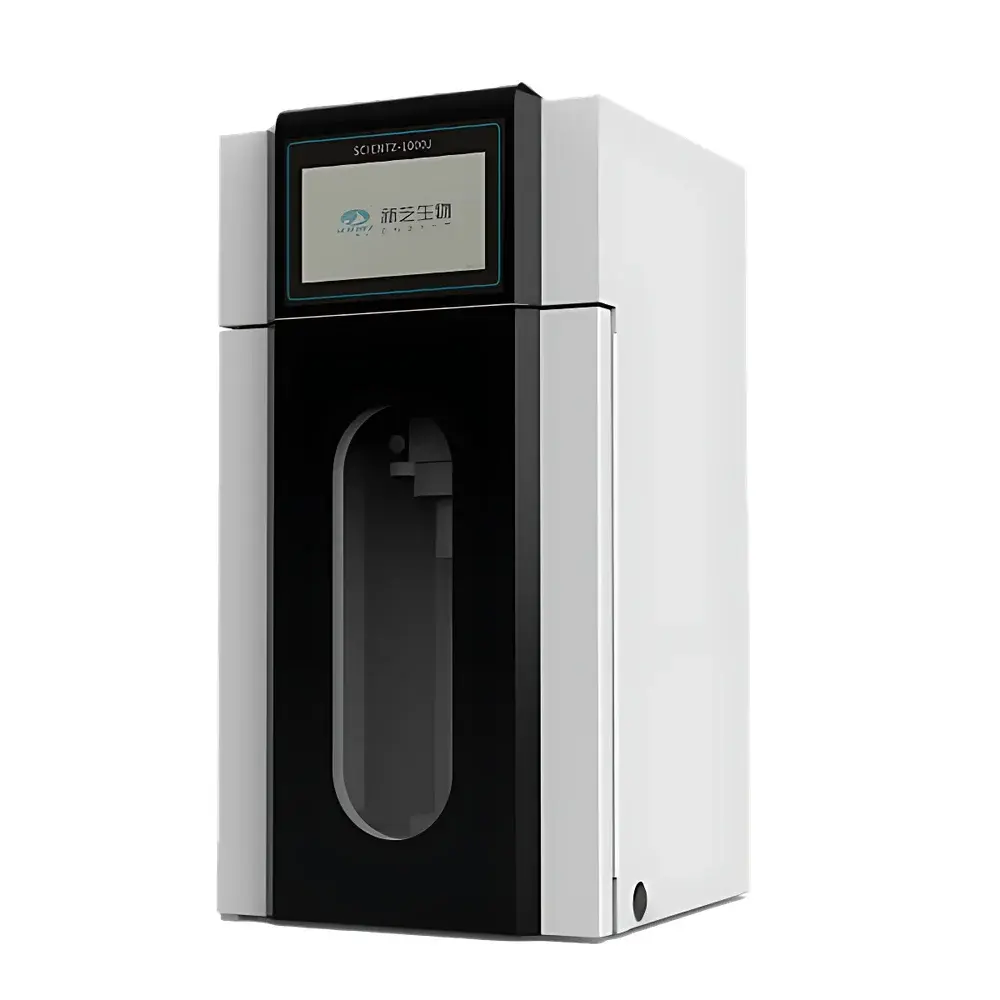
Ningbo Scientz SCIENTZ-1000J Integrated Ultrasonic Cell Disruptor
| Brand | Ningbo Scientz |
|---|---|
| Origin | Zhejiang, China |
| Manufacturer Type | Direct Manufacturer |
| Instrument Type | Ultrasonic Cell Disruptor |
| Model | SCIENTZ-1000J |
| Temperature Range | 0–99.9 °C |
| Operating Frequency | 20–25 kHz |
| Ultrasonic Power Output | 1000 W (adjustable in 1% increments) |
| Duty Cycle | 0.1–99.9% |
| Sample Volume Capacity | 10–200 mL |
| Alarm Functions | Overtemperature, Overload, and Timer Alert |
| Transducer Material | TC4 Titanium Alloy (Grade 5 Ti-6Al-4V) |
Overview
The Ningbo Scientz SCIENTZ-1000J Integrated Ultrasonic Cell Disruptor is an engineered platform for controlled mechanical lysis of biological samples via high-intensity ultrasonic cavitation. Operating within the 20–25 kHz frequency band, the system generates transient microcavities in liquid media that collapse violently—producing localized shockwaves, microstreaming, and shear forces sufficient to disrupt cell membranes, bacterial walls, viral envelopes, and soft plant or animal tissues. This physical lysis mechanism avoids chemical or enzymatic contamination, preserving native protein conformation, nucleic acid integrity, and post-translational modifications critical for downstream applications such as western blotting, mass spectrometry, RNA-seq library preparation, and recombinant protein purification. The instrument is designed for reproducible, scalable, and operator-safe operation in academic research labs, biopharmaceutical QC environments, and contract development and manufacturing organizations (CDMOs).
Key Features
- Integrated electromechanical architecture with built-in transducer and motorized vertical lift mechanism—eliminates external probe alignment and reduces benchtop footprint by >40% versus modular systems.
- TC4 titanium alloy (Ti-6Al-4V) probe assembly: Offers superior acoustic impedance matching, thermal conductivity, and fatigue resistance compared to standard stainless-steel or aluminum transducers; enables stable power delivery over extended duty cycles without resonance drift.
- Precision digital control: Ultrasonic output power adjustable in 1% increments (10–1000 W); time parameters (ultrasonication duration, interval pause, total run time) resolved to ±0.1 s; duty cycle programmable from 0.1% to 99.9% for fine-tuned energy dosing.
- Active temperature management: Peltier-assisted cooling jacket compatible with external recirculating chillers; real-time temperature monitoring via immersed Pt100 sensor with user-set upper limit (0–99.9 °C) and automatic shutdown on thermal excursion.
- Acoustic containment: Dual-layer sound-dampening enclosure featuring 30 mm composite acoustic foam and vibration-isolated mounting—meets ISO 7779:2010 noise emission standards (<65 dB(A) at 1 m).
- Comprehensive safety logic: Hardware-enforced interlocks prevent operation when lid is open; software-monitored overload detection triggers immediate amplitude reduction and audible/visual alert on exceeding current or impedance thresholds.
Sample Compatibility & Compliance
The SCIENTZ-1000J supports a broad range of sample matrices—including microbial cultures (E. coli, yeast, Bacillus), mammalian suspension and adherent cells (HEK293, CHO, Jurkat), plant leaf homogenates, tissue lysates (liver, spleen), and subcellular fractions (mitochondria, nuclei). Its 10–200 mL working volume accommodates both small-scale optimization runs and mid-throughput batch processing. All wetted components comply with USP Class VI biocompatibility requirements. The system’s parameter logging and audit trail functionality align with GLP documentation practices. While not pre-certified for GMP environments, its deterministic timing control, transducer calibration traceability (via factory-provided performance verification report), and alarm event timestamping support validation under FDA 21 CFR Part 11 when integrated into a documented quality management system.
Software & Data Management
The instrument operates via embedded firmware with a 5.7″ resistive touchscreen interface supporting multi-language localization (English, Chinese, Spanish). All operational parameters—including power profile, temperature setpoint, cycle count, and alarm history—are stored internally with timestamped records retained for ≥10,000 cycles. USB export enables CSV-formatted data transfer for integration with LIMS or ELN platforms. Optional RS-485/Modbus RTU interface allows remote command execution and real-time status polling in automated lab workflows. No proprietary cloud service or vendor-dependent software license is required for basic operation or data retrieval.
Applications
- High-yield extraction of intracellular proteins and organelles while minimizing proteolytic degradation.
- Preparation of antigenic lysates for monoclonal antibody development and epitope mapping studies.
- Rapid disruption of Gram-negative bacteria for plasmid DNA isolation without lysozyme pretreatment.
- Homogenization of fibrous plant tissues (e.g., Arabidopsis leaves, rice roots) prior to metabolite profiling.
- Nanoparticle dispersion stabilization in aqueous colloids for drug delivery formulation screening.
- Accelerated solvent-free synthesis of metal–organic frameworks (MOFs) and covalent organic frameworks (COFs).
FAQ
What is the recommended maintenance interval for the TC4 titanium probe?
Probe inspection (visual crack assessment, tip erosion measurement) is advised every 200 operating hours; full recalibration recommended annually or after any mechanical impact.
Can the SCIENTZ-1000J be used with corrosive solvents such as chloroform or DMSO?
Yes—provided the probe is rinsed immediately post-use with ethanol and deionized water; prolonged exposure to halogenated solvents may accelerate surface oxidation and requires enhanced visual inspection frequency.
Is third-party calibration certification available?
Ningbo Scientz provides NIST-traceable acoustic power calibration reports upon request (additional fee applies); field verification kits for amplitude and temperature accuracy are also available.
Does the system support external temperature feedback control loops?
Yes—the analog 0–10 V output port accepts input from external Pt100 or thermistor probes, enabling closed-loop chiller modulation synchronized with ultrasonic duty cycling.




