
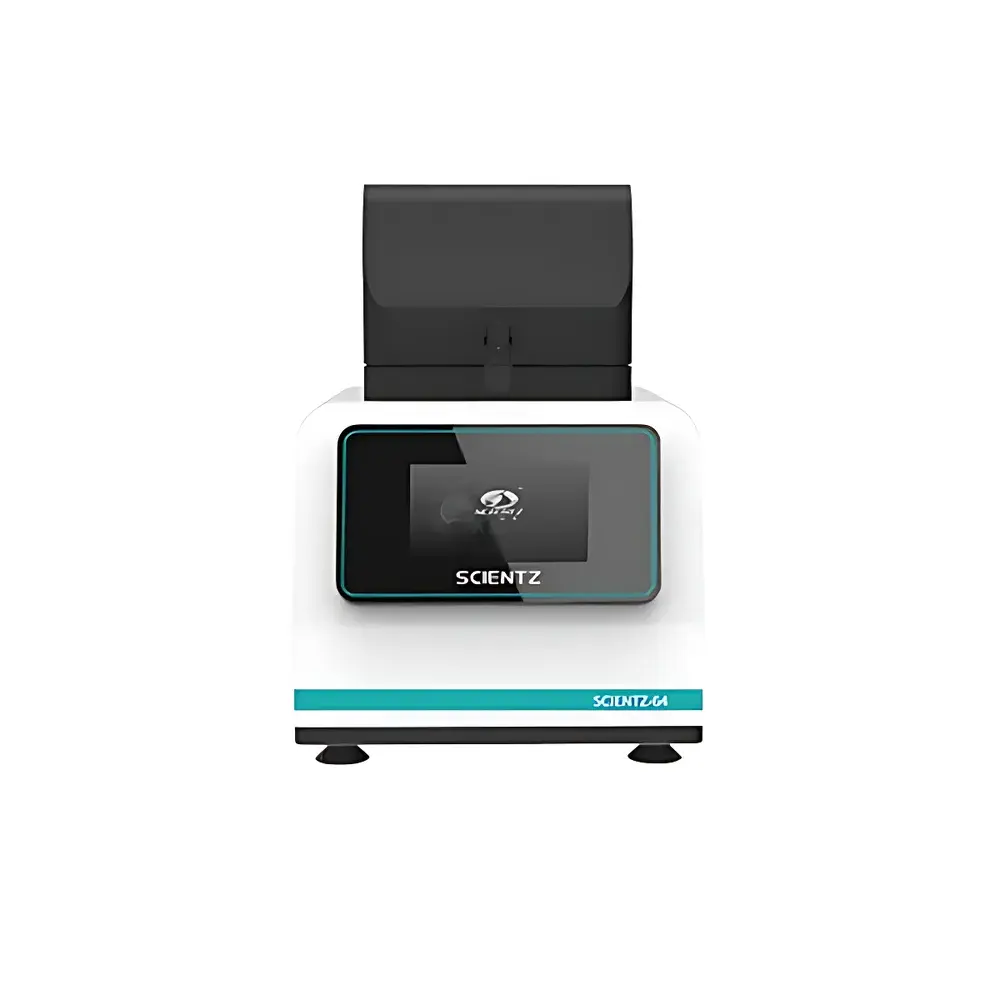
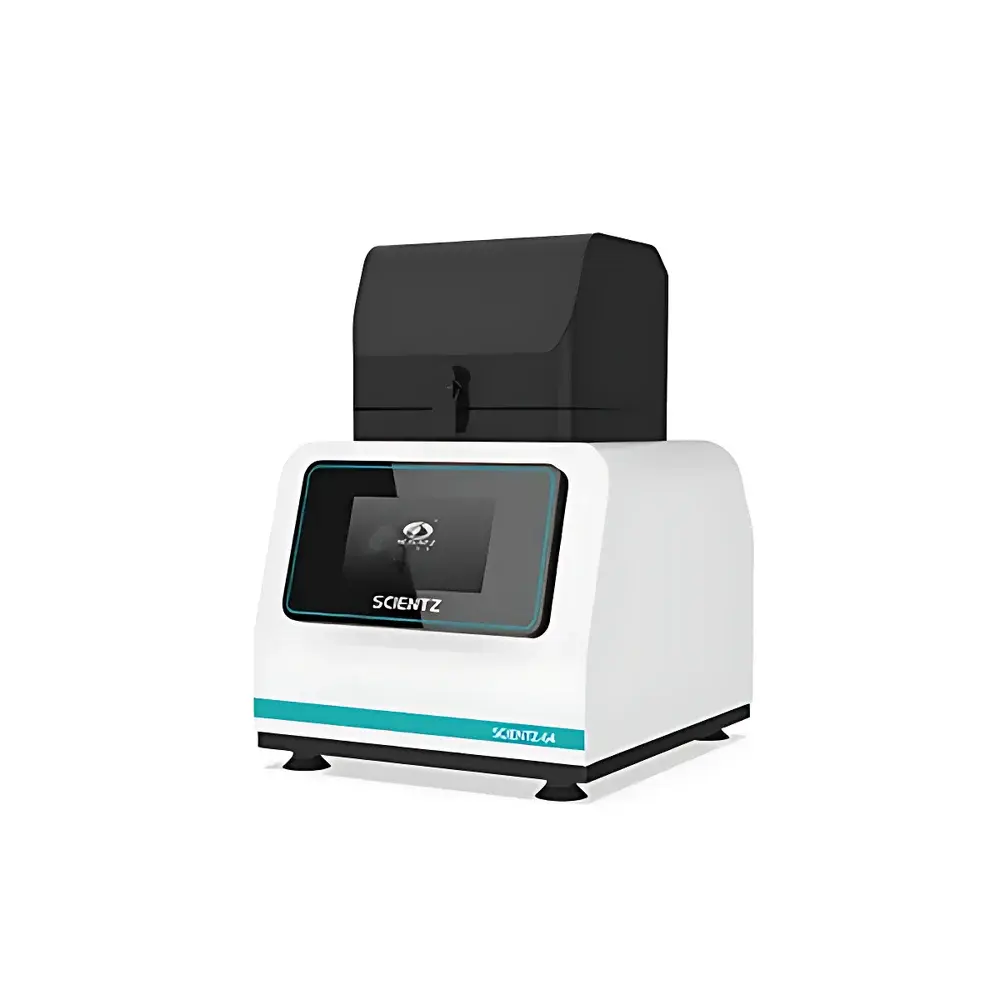
Scientz SCIENTZ-64 High-Throughput Tissue Grinder
| Brand | Scientz |
|---|---|
| Origin | Zhejiang, China |
| Manufacturer Type | Direct Manufacturer |
| Country of Origin | China |
| Model | SCIENTZ-64 |
| Pricing | Upon Request |
Overview
The Scientz SCIENTZ-64 High-Throughput Tissue Grinder is an engineered vertical-axis oscillation-based homogenization system designed for rapid, reproducible mechanical lysis of biological and non-biological samples. It operates on the principle of high-frequency reciprocating impact and shear forces generated by the collision between grinding beads and sample material inside sealed centrifuge tubes. This mechanism enables efficient disruption of cellular membranes, extracellular matrices, and rigid structural components—facilitating downstream extraction of intact nucleic acids (DNA/RNA), proteins, metabolites, and other intracellular biomolecules. Unlike rotor-stator or probe-based homogenizers, the SCIENTZ-64 eliminates heat accumulation and cross-contamination risks through its tube-contained, parallel-processing architecture. Its design conforms to core laboratory requirements for GLP-compliant sample preparation workflows in genomics, proteomics, environmental analysis, and pharmaceutical R&D.
Key Features
- 64-sample parallel processing capacity per run, supporting standard 1.5–2.0 mL microcentrifuge tubes or deep-well plates with compatible adapters
- Programmable digital controller with adjustable amplitude (0–3 mm), frequency (100–1800 rpm), and time (1 s–99 min 59 s) for method optimization
- Hermetically sealed grinding chamber with interlocked safety door; automatic motor shutdown upon lid opening (IEC 61000-4-2 compliant)
- Low-noise operation (<55 dB(A) at 1 m distance) achieved via balanced counterweight system and vibration-damping elastomeric mounts
- Cryogenic compatibility: direct insertion of pre-chilled tubes (−80 °C) without condensation interference or thermal shock to internal mechanisms
- Vertical oscillation kinematics ensure uniform energy distribution across all positions—validated by coefficient of variation (CV) <5% for replicate RNA yield assays
Sample Compatibility & Compliance
The SCIENTZ-64 accommodates diverse sample classes under standardized protocols aligned with ISO 17025 and ASTM D5231 (for environmental solid matrices). Verified applications include: mammalian tissues (liver, brain, kidney), fibrous plant materials (roots, seeds, lignified stems), microbial pellets (E. coli, yeast, spores), forensic specimens (hair, bone fragments), environmental solids (soil, sludge, sediment), polymers (PE, PS, PET), and pharmaceutical tablets. Grinding bead selection follows material compatibility guidelines: stainless steel (Fe/Cr trace risk), tungsten carbide (WC, minimal leaching), zirconia (ZrO₂/Y₂O₃, low elemental interference), and PTFE (F/C background control for halogen-sensitive analyses). All consumables meet USP Class VI biocompatibility standards.
Software & Data Management
The integrated controller stores up to 100 user-defined methods with timestamped execution logs. While the base unit does not include PC connectivity, optional RS-232/USB interfaces enable integration with LIMS environments supporting ASTM E1578 and FDA 21 CFR Part 11 audit trail requirements. Method parameters—including speed, duration, and cycle count—are exportable as CSV files for QA documentation. Firmware supports firmware version tracking and calibration certificate logging, facilitating GMP-aligned equipment qualification (IQ/OQ/PQ).
Applications
This instrument serves critical roles in: (1) high-throughput nucleic acid library prep for NGS; (2) quantitative proteomic workflows requiring unbiased protein solubilization; (3) metagenomic soil DNA extraction per ISO 11063; (4) pharmaceutical excipient homogeneity testing (USP ); (5) food allergen detection matrix preparation (AOAC 2012.01); and (6) forensic STR profiling from degraded tissue samples. Published studies demonstrate ≥92% recovery of full-length 18S rRNA from frozen liver tissue and ≤3% inter-run CV in qPCR Cq values for housekeeping genes.
FAQ
What types of grinding beads are recommended for RNA isolation?
Zirconia or PTFE beads are preferred due to low RNase adsorption and minimal metal ion leaching that could inhibit downstream enzymatic reactions.
Can the SCIENTZ-64 process samples below −20 °C?
Yes—pre-cooled tubes may be loaded directly; the chamber maintains thermal stability during operation, preventing frost formation on drive components.
Is validation documentation available for regulatory submissions?
Scientz provides IQ/OQ templates, bead compatibility matrices, and performance verification reports aligned with ISO/IEC 17025 Annex A.2 requirements.
How is cross-contamination prevented between samples?
Each tube operates independently within its adapter slot; no shared fluid paths or rotating shafts contact multiple samples simultaneously.
What maintenance intervals are recommended for long-term reliability?
Biannual inspection of drive belt tension, bearing lubrication, and door interlock functionality is advised per the manufacturer’s maintenance schedule (Rev. 3.1).



