
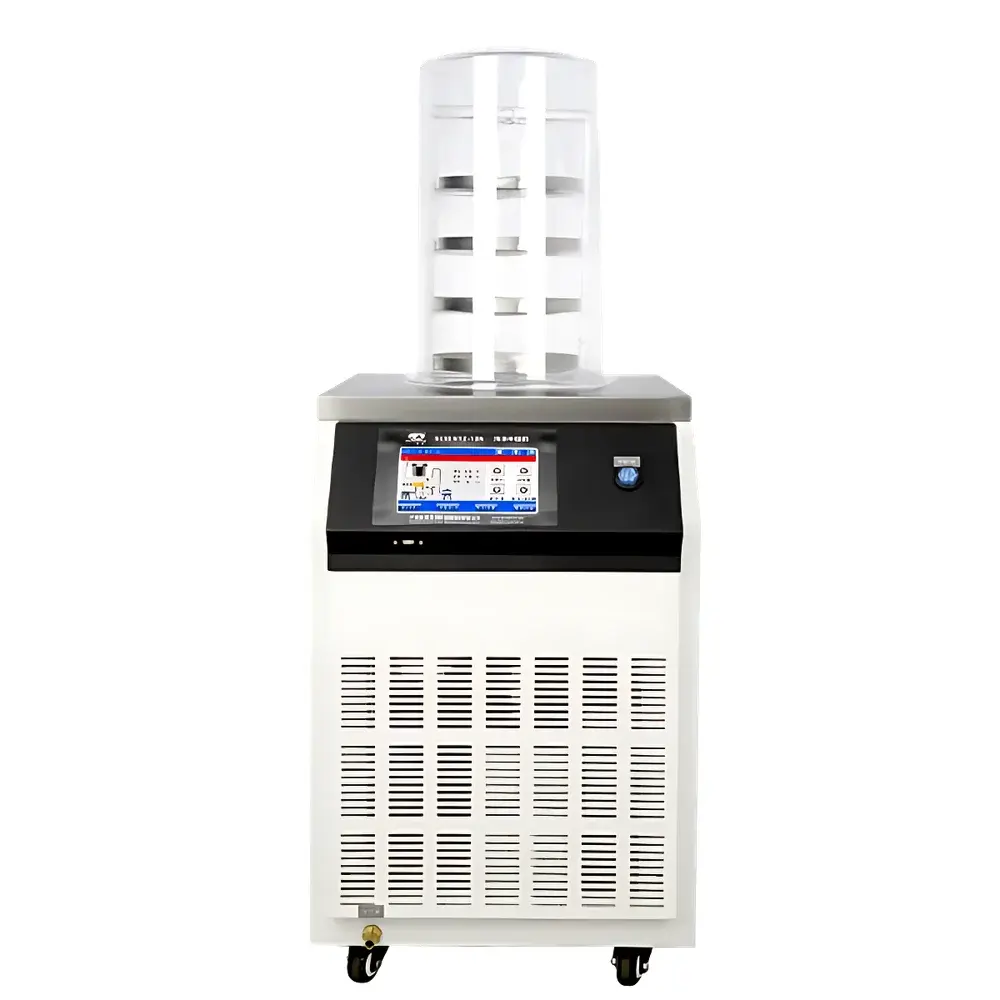
Ningbo Scientz SCIENTZ-12N/A Benchtop Bell-Jar Freeze Dryer
| Brand | Ningbo Scientz |
|---|---|
| Origin | Zhejiang, China |
| Manufacturer Type | Direct Manufacturer |
| Region | Domestic (China) |
| Model | SCIENTZ-12N/A |
| Instrument Type | Standard Shelf-Type (Bell-Jar Configuration) |
| Scale | Pilot-Scale |
| Lyophilization Area | 0.12 m² |
| Ultimate Vacuum | ≤5 Pa |
| Condensate Capacity (24 h) | 4 kg/batch |
| Cold Trap Temperature | ≤−56 °C |
| Dimensions (W×D×H) | 600 mm × 450 mm × 720 mm + 440 mm (cold trap height) |
Overview
The Ningbo Scientz SCIENTZ-12N/A is a benchtop bell-jar freeze dryer engineered for pilot-scale lyophilization in academic laboratories, R&D centers, and quality control environments. It operates on the fundamental principle of sublimation-based drying under high vacuum: frozen samples are subjected to controlled low pressure while maintaining sub-zero temperatures, enabling ice to transition directly from solid to vapor without passing through the liquid phase. This preserves thermolabile structures—including proteins, nucleic acids, enzymes, live cells, and nanomaterials—by minimizing denaturation, oxidation, and aggregation. Unlike shelf-based systems with heated shelves, the SCIENTZ-12N/A employs a static, non-contact drying configuration using a transparent polycarbonate bell jar mounted over a deep-cold condenser. Its design prioritizes spatial efficiency without compromising condensation capacity or thermal stability—making it especially suitable for multi-sample, low-to-medium throughput workflows where sample integrity and process visibility are critical.
Key Features
- Compact footprint (600 × 450 × 720 mm main unit + 440 mm cold trap height) optimized for limited lab space
- High-efficiency imported compressor delivering stable cold trap temperature ≤−56 °C (optionally upgradable to −80 °C with dual-stage cascade refrigeration)
- 7-inch true-color capacitive touchscreen interface with industrial-grade embedded OS; supports real-time monitoring of cold trap temperature, chamber vacuum level, and optional sample temperature via PT100 probe
- Automated data logging: all process parameters saved internally with timestamping; exportable via USB drive for offline analysis or integration into LIMS
- Optically clear, one-piece injection-molded polycarbonate drying chamber—chemically resistant, shatter-resistant, and fully sealable with O-ring gasket and manual vacuum valve
- Intelligent vacuum sequencing logic: vacuum pump activation is inhibited until cold trap reaches preset temperature, extending pump service life and reducing oil backstreaming risk
- Standard configuration includes eight universal Ø29 mm side-arm lyophilization flasks with stopcock valves; compatible with ISO-standard glassware and manifold accessories
Sample Compatibility & Compliance
The SCIENTZ-12N/A accommodates diverse sample formats—including vials, Petri dishes, centrifuge tubes, and irregular biological specimens—within its 0.12 m² effective drying area. Its open-chamber architecture allows direct visual observation throughout the entire lyophilization cycle, supporting method development and troubleshooting. The system meets baseline requirements for GLP-compliant documentation when paired with external audit-trail software; raw data files retain full metadata (start/stop timestamps, setpoints, deviations). While not certified for GMP manufacturing, it aligns with common preclinical and analytical workflow standards referenced in USP , ISO 22000, and ASTM F2375–04 (Standard Guide for Lyophilization Process Development). Optional features—including vacuum pressure control, eutectic point detection module, and inert gas backfill valve—enhance reproducibility for sensitive formulations such as monoclonal antibodies, mRNA-LNPs, and probiotic cultures.
Software & Data Management
The built-in operating system supports up to 100 user-defined lyophilization protocols, each configurable with ramp rates, hold durations, vacuum thresholds, and endpoint criteria. All sessions generate .CSV-formatted log files containing second-by-second records of vacuum pressure (mBar), cold trap temperature (°C), and elapsed time. These files are readable in Excel, MATLAB, or third-party chromatography/data analysis platforms. USB export enables secure transfer to networked workstations for trend analysis, batch comparison, or regulatory submission preparation. Optional PC-based upper-level software provides remote monitoring, alarm escalation (email/SMS via Ethernet), and 21 CFR Part 11-compliant electronic signatures when deployed with validated authentication modules.
Applications
This system is routinely deployed across life science and materials research domains: microbial culture preservation (bacteria, yeast, phage); stabilization of diagnostic reagents (ELISA kits, lateral flow conjugates); preparation of reference standards for food safety testing (pesticide residue, mycotoxin, heavy metal analysis); lyophilization of plant extracts and herbal formulations; dehydration of soil/sediment samples prior to elemental analysis (ICP-MS, XRF); nanostructured catalyst support drying; and formulation screening for oral disintegrating tablets (ODTs) and ocular therapeutics. Its adaptability to variable sample volumes and compositions makes it particularly valuable in teaching labs, contract research organizations (CROs), and early-phase bioprocess development.
FAQ
What is the maximum batch size supported by the SCIENTZ-12N/A?
With a condensate capacity of 4 kg per 24-hour cycle and 0.12 m² drying area, typical loading ranges from 1–3 L of aqueous solution (assuming 5–15% solids content), depending on vial geometry and freezing protocol.
Can this unit be integrated into a regulated QA/QC environment?
Yes—when used with validated procedures and supplemental documentation tools, it satisfies technical prerequisites for ISO/IEC 17025-accredited testing labs and supports traceability required under FDA guidance for analytical method development.
Is the cold trap temperature actively monitored and logged?
Yes—the PT100 sensor embedded in the cold trap surface delivers continuous temperature readings at 1-second intervals, recorded alongside vacuum data in every session log file.
Does the system support automated pressure rise testing (PRT) for endpoint determination?
Not natively; however, vacuum hold tests can be manually initiated via the touchscreen interface, and pressure decay trends may be inferred from logged vacuum curves.
Are replacement parts and service support available outside China?
Ningbo Scientz maintains authorized distributors in North America, Europe, and Southeast Asia offering spare compressors, vacuum gauges, O-rings, and firmware updates—with lead times typically under 4 weeks for stocked components.



