
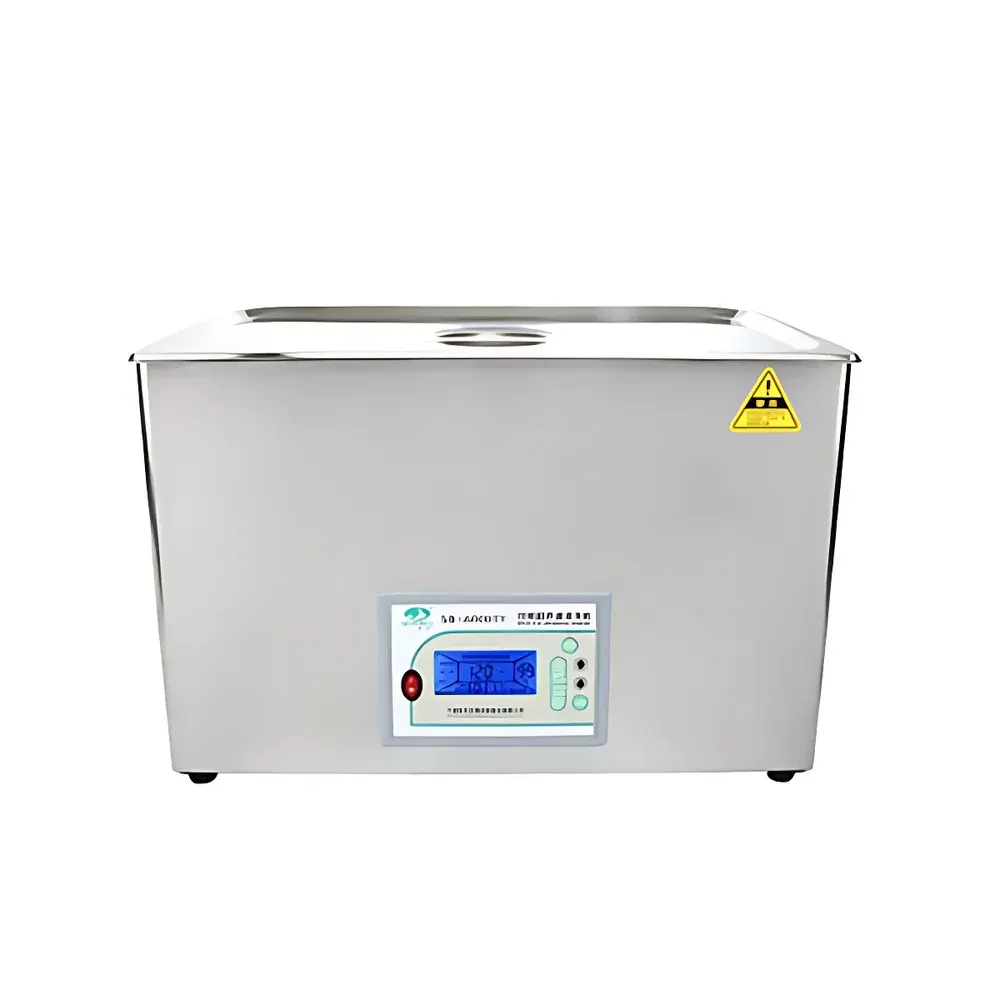
Ningbo Scientz SB-600DTY Sweep-Frequency Ultrasonic Cleaner
| Brand | Scientz |
|---|---|
| Origin | Zhejiang, China |
| Manufacturer Type | Direct Manufacturer |
| Instrument Type | General-Purpose Ultrasonic Cleaner |
| Tank Capacity | 30 L |
| Ultrasonic Frequency | 40 kHz (Sweep Mode) |
| Ultrasonic Power Output | 840 W |
| Power Adjustment | Yes (40–99% in 1% increments) |
| Heating Range | Ambient to 80 °C |
| Timer Range | 1–999 min |
| Sound-Dampening Lid | Included |
| Auto Fill/Drain Port | Equipped |
| Frequency Options | Four selectable frequencies with independent time settings per frequency |
| Display | Digital LED showing real-time temperature and remaining time |
| Safety | Power interruption memory function |
Overview
The Ningbo Scientz SB-600DTY Sweep-Frequency Ultrasonic Cleaner is an engineered solution for high-reliability laboratory and industrial cleaning tasks requiring consistent cavitation intensity across complex geometries. It operates on the principle of acoustic cavitation—where high-frequency mechanical vibrations (40 kHz, sweep-modulated) are transmitted through a liquid medium via piezoelectric transducers bonded to the stainless-steel tank base. The sweep-frequency mode dynamically varies the driving frequency within a narrow band around the nominal resonance, preventing standing wave formation and ensuring uniform energy distribution throughout the tank volume. This mitigates “dead zones” commonly observed in fixed-frequency units and enhances cleaning reproducibility for blind holes, microchannels, and porous substrates. Designed for continuous operation in QC labs, medical device reprocessing centers, and precision manufacturing environments, the SB-600DTY integrates thermal control, programmable power modulation, and multi-frequency flexibility without compromising structural integrity or long-term calibration stability.
Key Features
- Sweep-frequency operation: Dynamically modulates ultrasonic output near 40 kHz to suppress node/antinode patterns, improving cleaning uniformity across heterogeneous loads.
- Four-frequency selection: User-selectable discrete frequencies (e.g., 28, 40, 60, 80 kHz) with independent timer allocation per frequency—enabling staged cleaning protocols for multi-contaminant samples.
- Precision power regulation: Continuous adjustment from 40% to 99% of full 840 W output in 1% increments, allowing optimization for delicate optics or robust metal parts.
- Temperature-controlled cleaning: Integrated heating system maintains bath temperature from ambient to 80 °C with ±1 °C accuracy; PID-controlled feedback ensures minimal thermal drift during extended cycles.
- Digital operational interface: High-contrast LED display shows real-time bath temperature, countdown timer, active frequency, and power level—no ambiguous analog dials or hidden menus.
- Engineered safety architecture: Automatic shutdown on lid opening, overtemperature cutoff, and non-volatile memory that retains all user settings—including time, temperature, power, and frequency—after power interruption.
Sample Compatibility & Compliance
The SB-600DTY accommodates standard laboratory glassware (e.g., volumetric flasks, centrifuge tubes, NMR tubes), surgical instruments (stainless steel, titanium), optical components (lens assemblies, fiber optic connectors), and microelectromechanical systems (MEMS) wafers. Its 30 L capacity supports batch processing of up to 12 × 50 mL conical tubes or four 100 mm Petri dishes simultaneously. All wetted surfaces are electropolished 316L stainless steel, compliant with ISO 15223-1 labeling requirements and compatible with common aqueous cleaning agents meeting ASTM D4169 and USP <797> compatibility guidelines. While not certified as a medical device under FDA 21 CFR Part 820, its design aligns with AAMI ST79:2017 recommendations for ultrasonic cleaner validation in healthcare settings, including documentation-ready operational parameters and traceable temperature/power logging capability.
Software & Data Management
The SB-600DTY operates autonomously via front-panel controls; no external software or driver installation is required. However, its digital architecture supports optional RS-232 or USB-to-serial interface (accessory cable sold separately) for integration into lab information management systems (LIMS). When connected, it outputs timestamped logs of cycle start/end times, final temperature, cumulative ultrasonic exposure duration, and fault codes (e.g., “THERM_LIM”, “NO_LOAD”). These logs meet basic GLP audit requirements for cleaning validation records, including operator ID input via external keyboard (not included). Firmware updates are delivered via FAT32-formatted USB flash drive—no cloud dependency or proprietary software suite.
Applications
- Cleaning of chromatography vials, HPLC autosampler trays, and GC inlet liners where residual organics compromise analytical reproducibility.
- Pre-sterilization decontamination of orthopedic implants and dental handpieces prior to autoclaving—validated per ANSI/AAMI ST58.
- Removal of photoresist residues and etch byproducts from semiconductor wafers during R&D prototyping.
- Deagglomeration of nanoparticle suspensions (e.g., TiO₂, SiO₂) prior to DLS or zeta potential measurement.
- Ultrasonic-assisted solvent extraction of plant metabolites, where sweep-mode improves mass transfer kinetics versus fixed-frequency alternatives.
FAQ
Is the SB-600DTY suitable for cleaning delicate optical lenses without surface damage?
Yes—when operated at reduced power (40–60%), low temperature (25–35 °C), and using low-surface-tension, non-ionic detergent solutions, the unit achieves effective particulate removal while minimizing micro-scratching risk.
Can the sweep-frequency mode be disabled to run at fixed 40 kHz?
No—the sweep function is intrinsic to the transducer driver design and cannot be bypassed; however, the frequency deviation bandwidth is narrow (<±0.5 kHz), preserving resonant efficiency.
Does the unit support external temperature probe input for calibration verification?
No—it relies on factory-calibrated internal PT100 sensor; users requiring third-party traceability must validate bath temperature independently using NIST-traceable immersion thermometers.
What maintenance is required for long-term reliability?
Quarterly inspection of transducer bonding integrity, biannual descaling of heater elements (if using hard water), and annual verification of timer accuracy against a calibrated stopwatch.
Is the drain port compatible with standard laboratory floor drain fittings?
Yes—the 1/2″ NPT outlet accepts standard PVC or stainless-steel hose barbs; maximum continuous drainage flow rate is 1.2 L/min at 0.5 m head pressure.



