
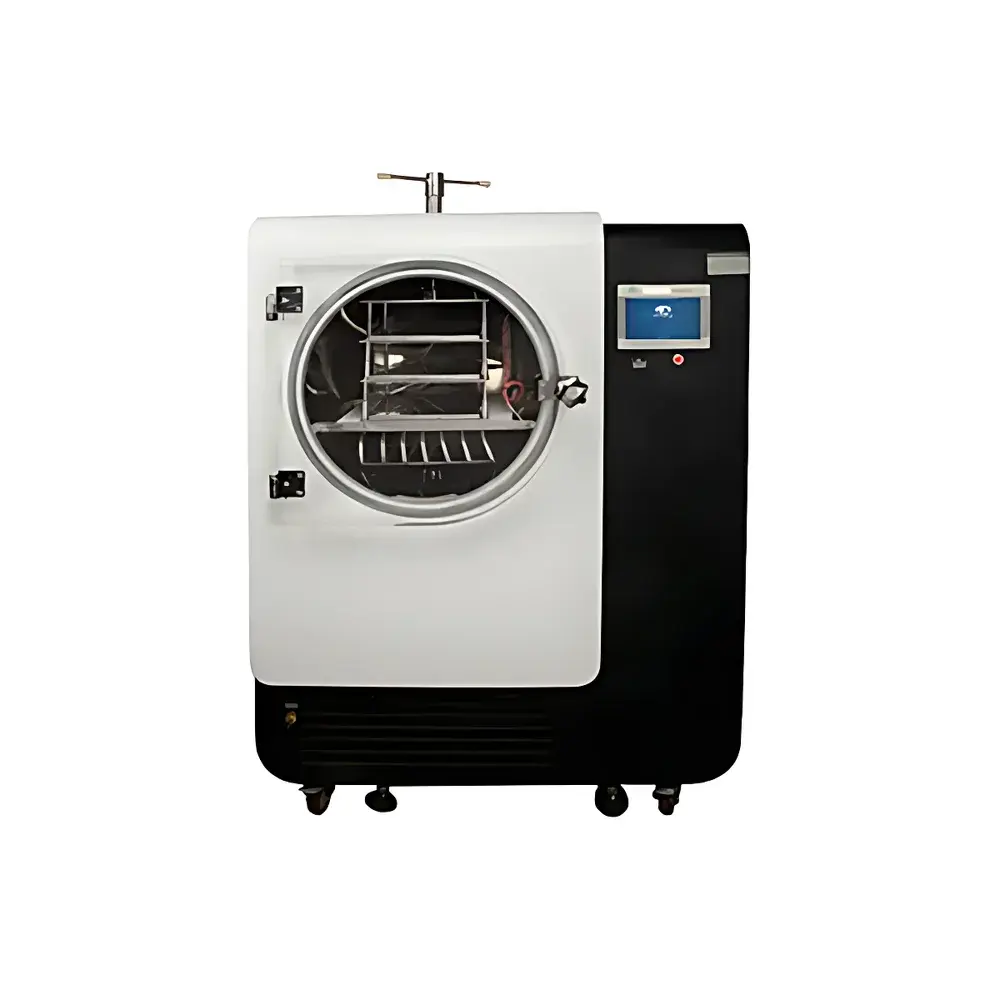
Scientz SCIENTZ-50YG/B Pilot-Scale In-Situ Freeze Dryer with Silicon Oil Heating and Square-Tube Stainless Steel Chamber
| Brand | Scientz |
|---|---|
| Origin | Zhejiang, China |
| Manufacturer Type | Direct Manufacturer |
| Instrument Type | Shelf-Type Freeze Dryer |
| Application Scale | Pilot-Scale |
| Lyophilization Area | 0.21 m² |
| Ultimate Vacuum (Empty) | ≤5 Pa |
| Condensate Capacity (24 h) | 4 kg/24 h |
| Cold Trap Temperature (Empty) | ≤−70 °C |
| Dimensions (L×W×H) | 750 × 640 × 1200 mm |
Overview
The Scientz SCIENTZ-50YG/B is a pilot-scale, in-situ freeze dryer engineered for reproducible, controllable lyophilization of temperature-sensitive biological, pharmaceutical, food, and environmental samples. It employs a silicon oil circulation heating system to regulate shelf temperature with high spatial uniformity and temporal precision—critical for optimizing primary and secondary drying stages in complex lyophilization cycles. Unlike steam or electric-resistance heated systems, silicon oil provides superior thermal inertia and minimal temperature gradient across shelves (±3 °C after equilibrium), enabling robust process development and scale-up from lab to pilot production. The unit integrates the drying chamber and cold trap into a single compact stainless steel (SUS304) square-tube frame, minimizing footprint while maintaining structural rigidity and corrosion resistance. Designed for method development rather than routine high-throughput operation, it supports iterative refinement of critical process parameters—including shelf ramp rates, hold durations, and vacuum ramp profiles—under full environmental monitoring and data traceability.
Key Features
- Integrated silicon oil heating/cooling system with PID temperature control algorithm for ±0.5 °C setpoint accuracy and <±3 °C inter-shelf uniformity
- Pilot-scale capacity with 0.21 m² shelf area and 4 kg/24 h condensate removal capability at ≤−70 °C cold trap temperature
- PLC-based control architecture with color touchscreen HMI, supporting up to 40-segment programmable lyo cycles per recipe
- Three-tier user permission system (Operator / Technician / Administrator) compliant with GLP/GMP documentation requirements
- Real-time data logging of shelf temperature, product thermocouple (optional), cold trap temperature, chamber pressure, and silicon oil loop temperature
- Automated vacuum pump management: pump activation delayed until cold trap reaches target temperature; total pump runtime logged for predictive maintenance
- Optically transparent polycarbonate drying chamber—single-piece injection molded, non-porous, chemically inert, and vacuum-rated to 10⁻² mbar
- Configurable inert gas backfill (N₂ or Ar) via integrated solenoid valve with adjustable flow rate and pressure regulation
Sample Compatibility & Compliance
The SCIENTZ-50YG/B accommodates vials (10–50 mL), trays (up to 200 mm × 200 mm), and custom T-frame configurations. Its controlled shelf temperature range (−50 °C to +80 °C) and fine vacuum resolution (0.1–100 Pa) support diverse sample classes: aqueous protein formulations, microbial cultures, plant tissue extracts, soil/sediment matrices, archival paper specimens, and heat-labile nutraceuticals. The system meets fundamental design and operational criteria referenced in ISO 22059 (freeze-drying equipment performance), ASTM F2375 (lyophilization cycle validation), and USP (container closure integrity testing prerequisites). Data audit trails—including parameter changes, alarm events, and user logins—are timestamped and exportable via USB to support FDA 21 CFR Part 11 compliance when deployed with electronic signature protocols.
Software & Data Management
All process data—including time-stamped shelf temperature, vacuum pressure, cold trap temperature, and silicon oil inlet/outlet differential—is automatically saved in CSV format with metadata (operator ID, batch ID, recipe name). Up to 100 complete lyophilization cycles can be stored internally; historical runs are retrievable for overlay comparison or deviation analysis. USB export enables offline review in Excel or integration with LIMS platforms. Optional PC-based supervisory software provides remote monitoring, real-time graphing, and automated report generation (PDF/Excel) with customizable templates. An optional mobile application extends status visibility and basic control (start/pause/abort) via secure Wi-Fi or Ethernet connection—without compromising firewall integrity.
Applications
- Pharmaceutical R&D: Optimization of freeze-drying cycles for monoclonal antibodies, mRNA-LNPs, and sterile powder formulations prior to clinical trial manufacturing
- Agricultural & Environmental Research: Stabilization of soil microbiome samples, pesticide residue standards, and wet plant tissues for subsequent GC-MS or ICP-MS analysis
- Food Science: Development of low-temperature dehydration protocols for probiotics, enzymatic extracts, and functional food ingredients without Maillard degradation
- Cultural Heritage Conservation: Controlled water removal from water-damaged manuscripts and parchment without dimensional distortion or ink migration
- Academic Training: Hands-on instruction in lyophilization thermodynamics, mass transfer modeling, and critical quality attribute (CQA) mapping
FAQ
What is the maximum shelf temperature range?
Shelf temperature is programmable from −50 °C to +80 °C, with silicon oil loop operating within the same range.
Can the system accommodate custom shelf configurations?
Yes—standard configuration includes two fixed shelves; optional T-frame mounting kits enable external sample racks or custom tray supports.
Is the data export compatible with LIMS integration?
CSV-formatted logs include ISO 8601 timestamps and structured column headers, enabling direct ingestion by most laboratory information management systems.
Does the unit meet regulatory requirements for GMP environments?
While not certified as GMP-compliant out-of-the-box, its PLC architecture, audit trail capability, and user access controls align with Annex 11 and 21 CFR Part 11 expectations when validated per site-specific SOPs.
What refrigeration technology is used?
A dual-stage cascade refrigeration system with imported compressors delivers stable cold trap performance down to −70 °C (standard) or −80 °C (optional upgrade).



