
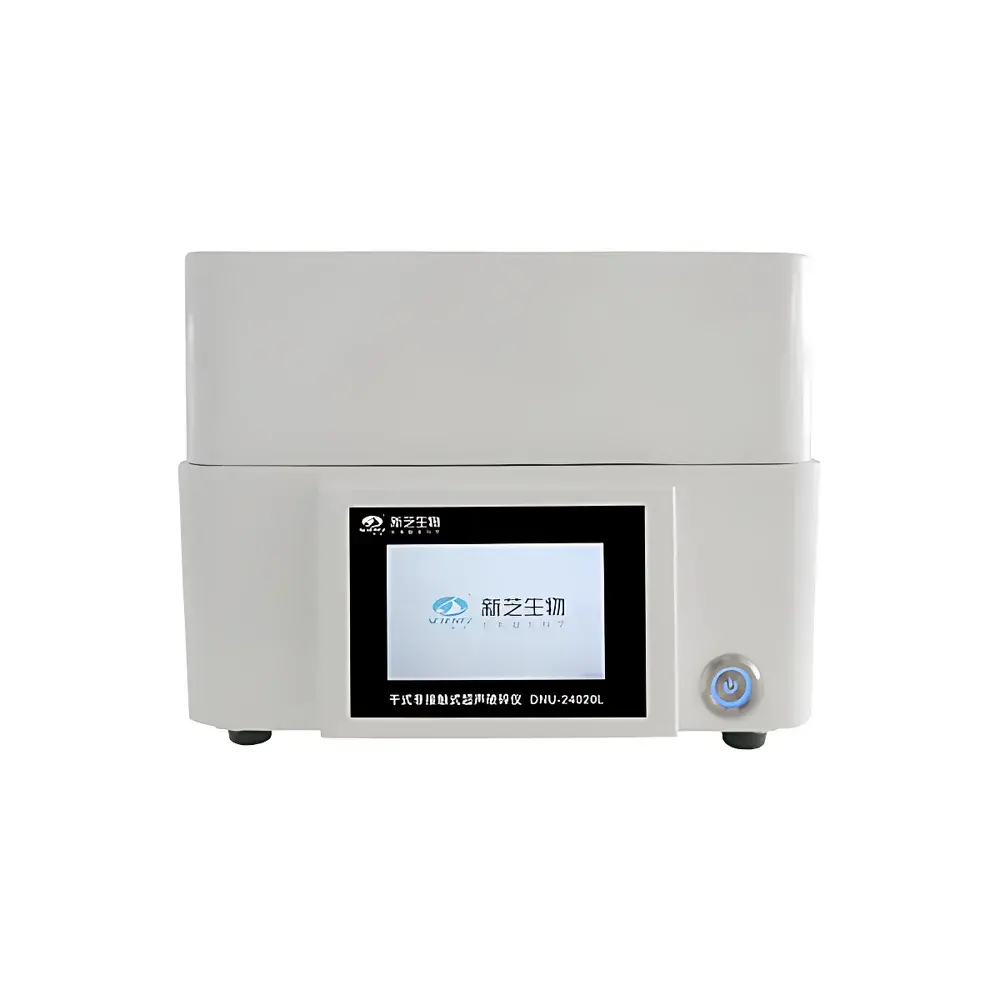
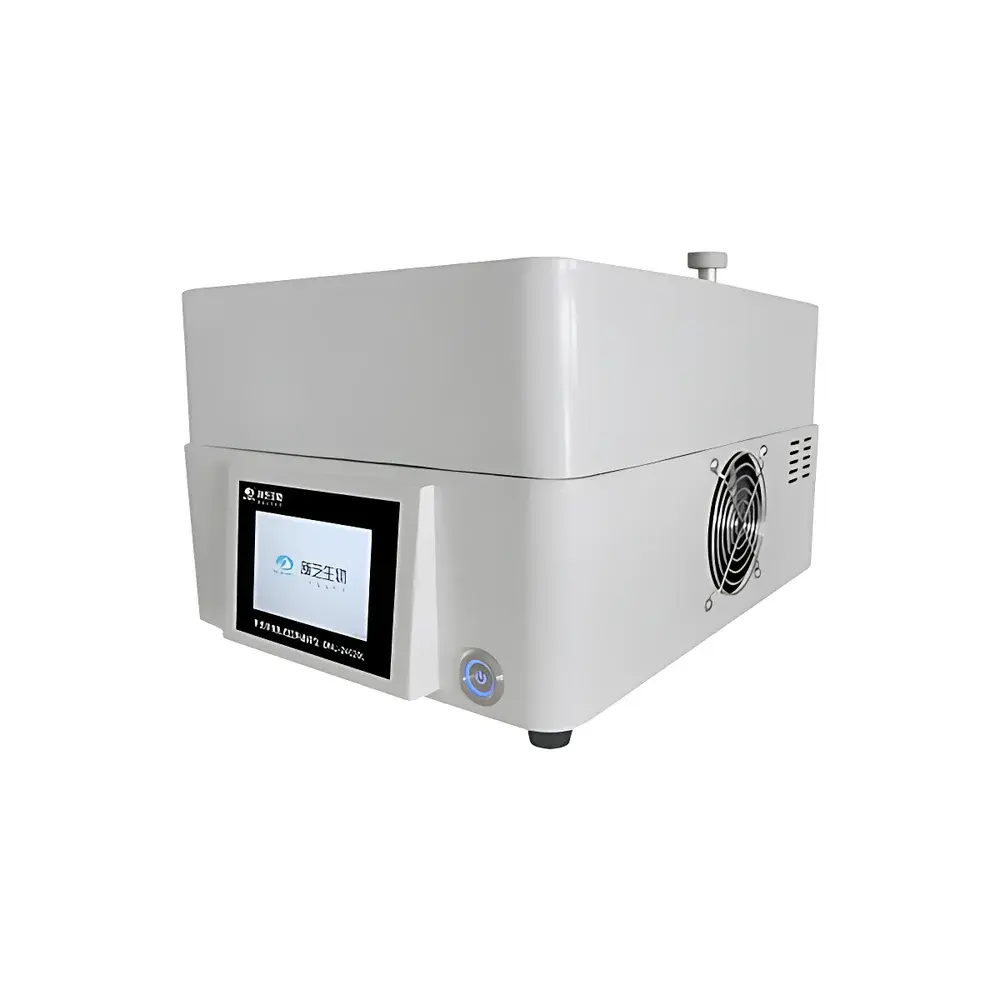
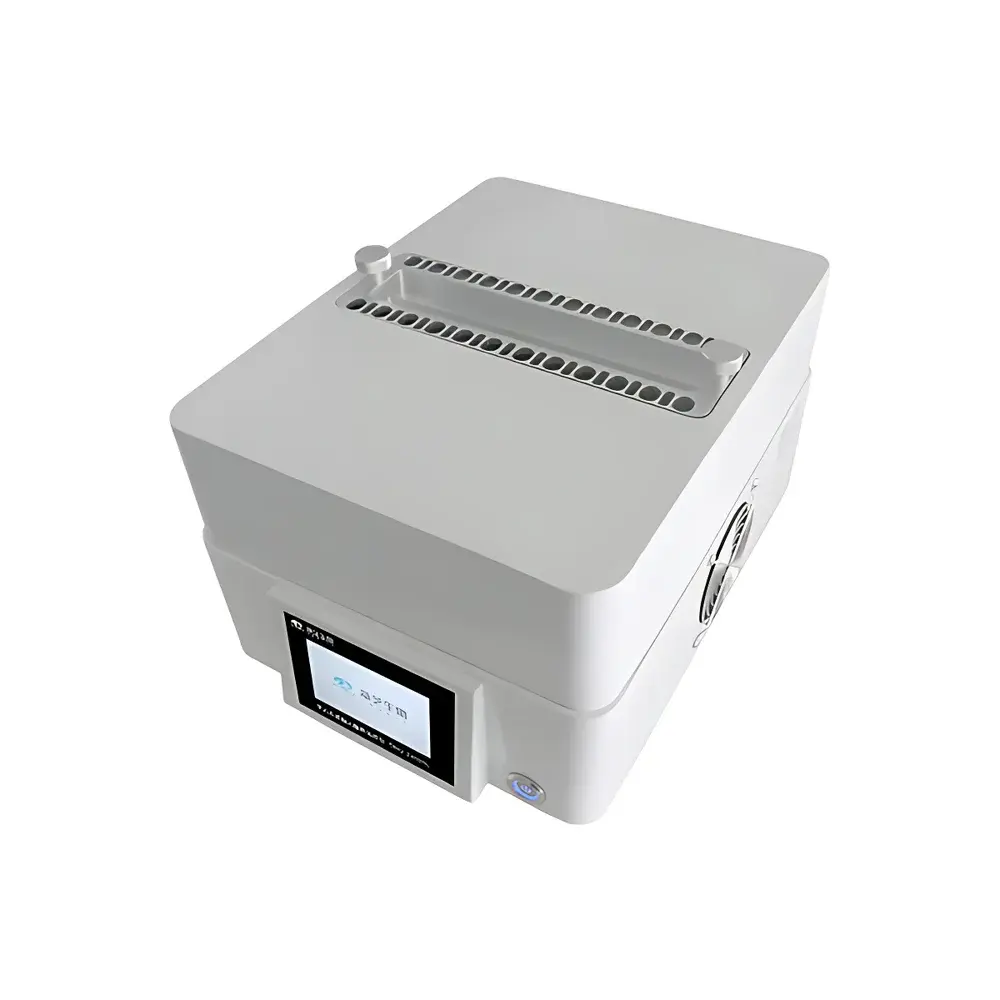
Scientz DNU-24020L High-Throughput Non-Contact Ultrasonic Cell Disruptor
| Brand | Scientz |
|---|---|
| Origin | Zhejiang, China |
| Manufacturer Type | Original Equipment Manufacturer (OEM) |
| Instrument Type | Ultrasonic Cell Disruptor |
| Operating Frequency | 30–40 kHz |
| Total Ultrasonic Power | 4 × 50 W (200 W total) |
| Sample Volume per Tube | 500 µL – 1000 µL |
| Throughput | 24 samples per run |
| Temperature Control Range | 4–10 °C (Peltier-based cooling) |
| Compatible Tube Format | Standard 2 mL microcentrifuge tubes |
Overview
The Scientz DNU-24020L is a high-throughput, non-contact ultrasonic cell disruptor engineered for reproducible, low-volume biological sample lysis under precisely controlled thermal conditions. Unlike conventional probe-based sonicators—which introduce mechanical wear, cross-contamination risk, and inconsistent energy delivery—the DNU-24020L employs a multi-channel transducer array with optimized acoustic coupling to deliver focused ultrasonic energy directly to the exterior surface of standard 2 mL microcentrifuge tubes. This non-invasive architecture operates on the principle of cavitation-induced shear stress within the liquid phase, enabling efficient disruption of bacterial cells, mammalian cells, yeast, and subcellular organelles without physical probe immersion. The system integrates Peltier-based thermoelectric cooling to maintain sample temperature between 4 °C and 10 °C throughout operation—critical for preserving labile biomolecules such as RNA, native membrane proteins, and enzymatic complexes during lysis. Designed for integration into automated or semi-automated nucleic acid and protein workflows, the DNU-24020L meets core requirements for GLP-compliant sample preparation in academic, pharmaceutical, and contract research laboratory environments.
Key Features
- Non-contact, tube-based ultrasonic lysis eliminates probe contamination, sample carryover, and consumable dependency—ideal for high-sensitivity applications including qPCR and single-cell omics.
- 24-position sample rack with precision-machined semi-circular grooves ensures consistent acoustic coupling across all tubes; compatible with widely available 2 mL conical-bottom microcentrifuge tubes (e.g., Eppendorf Safe-Lock™, Axygen MaxyClear™).
- Programmable operational parameters: total treatment time, ultrasonic ON/OFF duty cycle (pulse mode), and amplitude control (via power modulation across four independent 50 W transducers).
- Integrated Peltier cooling system maintains real-time thermal stability without external chillers or water baths—reducing infrastructure dependency and footprint.
- Automated clamping mechanism secures tubes prior to sonication and releases them post-cycle, minimizing manual handling and operator variability.
- Rugged aluminum alloy chassis with IP20-rated enclosure supports continuous use in shared core facilities and regulated QC laboratories.
Sample Compatibility & Compliance
The DNU-24020L is validated for lysis of Gram-negative and Gram-positive bacteria (e.g., E. coli, B. subtilis), cultured mammalian cells (HEK293, CHO), yeast (S. cerevisiae), and tissue homogenates. Its sealed acoustic chamber meets biosafety Level 2 (BSL-2) containment guidelines when processing pathogenic agents—including Mycobacterium tuberculosis and enveloped viruses—by eliminating aerosol generation associated with probe sonication. While not certified to IEC 61010-1 or ISO 13485 out-of-the-box, the instrument’s design aligns with key elements of FDA 21 CFR Part 11 data integrity expectations when used with compliant LIMS or ELN systems. It supports documentation of critical process parameters (time, power, temperature) required for audit readiness under ISO/IEC 17025 and GLP frameworks.
Software & Data Management
The DNU-24020L features an embedded microcontroller interface with tactile keypad and LCD display for local parameter entry and status monitoring. All user-defined protocols—including up to 10 saved methods—are stored in non-volatile memory with timestamped execution logs. Optional RS-232 or USB-to-serial connectivity enables integration with laboratory information management systems (LIMS) for electronic record capture. Audit trails include start/stop timestamps, setpoints, actual measured chamber temperature, and error codes—supporting traceability requirements in GxP environments. No proprietary software installation is required for basic operation; advanced protocol scheduling and remote monitoring may be implemented via third-party SCADA or Python-based automation scripts.
Applications
- Nucleic acid isolation: Efficient release of genomic DNA and total RNA from low-input clinical or microbial samples prior to library preparation for NGS or qRT-PCR.
- Membrane protein solubilization: Gentle yet effective disruption of eukaryotic and prokaryotic membranes while retaining native conformation for downstream affinity purification and structural analysis.
- Subcellular fractionation: Preparation of cytosolic, nuclear, and mitochondrial extracts with minimal organelle damage.
- Pre-analytical processing in biobanking: Standardized lysis of cryopreserved PBMCs or tumor biopsies under temperature-controlled conditions to ensure inter-batch comparability.
- Formulation development: Emulsification and nanoparticle dispersion in small-volume formulations of therapeutic proteins or mRNA-LNPs.
FAQ
Is the DNU-24020L compatible with PCR-grade consumables?
Yes—it accepts standard autoclavable or sterile-certified 2 mL polypropylene microcentrifuge tubes without requiring proprietary adapters or inserts.
Can I validate the temperature uniformity across all 24 positions?
Temperature mapping studies using calibrated fiber-optic probes confirm ≤ ±0.8 °C variation across the full rack at steady state (4 °C setpoint), per internal validation report #SC-DNU-24020L-TM-2023.
Does the system support IQ/OQ documentation packages?
Scientz provides template qualification protocols (including test scripts and acceptance criteria) aligned with ASTM E2500 and ISO/IEC 17025 for user-executed installation and operational qualification.
What maintenance is required beyond routine cleaning?
No scheduled transducer replacement or calibration is needed; only periodic inspection of the sealing gasket and cleaning of the sample chamber with 70% ethanol is recommended.
Is remote firmware update supported?
Firmware updates are performed locally via USB drive; no cloud connectivity or internet access is implemented—ensuring air-gapped security in regulated labs.



