
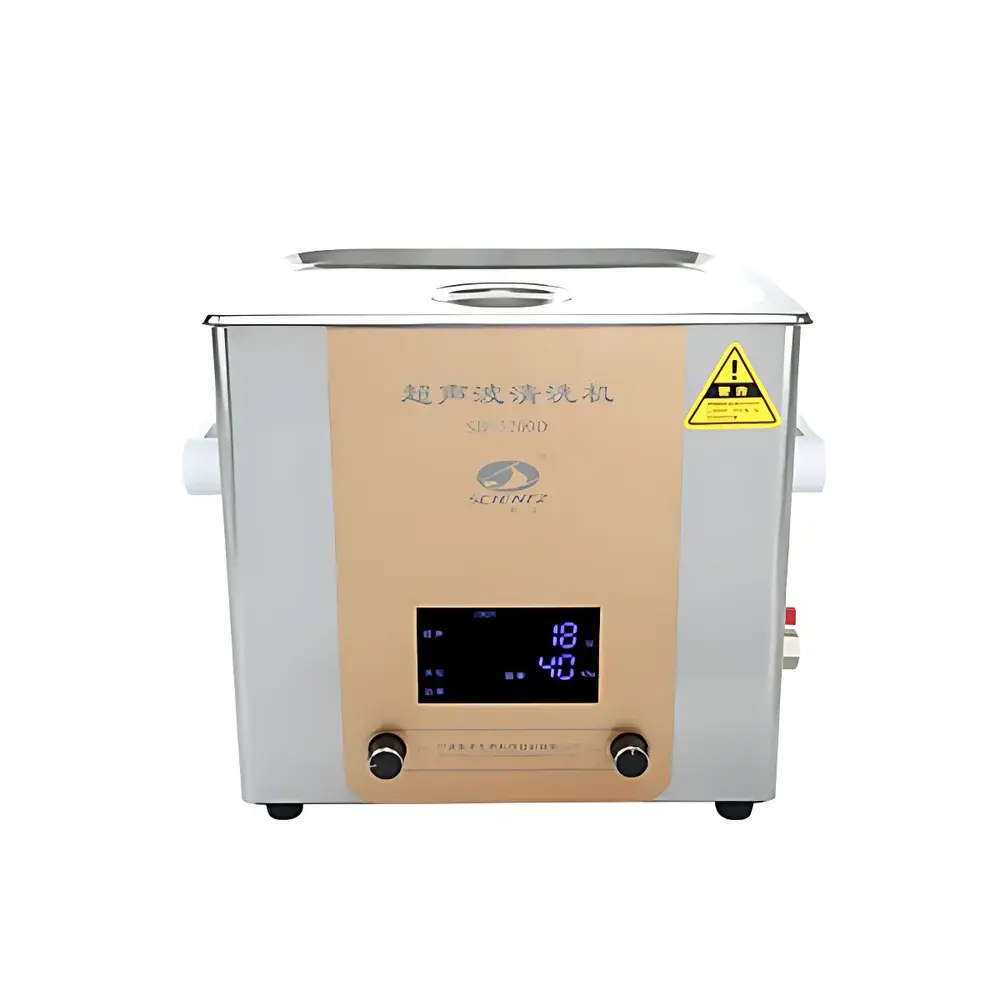
Ningbo Scientz SB-5200D Ultrasonic Cleaner
| Brand | Scientz |
|---|---|
| Origin | Zhejiang, China |
| Manufacturer | Ningbo Scientz Biotechnology Co., Ltd. |
| Type | Benchtop General-Purpose Ultrasonic Cleaner |
| Tank Capacity | 14.4 L |
| Ultrasonic Frequency | 40 kHz |
| Ultrasonic Power Output | 400 W |
| Power Adjustment | Fixed |
| Temperature Control | Not Available |
| Timer Range | 1–600 min |
| Sound-Dampening Lid | Included |
| Drain & Fill Fitting | Equipped |
Overview
The Ningbo Scientz SB-5200D Ultrasonic Cleaner is a benchtop general-purpose cleaning system engineered for precision laboratory and light industrial applications. It operates on the principle of acoustic cavitation—where high-frequency mechanical vibrations (40 kHz) generated by piezoelectric transducers are transmitted through an aqueous or solvent-based cleaning medium. These vibrations induce the formation, growth, and implosive collapse of microscopic vapor cavities in the liquid. Each collapse releases localized energy in the form of micro-jets and shockwaves (up to ~5,000 K and ~1,000 atm transiently), enabling non-contact removal of particulate contaminants, organic residues, oils, and biofilms from complex geometries—including blind holes, narrow lumens, porous surfaces, and microstructured components. Unlike manual scrubbing or immersion soaking, ultrasonic cleaning delivers uniform energy distribution across submerged surfaces without mechanical abrasion, preserving surface integrity and dimensional accuracy of sensitive substrates.
Key Features
- Benchtop robust architecture: Constructed with 304 stainless steel tank interior and exterior housing, ensuring corrosion resistance, structural rigidity, and long-term stability in routine lab environments.
- Integrated sound-dampening lid: Reduces airborne noise emissions during operation while minimizing solvent evaporation and enhancing operator safety in shared lab spaces.
- Precision digital timer: Adjustable 1–600 minute cycle duration with real-time countdown display; retains last-used settings after power interruption (non-volatile memory).
- High-efficiency transducer array: Optimized placement and coupling ensure uniform energy distribution across the full 14.4 L tank volume, validated via aluminum foil erosion test per ASTM E1759-18.
- Drain and fill port: Standard 1/2″ NPT threaded outlet facilitates rapid fluid exchange, compatible with standard laboratory tubing and waste collection systems.
- No thermal regulation: Designed for ambient-temperature operation only; users requiring heated cleaning must integrate external thermostatic baths or select Scientz models with integrated heating modules (e.g., SB-5200DT series).
Sample Compatibility & Compliance
The SB-5200D accommodates a broad range of sample types and container formats: glassware (volumetric flasks, centrifuge tubes, Petri dishes), metal components (surgical instruments, watch gears, fuel injectors), optical elements (lens assemblies, quartz cuvettes), and polymer-based parts (microfluidic chips, 3D-printed fixtures). Its fixed 40 kHz frequency provides optimal balance between penetration depth and surface shear intensity—suitable for macro-scale particulate removal without risking micro-fracture in brittle substrates. While the unit itself does not carry CE, UL, or FDA premarket clearance as a medical device, it complies with IEC 61000-6-3 (EMC emission limits) and meets basic electrical safety requirements per IEC 61010-1 for laboratory equipment. When used in GxP-regulated environments (e.g., pharmaceutical QC labs), integration into documented cleaning validation protocols—including dwell time, solution composition, and post-cleaning residue testing per USP —is required.
Software & Data Management
The SB-5200D operates as a standalone analog-digital hybrid instrument with no embedded firmware, network interface, or software dependency. All controls are local and tactile: a rotary encoder for timer setting and LED-based digital display for elapsed/remaining time. This design eliminates cybersecurity vulnerabilities, firmware update dependencies, and compatibility constraints associated with proprietary software platforms. For laboratories implementing electronic recordkeeping under 21 CFR Part 11, operators may document cleaning parameters manually in bound logbooks or link the device to external environmental monitoring systems via dry-contact relay outputs (optional accessory). No audit trail, user authentication, or electronic signature functionality is provided natively.
Applications
- Cleaning of reusable labware prior to sterilization or analytical use—especially items with internal channels or textured surfaces where manual wiping is ineffective.
- Pre-analytical sample preparation: degassing solvents prior to HPLC mobile phase preparation; dispersing nanoparticles for DLS or TEM analysis.
- Maintenance of precision instrumentation: removal of lubricant residues from optical mounts, micromanipulators, and stage mechanisms.
- Reprocessing of reusable medical devices in low-risk clinical settings (e.g., dental handpieces, endoscope accessories), when paired with EPA-registered disinfectants and validated cleaning SOPs.
- Restoration of heritage artifacts and jewelry: gentle yet effective removal of oxidation films and organic grime from silver, gold, and gemstone surfaces without polishing abrasives.
FAQ
Does the SB-5200D support temperature control?
No. This model operates at ambient temperature only. Heating functionality is available in the SB-5200DT variant.
Can the ultrasonic power be adjusted?
No. The 400 W output is fixed at 40 kHz. Variable-power models (e.g., SB-5200DTD) offer 20–100% amplitude modulation.
Is the unit suitable for cleaning delicate optics?
Yes—when used with low-surface-tension, non-ionic detergents and appropriate dwell times. Avoid prolonged exposure (>10 min) in pure water or aggressive solvents on coated lenses.
What maintenance is required?
Regular tank cleaning to prevent residue buildup; periodic inspection of transducer bonding integrity; replacement of degraded gaskets every 24 months under continuous use.
Does it comply with ISO 13485 or FDA 21 CFR Part 11?
No. It is a Class I general-purpose lab instrument. Compliance with regulatory frameworks requires site-specific validation and procedural documentation—not inherent device certification.



