
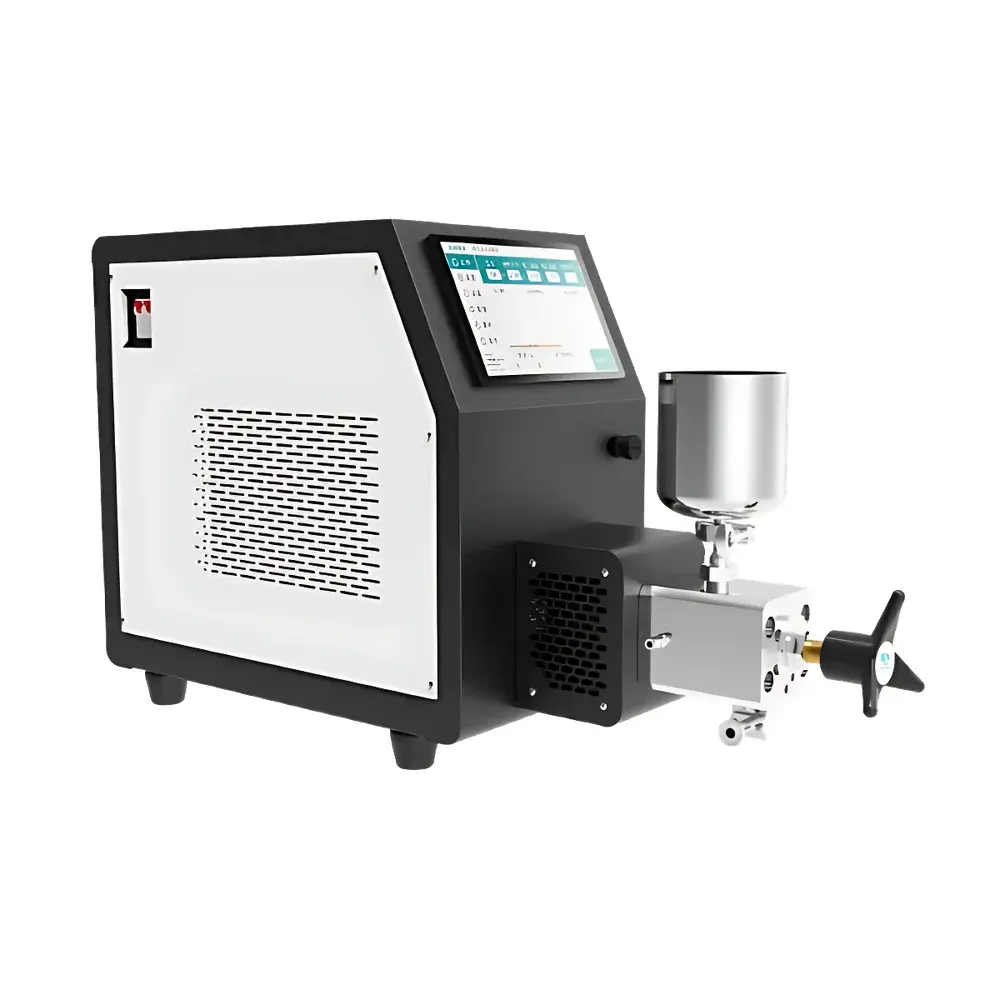
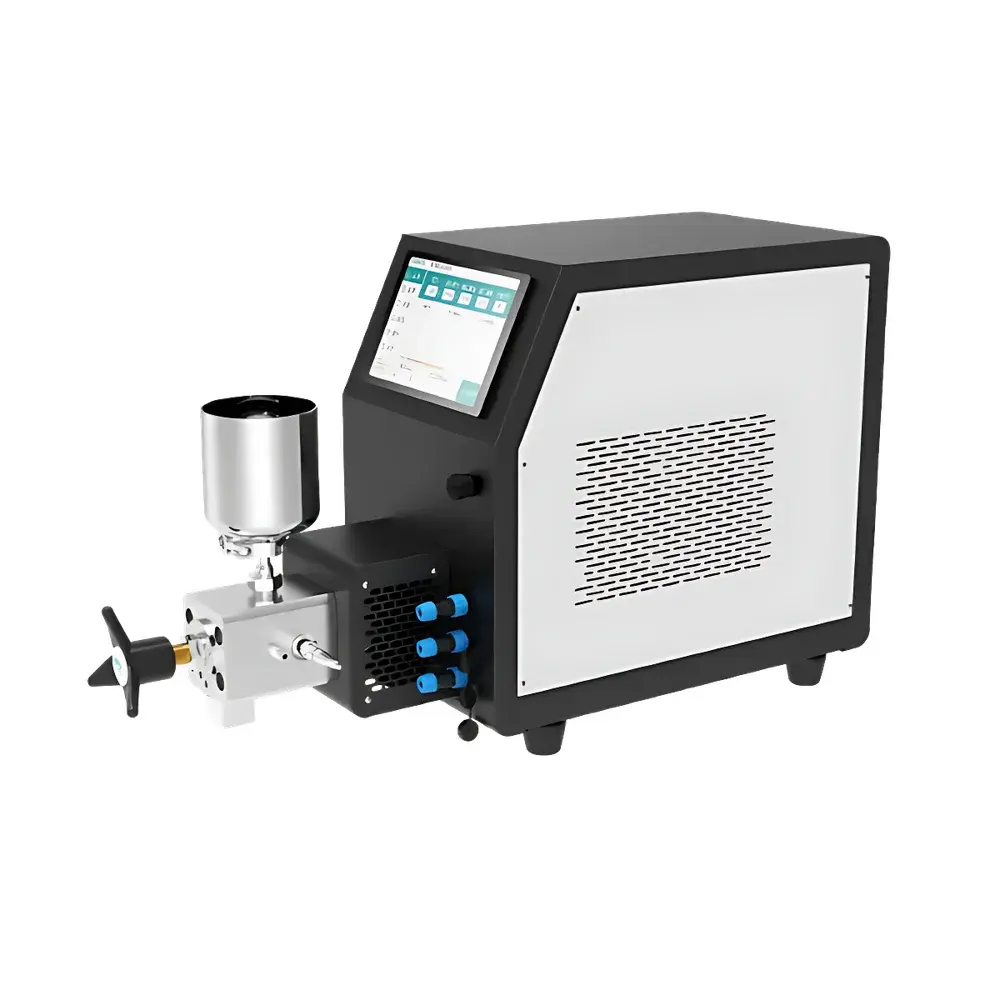
Ningbo Scientz SCIENTZ-207B Benchtop High-Pressure Homogenizer
| Brand | Ningbo Scientz |
|---|---|
| Origin | Zhejiang, China |
| Manufacturer Type | Original Equipment Manufacturer (OEM) |
| Product Category | Domestic |
| Model | SCIENTZ-207B |
| Instrument Type | High-Pressure Homogenizer |
| Dimensions (W×D×H) | 1070 × 340 × 460 mm |
| Processing Volume Range | 15–250 mL |
| Maximum Operating Pressure | 0–180 MPa |
| Material Contact Surface | ASTM F899 Grade 316L Stainless Steel |
| Temperature Control | External Chilled Circulation Interface (Compatible with Standard Laboratory Chillers) |
| Sample Throughput | Continuous Flow, Auto-Feeding |
| Valve Core Material | Synthetic Diamond |
| Regulatory Compliance | Designed for GLP/GMP-aligned workflows |
Overview
The Ningbo Scientz SCIENTZ-207B Benchtop High-Pressure Homogenizer is an engineered solution for controlled mechanical disruption and nano-scale dispersion of biological, colloidal, and viscous suspensions in research and pilot-scale development environments. It operates on the principle of high-pressure microfluidization—where sample suspension is pressurized by a precision reciprocating plunger pump and forced through a geometrically defined homogenizing valve or impact chamber. This generates simultaneous hydrodynamic effects: cavitation, turbulent shear, and inter-particle collision under controlled pressure gradients. The resulting energy dissipation enables reproducible cell lysis, sub-100 nm particle size reduction, stable emulsion formation, and uniform dispersion of nanomaterials—without thermal degradation or chemical additives. Its compact footprint and modular cooling interface make it suitable for integration into biosafety cabinets, cold rooms, or regulated QC laboratories where spatial constraints and temperature-sensitive processing are critical.
Key Features
- Adjustable operating pressure from 0 to 180 MPa—enabling method optimization across diverse sample matrices including Gram-negative bacteria, algal cells, liposomes, and pigment dispersions.
- 316L stainless steel wetted path compliant with USP , ISO 10993-1, and FDA-recommended materials for pharmaceutical contact surfaces.
- Synthetic diamond homogenizing valve ensures long-term pressure stability, minimal wear-induced particle shedding, and consistent flow dynamics over >5,000 operational cycles.
- Integrated auto-feeding system with programmable peristaltic intake allows unattended continuous processing within the 15–250 mL volume range.
- Dual-port external chiller interface (inlet/outlet) supports connection to standard laboratory recirculating chillers (e.g., Julabo, Thermo Scientific), maintaining sample temperature rise ≤2 °C during extended operation at ≥120 MPa.
- On-board pressure recovery after manual air purge—eliminating recalibration steps and ensuring process continuity during routine maintenance intervals.
- Optional column seal cleaning module reduces downtime by extending dynamic seal service life by up to 40% under high-viscosity or particulate-laden conditions.
Sample Compatibility & Compliance
The SCIENTZ-207B accommodates heterogeneous feedstocks including microbial cultures (E. coli, yeast, Nannochloropsis), plant tissues (ginseng root homogenates, citrus peel extracts), lipid-based systems (soy lecithin emulsions, PEGylated liposomes), and industrial dispersions (carbon black in aqueous acrylic media, phthalocyanine pigments). All wetted components meet ASME BPE-2022 surface finish requirements (Ra ≤ 0.4 µm) and are passivated per ASTM A967. The system architecture supports IQ/OQ documentation packages and aligns with ISO 22000, ICH Q5A(R2), and USP guidelines for sterile process validation. When paired with time-stamped, user-access-controlled acquisition software, it satisfies audit requirements under 21 CFR Part 11 for electronic records in GxP-regulated environments.
Software & Data Management
While the base unit features analog pressure monitoring and manual parameter setting, optional digital control modules provide real-time logging of pressure profiles, flow rate (via calibrated load-cell feedback), cycle count, and chiller inlet/outlet temperatures. Export formats include CSV and XML for traceability integration into LIMS platforms such as LabVantage or Thermo Fisher SampleManager. Audit trail functionality records operator ID, timestamp, parameter changes, and emergency stop events—retained for ≥36 months per internal retention policy. Firmware updates follow IEC 62304 Class B safety standards, with version-controlled release notes available via Scientz’s secure customer portal.
Applications
- Biopharmaceutical Development: Production of nanostructured drug carriers—including lipid nanoparticles (LNPs) for mRNA delivery, nanoemulsions for parenteral nutrition, and polymeric micelles—under pressure-controlled, low-thermal-load conditions.
- Functional Food Research: Stabilization of plant protein isolates (soy, pea, rice) into heat-sensitive bioactive nano-dispersions without Maillard reaction induction.
- Nanomaterial Engineering: Exfoliation of graphene oxide suspensions and dispersion of quantum dots in biocompatible matrices for diagnostic probe synthesis.
- Botanical Extraction Optimization: Enhanced solubilization of poorly water-soluble phytochemicals (e.g., curcumin, quercetin) via amorphous nanoparticle formation prior to lyophilization.
- Industrial Coatings: Sub-micron milling of organic pigments (Pigment Violet 23, Phthalo Blue RS) in waterborne resin systems to achieve spectral consistency and rheological predictability.
FAQ
What is the minimum recommended sample volume for reproducible pressure generation?
For optimal hydraulic efficiency and pressure stability, a minimum working volume of 15 mL is required—validated using glycerol-water standards per ISO 11357-3 Annex D.
Can the SCIENTZ-207B be used for sterile processing?
Yes—when coupled with pre-sterilized disposable sample cups (available as accessory SKUs) and validated SIP protocols, the system supports aseptic processing down to ISO 5 cleanroom conditions.
Is third-party calibration support available?
Ningbo Scientz maintains ISO/IEC 17025-accredited calibration laboratories in Shanghai and Hangzhou; field verification services include pressure transducer traceability to NIM (National Institute of Metrology, China) standards.
How does the diamond valve compare to tungsten-carbide alternatives in long-term use?
Accelerated wear testing shows ≤0.3% pressure drift after 2,000 cycles at 150 MPa—significantly lower than industry-standard WC valves exhibiting ≥2.1% drift under identical conditions.
Does the system comply with CE or UL safety directives?
The SCIENTZ-207B carries CE marking per Machinery Directive 2006/42/EC and EMC Directive 2014/30/EU; UL 61010-1 certification is pending final review by Intertek (ETA expected Q3 2025).



