
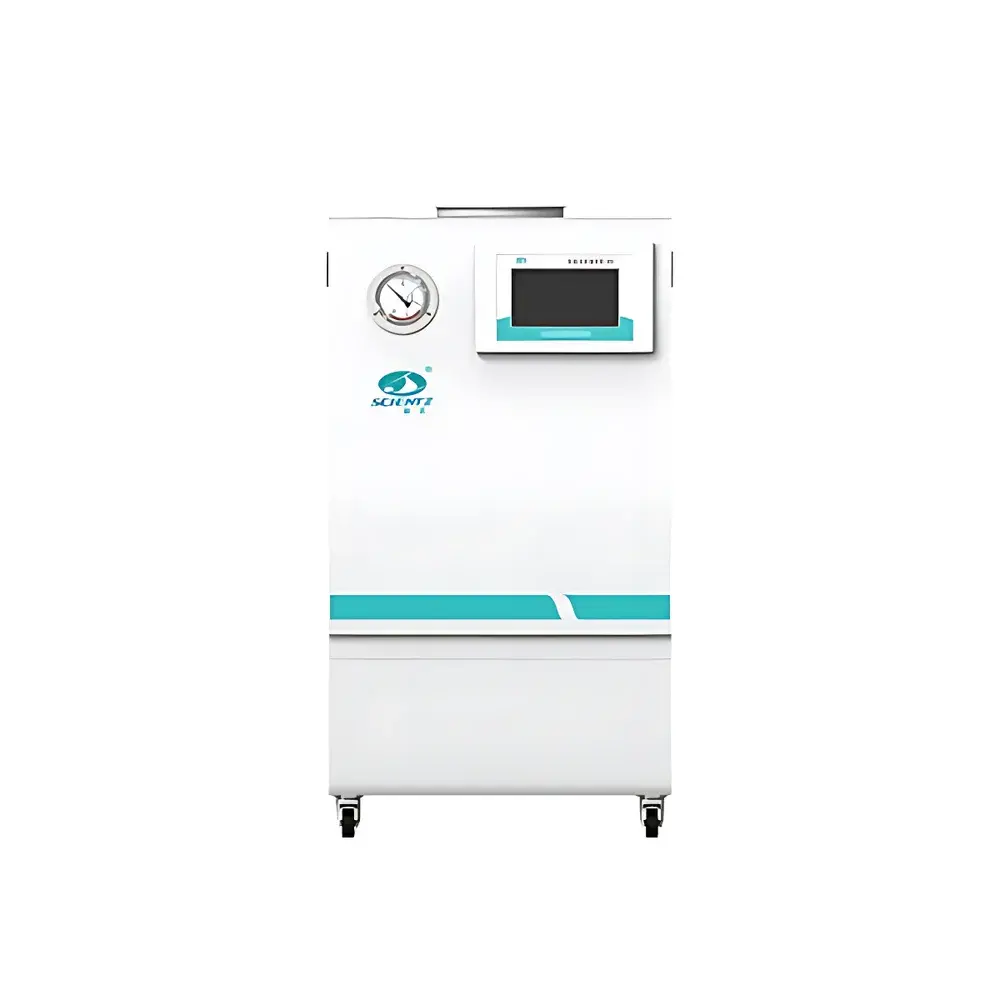
Scientz DLK-2010 Low-Temperature Circulating Chiller
| Brand | Scientz |
|---|---|
| Origin | Zhejiang, China |
| Manufacturer Type | Direct Manufacturer |
| Product Category | Domestic |
| Model | DLK-2010 |
| Instrument Type | Constant-Temperature Bath |
| Circulation Mode | Internal & External Circulation |
| Temperature Control | Refrigeration & Heating |
| Bath Volume | 10 L |
| Temperature Range | −20 °C to Ambient |
| Temperature Stability | ±0.1 °C (at setpoint, steady state) |
| Refrigerant | R-134a (environmentally compliant, zero ozone depletion potential) |
| Compressor | Sealed imported unit (Panasonic or Tecumseh) |
| Display | 7-inch inclined capacitive touchscreen |
| Control System | Microprocessor-based PID algorithm with auto-tuning |
| Safety Features | Overheat protection, compressor overcurrent/overload cutoff, low-level fluid alarm |
| Power Recovery | Configurable auto-restart or standby mode upon power restoration |
| Pump Pressure | Up to 0.8 bar (adjustable flow rate, max. 20 L/min) |
| Noise Level | ≤58 dB(A) at 1 m |
Overview
The Scientz DLK-2010 Low-Temperature Circulating Chiller is an engineered thermal management system designed for precision temperature control in laboratory and analytical applications requiring stable cold or dual-range (cooling/heating) liquid circulation. Operating on the principle of vapor-compression refrigeration combined with resistive heating elements, the DLK-2010 delivers a tightly regulated thermal environment within a 10-liter stainless-steel bath reservoir. Its operational range spans from −20 °C up to ambient temperature, with typical stability maintained at ±0.1 °C under steady-state conditions—critical for reproducible physicochemical measurements. Unlike passive water-cooled systems, the DLK-2010 eliminates dependency on municipal water supply or seasonal ambient fluctuations, enabling consistent condensation temperatures during rotary evaporation, reliable cooling of graphite furnace atomic absorption spectrometers (GFAAS), and stable thermal loading for calorimetric or reaction calorimetry setups.
Key Features
- 7-inch inclined capacitive touchscreen interface with intuitive navigation, real-time display of bath temperature, setpoint, elapsed time, flow status, and system diagnostics
- Environmentally responsible refrigeration using R-134a—a non-ozone-depleting, low-GWP refrigerant compliant with current EU F-Gas Regulation and EPA SNAP guidelines
- Dual-mode circulation architecture supporting both internal bath homogenization and external load cooling via high-head centrifugal pump (max. 0.8 bar pressure, adjustable flow up to 20 L/min)
- Microprocessor-controlled PID temperature regulation with adaptive tuning, minimizing overshoot and ensuring rapid thermal equilibration
- Industrial-grade sealed compressor (Panasonic or Tecumseh), acoustically insulated to achieve ≤58 dB(A) noise emission—suitable for shared lab environments
- Comprehensive safety suite including compressor overtemperature cutoff, overcurrent protection, low-bath-fluid level detection, and dry-run prevention
- Power-fail resilience: user-configurable behavior upon restoration—either resume prior operating parameters or enter standby cooling mode
Sample Compatibility & Compliance
The DLK-2010 is compatible with aqueous solutions, ethylene glycol–water mixtures (up to 30% v/v), and other non-corrosive heat-transfer fluids commonly used in analytical instrumentation. It meets CE marking requirements for electromagnetic compatibility (EMC Directive 2014/30/EU) and low-voltage safety (LVD Directive 2014/35/EU). While not certified to ISO/IEC 17025 or GLP-specific hardware standards, its deterministic thermal performance, traceable calibration capability (via external PT100 probe input), and audit-ready operational logs support compliance with ISO 17025 Clause 6.4.3 (equipment verification) and FDA 21 CFR Part 11 when integrated into validated workflows involving chromatography, spectroscopy, or dissolution testing.
Software & Data Management
The embedded controller supports time-stamped logging of temperature, flow status, compressor duty cycle, and fault events—stored locally for ≥30 days. Optional RS485 Modbus RTU or USB-to-serial interface enables integration with LabVIEW, MATLAB, or SCADA platforms for remote monitoring and automated protocol sequencing. All logged data include UTC timestamps and are exportable as CSV files without proprietary software dependencies. No cloud connectivity or vendor-hosted firmware updates are implemented—ensuring full data sovereignty and alignment with institutional IT security policies.
Applications
- Rotary Evaporation: Simultaneous cooling of 1–4 rotovaps at fixed condenser temperatures (e.g., 10 °C), independent of ambient humidity or seasonal variation
- Atomic Absorption Spectroscopy: Continuous recirculation for graphite furnace cooling and flame atomizer thermal management in GFAAS and FAAS systems
- Extraction & Soxhlet Analysis: Precise condenser temperature control in fat and lipid extraction workflows per AOAC 991.36 and ISO 1443
- Synthesis & Reaction Calorimetry: Thermal jacketing of reactors, jacketed flasks, or flow chemistry modules requiring sub-ambient stabilization
- Material Testing: Conditioning of polymer samples, viscometer baths, or DSC reference cells per ASTM D3418 and ISO 11357 series
FAQ
What is the maximum external load capacity supported by the DLK-2010?
The unit maintains specified temperature stability when delivering up to 2.5 kW of thermal load (at −20 °C setpoint) with recommended flow rates between 10–15 L/min and ΔT ≤ 5 °C across the external circuit.
Can the DLK-2010 be used with silicone oil or other non-aqueous heat transfer fluids?
Yes—provided fluid viscosity remains below 50 cSt at operating temperature and chemical compatibility with stainless steel (304), EPDM seals, and copper tubing is confirmed; consult fluid SDS prior to use.
Is external calibration traceability available?
The system includes a dedicated PT100 input port for connection to NIST-traceable reference probes; calibration certificates may be generated in-house following ISO/IEC 17025 procedures.
Does the chiller support programmable ramp-soak temperature profiles?
No—this model implements single-setpoint PID control only; multi-step thermal programming requires external PLC or software integration via Modbus.
What maintenance intervals are recommended for long-term reliability?
Compressor oil inspection every 24 months; condenser coil cleaning every 6 months in dust-prone environments; annual verification of refrigerant charge integrity using manifold gauge set.



