
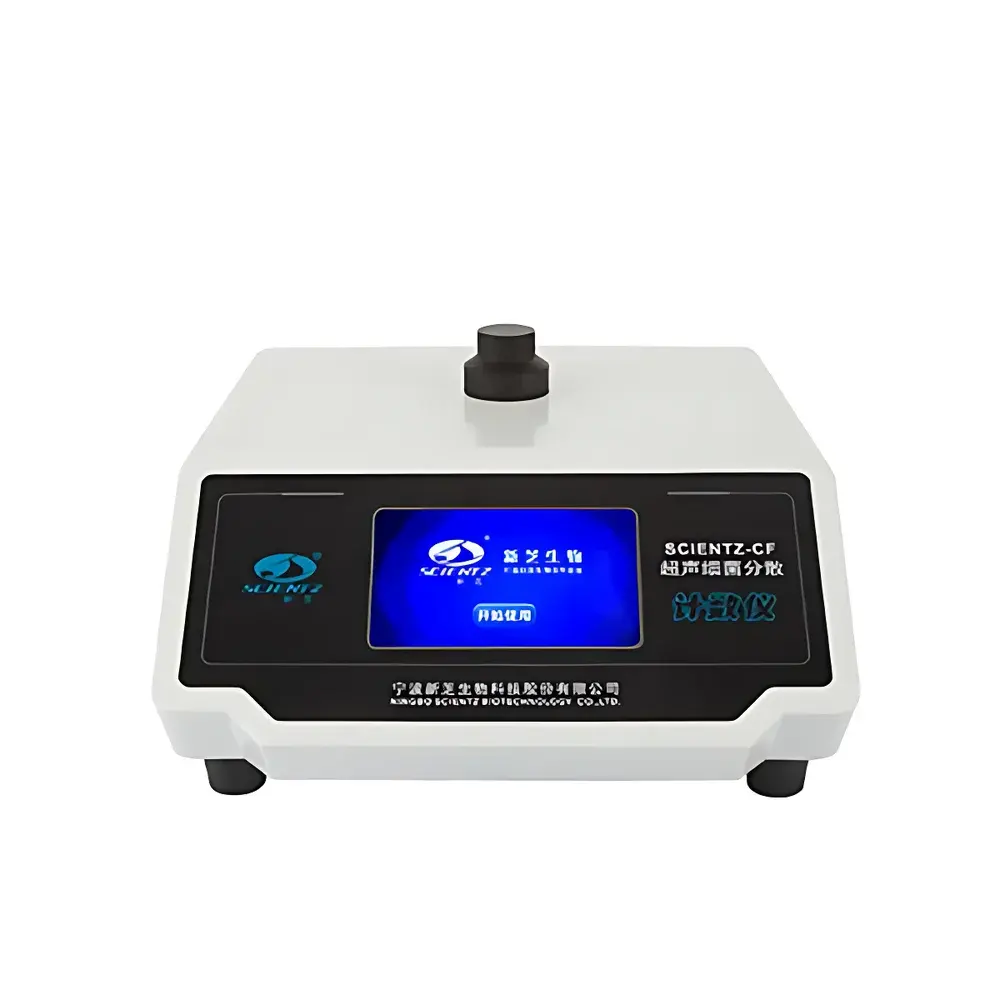
Scientz SCIENTZ-CF Ultrasonic Bacterial Dispersion and McFarland Turbidity Counter
| Brand | Scientz |
|---|---|
| Origin | Zhejiang, China |
| Manufacturer Type | Direct Manufacturer |
| Region Classification | Domestic (China) |
| Model | SCIENTZ-CF |
| Detection Time Range | 0–999 s (user-configurable) |
| Detection Concentration Range | 0.00–6.00 McFarland (MCF) |
| Sample Volume | 1.5–4 mL |
| Throughput | 6 samples per run |
| Detectable Cell Size Range | 1.5–4 µm |
| Step Resolution | 0.01 MCF |
Overview
The Scientz SCIENTZ-CF Ultrasonic Bacterial Dispersion and McFarland Turbidity Counter is a dedicated pre-analytical instrument engineered for standardized, reproducible preparation of bacterial suspensions in clinical microbiology and industrial quality control laboratories. It integrates high-frequency ultrasonic energy delivery with real-time optical density (OD) measurement at 600 nm to achieve uniform dispersion of microbial aggregates followed by precise McFarland-standard turbidity quantification. Unlike manual vortexing or pipetting-based dispersion—methods prone to operator variability, incomplete disaggregation, and cell lysis—the SCIENTZ-CF applies controlled cavitation forces within a sealed, temperature-stabilized chamber, preserving cellular integrity while ensuring homogenous suspension. The system correlates measured optical density directly to McFarland standards (0.5–6.0 MCF), enabling traceable, calibration-verified suspension concentration without reliance on spectrophotometer cross-referencing or empirical dilution tables.
Key Features
- Ultrasonic Dispersion Module: 40 kHz piezoelectric transducer with adjustable amplitude and time parameters (0–999 s), optimized for gentle yet effective deagglomeration of Gram-positive cocci (e.g., Staphylococcus aureus), acid-fast bacilli (Mycobacterium tuberculosis complex), and Enterobacteriaceae without compromising viability or membrane integrity.
- Integrated Photometric Detection: Dual-beam 600 nm LED photometer with auto-zeroing reference channel; calibrated against NIST-traceable McFarland standard suspensions (BaSO4); accuracy ±0.05 MCF across full 0.00–6.00 range.
- Smart Dilution Guidance Algorithm: Real-time calculation of required dilution volume to reach target McFarland value (e.g., 0.5 MCF for AST), displayed alongside current OD reading and recommended pipetting steps—reducing protocol deviation and inter-operator variance.
- Sealed Sample Cartridge System: Six-position, UV-resistant polystyrene cuvette holder with integrated lid seal; prevents aerosol generation, minimizes contamination risk, and complies with CLSI M07-A10 biosafety recommendations for handling potentially pathogenic isolates.
- Robust Architecture: All-metal housing with IP20-rated enclosure; CE-marked electrical safety; firmware supports audit trail logging (user ID, timestamp, parameter settings, result output) compliant with GLP documentation requirements.
Sample Compatibility & Compliance
The SCIENTZ-CF is validated for use with common aerobic and facultative anaerobic bacteria including Escherichia coli, Klebsiella pneumoniae, Staphylococcus aureus, Enterococcus faecalis, and Mycobacterium smegmatis (as a surrogate for M. tuberculosis). It accommodates viscous suspensions from blood culture broths, colony suspensions from agar plates, and lyophilized reconstituted cultures. All protocols align with CLSI M02-A12 (standardization of inoculum) and ISO 20776-1:2021 (antimicrobial susceptibility testing). Data output meets minimum requirements for FDA 21 CFR Part 11–compliant environments when paired with Scientz’s optional LIMS-integrated software module (SCIENTZ-Link v3.2).
Software & Data Management
The embedded firmware provides local storage of up to 1,000 test records with metadata (date/time, operator ID, sample ID, initial and target MCF, dispersion duration, final OD). USB-C interface enables export of CSV-formatted logs for integration into laboratory information systems. Optional Scientz CloudSync service offers encrypted remote backup, role-based access control, and automated report generation aligned with ISO/IEC 17025 clause 7.7 (result reporting). Audit trails include electronic signatures and immutable timestamps—supporting internal QA reviews and external accreditation audits (e.g., CAP, UKAS, CNAS).
Applications
- Routine preparation of standardized inocula for broth microdilution and disk diffusion antimicrobial susceptibility testing (AST) per CLSI and EUCAST guidelines.
- Quantitative suspension preparation in vaccine development labs for challenge studies requiring defined bacterial load (e.g., S. typhi Vi polysaccharide conjugate formulation).
- Quality control of probiotic suspensions in food and dietary supplement manufacturing (ISO 20128:2018 compliance).
- Water microbiology labs performing heterotrophic plate count (HPC) pre-enrichment standardization per APHA Standard Methods 9215B.
- Academic research involving biofilm dispersal kinetics, where consistent starting biomass is critical for reproducibility across replicates.
FAQ
Does the SCIENTZ-CF require external calibration with McFarland standards?
No—factory calibration uses NIST-traceable BaSO4 suspensions; users perform only periodic verification using supplied reference standards (Cat. No. SC-CAL-05, SC-CAL-10, SC-CAL-20).
Can it handle mycobacterial cultures without decontamination steps?
Yes—the sealed chamber and ultrasonic parameters are validated for M. smegmatis; for M. tuberculosis, use must comply with BSL-3 containment protocols and pre-treatment per CLSI M24-A2.
Is the 1.5–4 mL sample volume range fixed per cuvette?
Yes—each position accepts only standard 1.5–4 mL disposable polystyrene cuvettes (SCIENTZ-CF-CUVETTE, supplied); volume tolerance is ±0.1 mL for optimal acoustic coupling and photometric pathlength consistency.
How does it ensure viability retention post-dispersion?
Ultrasonic energy is delivered in pulsed mode (10% duty cycle) at ≤1.2 W/cm² intensity—validated via CFU recovery assays showing ≥98.5% viability retention for E. coli ATCC 25922 after 60 s dispersion.
Is GLP-compliant data export supported out-of-the-box?
Basic CSV export is included; full 21 CFR Part 11 compliance (electronic signatures, audit trail encryption, system validation documentation) requires purchase of Scientz Validation Package (VP-SCCF-2024).




