
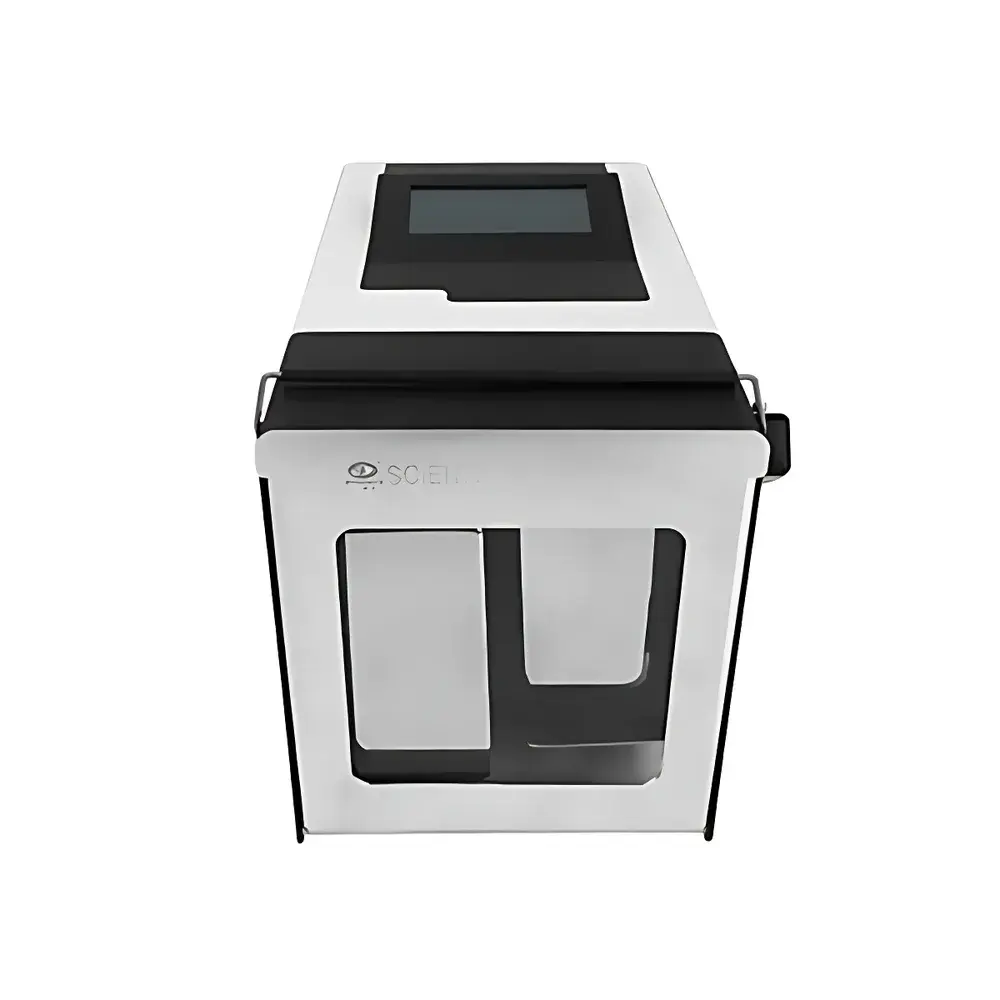
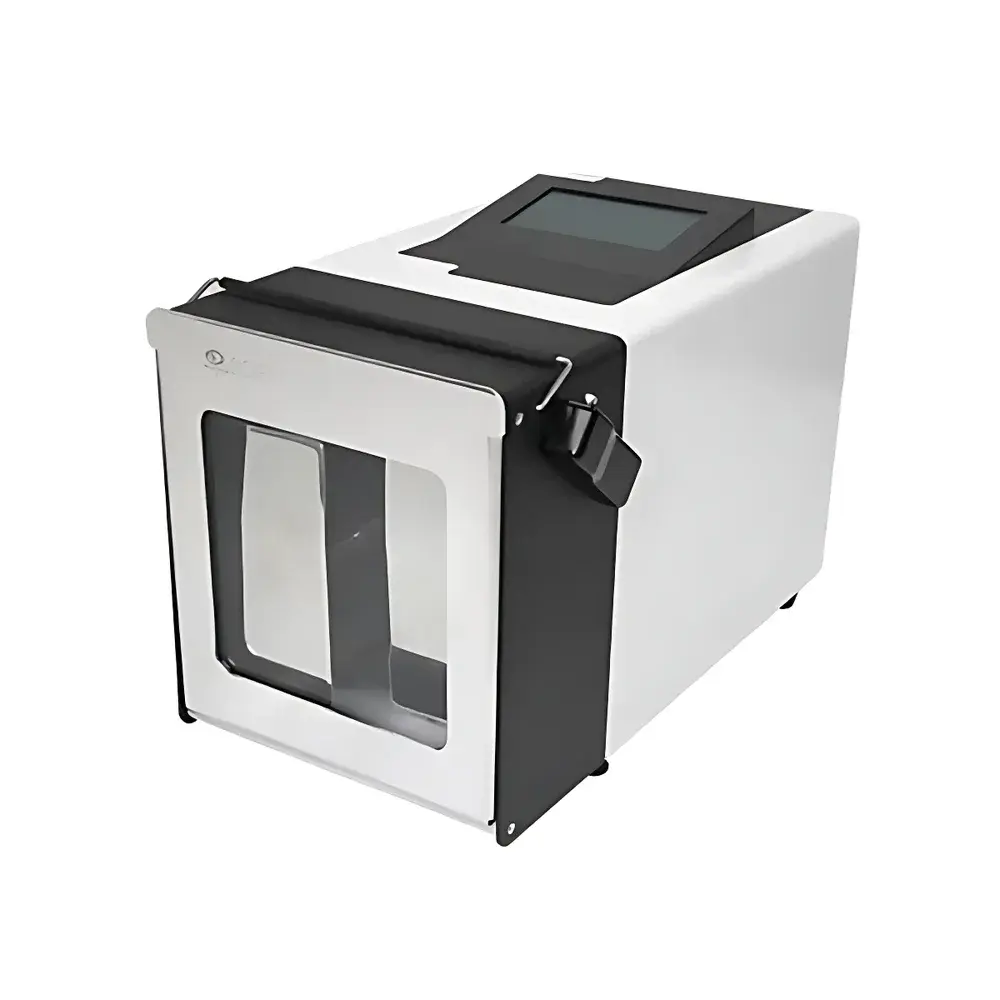
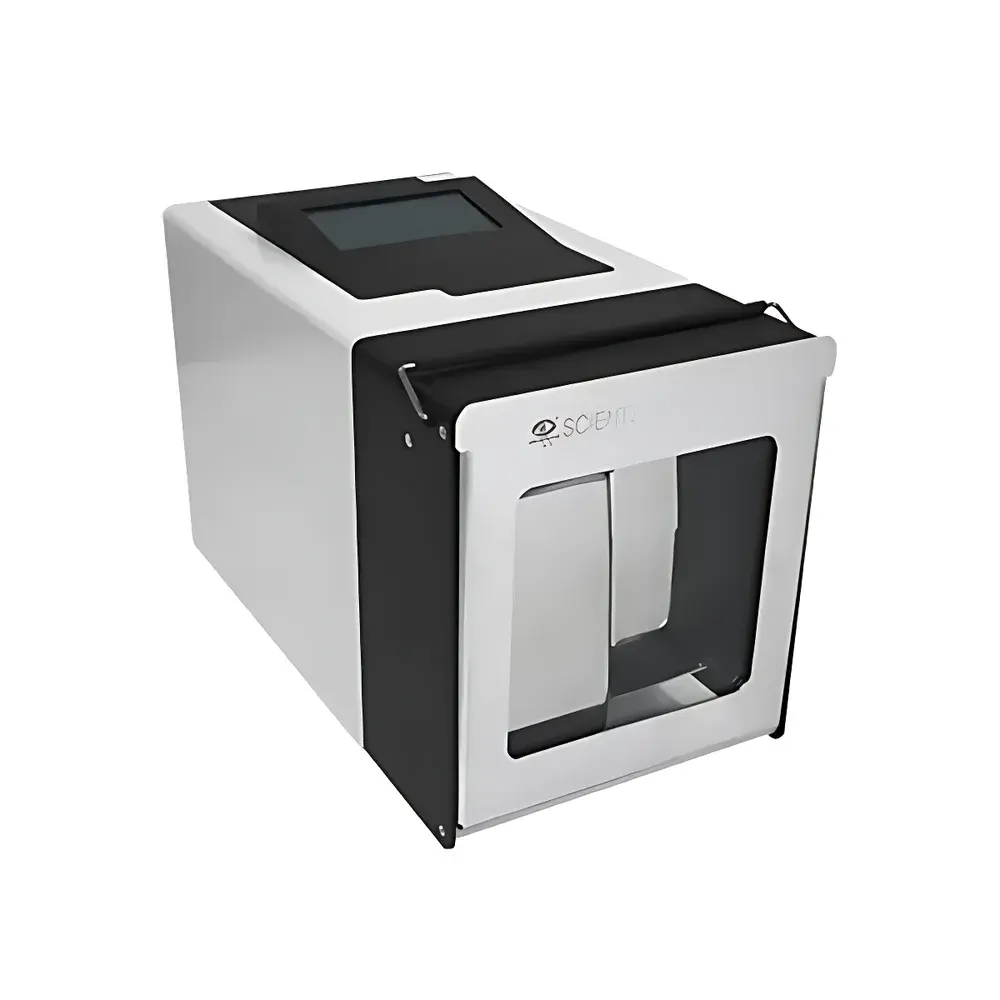
Ningbo Scientz SCIENTZ-02 Sterile Stomacher Homogenizer
| Brand | Ningbo Scientz |
|---|---|
| Origin | Zhejiang, China |
| Manufacturer Type | Direct Manufacturer |
| Instrument Type | Paddle-Beater (Stomacher-Style) Homogenizer |
| Dimensions (W×D×H) | 400 × 420 × 260 mm |
| Sample Volume Range | 3–400 mL |
Overview
The Ningbo Scientz SCIENTZ-02 Sterile Stomacher Homogenizer is a laboratory-grade paddle-beater homogenizer engineered for reproducible, contamination-free mechanical disruption of biological and food samples. It operates on the principle of controlled percussive shearing: two opposing stainless-steel paddles alternately strike a sealed sterile sample bag containing the specimen and diluent, generating transient pressure gradients and oscillatory shear forces that efficiently dissociate tissues, disperse particulates, and liberate microorganisms without thermal or enzymatic artifacts. Unlike rotor-stator or probe-type homogenizers, the SCIENTZ-02 ensures complete physical separation between the sample matrix and instrument hardware—eliminating carryover risk and enabling strict adherence to aseptic processing requirements in microbiological testing workflows. Designed for compliance with ISO 6887-1, ASTM D5600, and USP <61> microbial enumeration protocols, it serves as a critical front-end sample preparation tool in regulated environments including clinical diagnostics, food safety laboratories, and GLP-compliant QC facilities.
Key Features
- Optically transparent acrylic viewing window enables real-time visual monitoring of bag integrity, homogenization progress, and potential leakage—supporting immediate process verification without interrupting operation.
- Adjustable homogenization parameters: time (10 s–3 min per cycle) and stroke frequency (0–12 cycles) are independently programmable via intuitive membrane keypad, allowing optimization for fragile cells (e.g., primary tumor isolates) or resilient matrices (e.g., muscle tissue or dried spices).
- Integrated parameter memory stores up to 10 user-defined protocols—including dwell time, cycle count, and pause intervals—for rapid recall and inter-laboratory method standardization.
- Sealed chamber architecture with gasketed door and splash-resistant housing prevents aerosol escape and liquid ingress; combined with single-use sterile stomacher bags (ISO 11737-1 compliant), it guarantees zero cross-contamination between samples.
- Compact footprint (400 × 420 × 260 mm) and low acoustic emission (<65 dB(A)) enable safe deployment in biosafety cabinets, laminar flow hoods, or shared core facility spaces without spatial or noise constraints.
Sample Compatibility & Compliance
The SCIENTZ-02 accommodates a broad spectrum of sample types—including animal soft tissues (liver, spleen, kidney, brain), plant materials (leaf, root, fruit pulp), processed foods (ground meat, fish fillets, baked goods), and environmental swabs—within its 3–400 mL operational range. All contact surfaces are constructed from electropolished 316 stainless steel and medical-grade polymers compatible with common disinfectants (70% ethanol, 0.5% sodium hypochlorite). The system supports validation under FDA 21 CFR Part 11 when paired with audit-trail-enabled LIMS integration (via optional RS-232/USB interface), and meets ISO/IEC 17025 documentation requirements for accredited microbiology labs conducting pathogen isolation, total viable count (TVC), or selective enrichment assays.
Software & Data Management
While the SCIENTZ-02 operates as a standalone benchtop unit with embedded firmware, its parameter logs (date/time stamp, cycle count, duration) are exportable via USB flash drive in CSV format for traceability and audit readiness. Optional firmware upgrade enables timestamped protocol execution logging and password-protected administrator access—facilitating alignment with GMP Annex 11 and EU GMP Chapter 4 data integrity expectations. No proprietary software installation is required; exported files integrate natively with Excel-based QA reporting templates or enterprise ELN platforms.
Applications
- Microbial recovery from food and feed matrices per ISO 6887-1 and AOAC Official Method 990.12 for Salmonella, Listeria, and E. coli detection.
- Single-cell suspension generation from solid tumor biopsies for flow cytometry, cell sorting, or RNA-seq library prep—preserving membrane integrity and surface antigen expression.
- Routine homogenization of veterinary diagnostic specimens (fecal, nasal swab, tissue homogenates) in national reference laboratories adhering to OIE diagnostic guidelines.
- Preparation of uniform suspensions for endotoxin testing (USP <85>) and sterility assurance validation (USP <71>).
- Standardized dispersion of cosmetic emulsions and topical formulations for particle size distribution analysis prior to laser diffraction measurement.
FAQ
What types of sterile sample bags are compatible with the SCIENTZ-02?
The instrument accepts standard ISO 11737-1 compliant stomacher bags (typically 100 × 150 mm or 120 × 180 mm dimensions) made from multilayer polyethylene/polyamide film with heat-sealed seams and integrated filter vents. Bags must be certified non-pyrogenic and DNase/RNase-free for molecular applications.
Can the SCIENTZ-02 be used for mycobacterial or spore-containing samples?
Yes—its high-energy percussive action achieves effective lysis of acid-fast bacilli and bacterial endospores when combined with appropriate pre-treatment (e.g., bead beating adjunct or lysozyme digestion), though extended cycle times (>2 min) may be required per ISO 11737-2 recommendations.
Is calibration required, and how often should it be performed?
No routine calibration is mandated; however, users should conduct periodic performance verification using standardized test samples (e.g., calibrated latex bead suspensions or defined tissue homogenates) every 6 months or after major maintenance—documented per internal SOPs aligned with ISO/IEC 17025 Clause 6.5.
Does the device support regulatory audit trails for GLP/GMP environments?
When configured with the optional data logging module and timestamped USB export, the SCIENTZ-02 satisfies ALCOA+ principles (Attributable, Legible, Contemporaneous, Original, Accurate) for raw data capture, supporting inspection readiness under FDA, EMA, and NMPA regulatory frameworks.



