
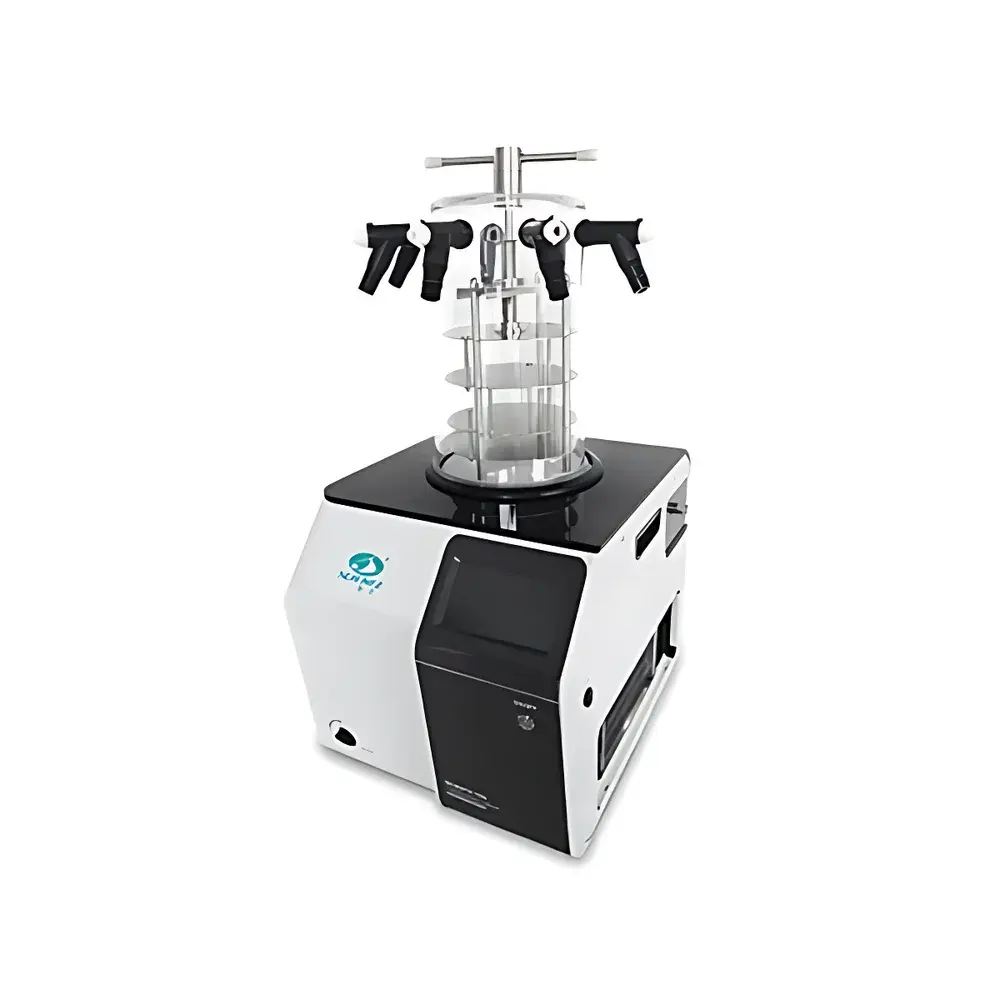
Ningbo Scientz SCIENTZ-10ND/D Benchtop Manifold Freeze Dryer with Heated Shelf and Vacuum Control
| Brand | Scientz |
|---|---|
| Origin | Zhejiang, China |
| Manufacturer Type | Direct Manufacturer |
| Instrument Type | Manifold Freeze Dryer with Top-Loading Bell Jar and Electrically Heated Shelf |
| Freeze-Drying Area | 0.12 m² |
| Ultimate Vacuum (Empty Chamber) | ≤5 Pa |
| Condensate Capacity | 3 kg/24 h |
| Cold Trap Temperature (Empty) | ≤−56 °C |
| Dimensions (L×W×H) | 590 × 460 × 400 mm + 440 mm (Bell Jar Height) |
| Compressor | Imported High-Efficiency Refrigeration Compressor |
| Heating System | 36 V Silicone Rubber Heated Shelf with PID Temperature Control |
| Display | 7-inch True-Color Touchscreen Interface |
| Compliance | Designed for GLP-compliant lab environments |
Overview
The Ningbo Scientz SCIENTZ-10ND/D is a benchtop manifold freeze dryer engineered for precision lyophilization in academic, governmental, and early-stage biopharmaceutical laboratories. It operates on the principle of sublimation under deep vacuum—where frozen aqueous samples transition directly from solid to vapor phase without passing through liquid state—preserving structural integrity, biological activity, and chemical stability of thermolabile compounds. The system integrates a high-efficiency imported refrigeration compressor, a heated shelf with precise PID-controlled temperature ramping (0–60 °C), and an optically transparent polycarbonate bell jar chamber. Its compact footprint (590 × 460 × 840 mm total height) and modular manifold configuration support parallel processing of up to eight standard 24/29 mm or 35/40 mm neck vials—ideal for process development, small-batch formulation screening, and sample preservation across life sciences and materials research.
Key Features
- Heated shelf with 36 V low-voltage silicone rubber heating elements ensures electrical safety and uniform thermal distribution across the 0.12 m² drying surface.
- PID-based intelligent heating algorithm eliminates temperature overshoot and enables reproducible, stepwise ramp profiles—critical for optimizing primary and secondary drying phases.
- Cold trap rated at ≤−56 °C (empty); optional −80 °C dual-stage cascade refrigeration system available for low-eutectic-point formulations.
- 7-inch true-color touchscreen interface with industrial-grade embedded OS provides real-time visualization of cold trap temperature, chamber pressure, shelf temperature, and elapsed time.
- Automated vacuum control logic delays pump activation until cold trap reaches setpoint—extending oil pump service life and minimizing contamination risk.
- Integrated data logging stores complete freeze-drying cycles (including timestamps, setpoints, and actual values); exportable via USB to PC for post-process analysis and regulatory documentation.
- Polycarbonate bell jar chamber offers full visual access, chemical resistance, and mechanical robustness—no adhesives or seams compromising vacuum integrity.
- Optional features include vacuum oil mist filter, auto pressure-differential valve (prevents backstreaming), eutectic point detection module, and electric defrost function.
Sample Compatibility & Compliance
The SCIENTZ-10ND/D accommodates diverse sample formats: bulk-loaded trays (for tissue, gels, or slurries), stoppered vials on manifold arms (for microbiological cultures, proteins, vaccines, or nucleic acids), and custom containers sealed with O-ring flanges. It meets functional requirements for ISO 22000, USP , and ASTM F2337-04 (Standard Practice for Lyophilization Process Development). When paired with validated protocols and optional 21 CFR Part 11-compliant software, the system supports GMP-aligned documentation workflows—including electronic signatures, user access levels, and immutable audit trails—suitable for QC labs in pharmaceutical R&D and contract manufacturing organizations.
Software & Data Management
Data acquisition is handled by an onboard Linux-based controller with ≥16 GB internal flash storage. Each cycle automatically records >10 parameters at 1-second intervals, including vacuum pressure (via Pirani sensor), cold trap temperature (PT100), shelf setpoint vs. actual, and elapsed time. Exported .csv files are compatible with MATLAB, Python pandas, and commercial statistical process control (SPC) platforms. Optional Scientz LyoView™ desktop software enables curve overlay comparison, deviation alert thresholds, and PDF report generation with embedded metadata (operator ID, batch number, timestamp). All stored data conforms to ALCOA+ principles (Attributable, Legible, Contemporaneous, Original, Accurate, Complete, Consistent, Enduring, Available).
Applications
This instrument serves as a scalable platform for method development prior to pilot-scale freeze drying. Typical use cases include: lyophilization of monoclonal antibodies and recombinant enzymes for stability assessment; preparation of sterile vaccine powders and oral disintegrating tablets; dehydration of plant extracts and herbal active ingredients while retaining phytochemical profiles; long-term preservation of bacterial/fungal strains and viral vectors; stabilization of nanocarriers and liposomal formulations; and pretreatment of environmental matrices (soil, sludge, sediment) for trace metal or organic contaminant analysis. Its versatility extends to polymer science (e.g., templated porous hydrogels) and food science (nutraceutical encapsulation, probiotic powder formulation).
FAQ
What is the maximum batch capacity for vial-based drying?
Up to eight standard 24/29 mm or 35/40 mm neck vials can be processed simultaneously using the included manifold arms.
Can the shelf temperature be programmed independently of vacuum level?
Yes—the heating profile is fully decoupled from vacuum control, allowing independent optimization of heat input during primary and secondary drying stages.
Is the system compatible with inert gas backfilling?
Yes—a built-in solenoid-controlled inert gas inlet valve supports nitrogen or argon purging post-drying to prevent oxidation of sensitive APIs.
Does the unit meet electromagnetic compatibility (EMC) standards for laboratory deployment?
It complies with IEC 61326-1:2013 for measurement and control equipment used in laboratory environments.
What maintenance intervals are recommended for the refrigeration system?
Compressor oil inspection every 12 months; cold trap cleaning after every 50 operating hours or when frost accumulation exceeds 5 mm depth.



