
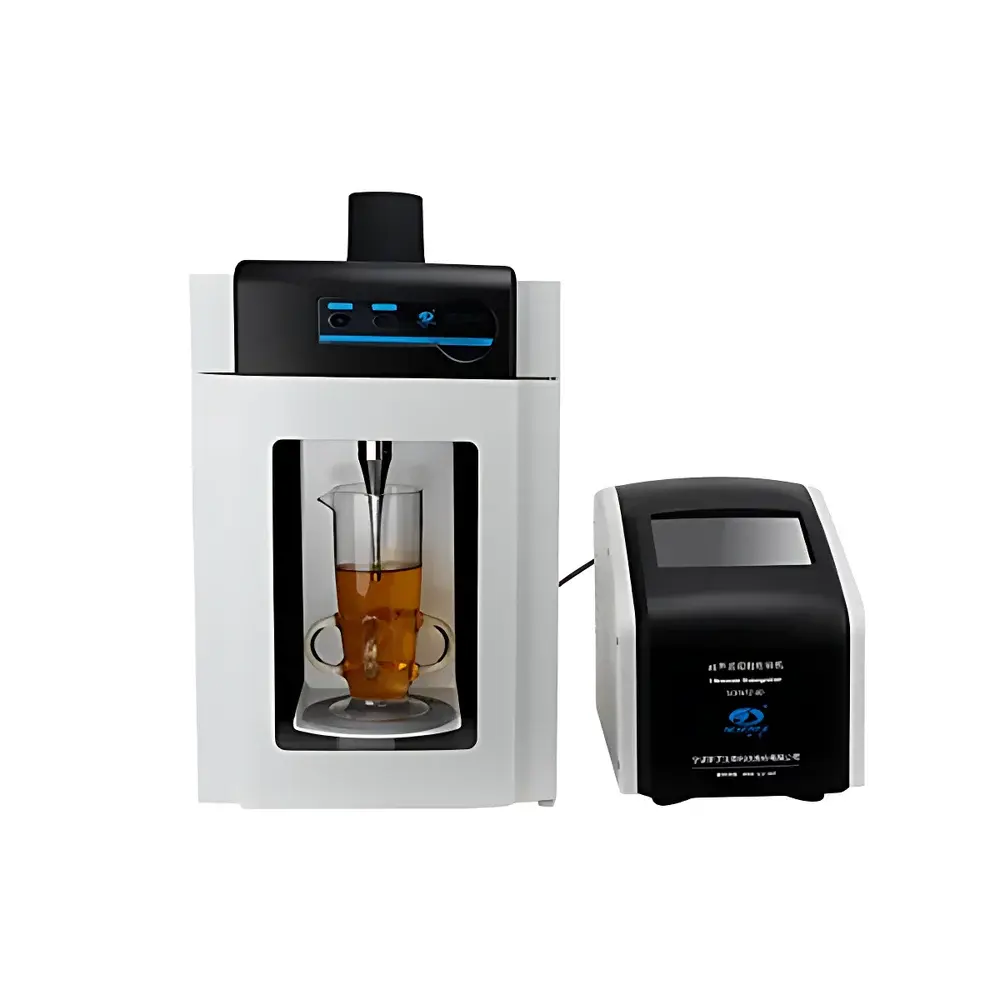
Ningbo Scientz JY88-PRO Ultrasonic Cell Disruptor
| Brand | Ningbo Scientz |
|---|---|
| Origin | Zhejiang, China |
| Manufacturer Type | Direct Manufacturer |
| Instrument Type | Ultrasonic Cell Disruptor |
| Model | JY88-PRO |
| Temperature Range | 0–99.9 °C |
| Operating Frequency | 20–25 kHz |
| Ultrasonic Power Output | 4.5–450 W |
| Sample Volume Capacity | 10–200 mL |
| Sample Throughput | Single-sample mode |
| Compliance | Designed for GLP-compliant lab environments |
Overview
The Ningbo Scientz JY88-PRO Ultrasonic Cell Disruptor is an engineered benchtop system designed for controlled mechanical lysis of biological cells and subcellular structures via high-intensity ultrasonic cavitation. It operates on the physical principle of acoustic cavitation—where rapid pressure oscillations generated by a piezoelectric transducer (20–25 kHz) induce transient microbubble formation, growth, and violent collapse in liquid media. This collapse produces localized shockwaves, extreme shear forces (>10⁶ Pa), and microstreaming effects sufficient to disrupt membranes of mammalian cells, bacterial walls, yeast, spores, and viral capsids without significant thermal denaturation when operated with temperature control. The instrument integrates a TC4 titanium alloy probe assembly for enhanced acoustic transmission efficiency and corrosion resistance, supporting reproducible energy delivery across repeated cycles. Its architecture adheres to fundamental design requirements for regulated life science workflows—including thermal management (0–99.9 °C Peltier-assisted cooling/heating), real-time power monitoring, and fail-safe operational limits.
Key Features
- Precisely adjustable ultrasonic power output (4.5–450 W) with digital feedback control ensures consistent energy delivery across variable sample viscosities and densities.
- Programmable time settings (0.1–999 s) and dual-mode operation—continuous or pulsed (duty cycle adjustable from 0.1% to 99.9%)—minimize thermal accumulation during sensitive applications such as chromatin shearing or RNA preservation.
- Integrated temperature monitoring with active cooling/heating maintains sample integrity; the system halts automatically upon exceeding user-defined thermal thresholds (e.g., >4°C for nucleic acid work).
- Overload protection, overtemperature cutoff, and elapsed-time alarm functions comply with IEC 61010-1 safety standards for laboratory electrical equipment.
- Modular probe configuration supports standardized 3–25 mm tip diameters (optional accessories), enabling scalable processing from micro-volume lysates (10 mL) to preparative-scale homogenization (200 mL).
Sample Compatibility & Compliance
The JY88-PRO accommodates aqueous and low-viscosity organic-aqueous suspensions typical in molecular biology, biopharmaceutical development, and nanomaterial dispersion. Validated use cases include lysis of E. coli, S. cerevisiae, cultured mammalian cell lines (HEK293, CHO), plant leaf tissue, and soft animal tissues. It meets essential functional requirements for ISO/IEC 17025-accredited laboratories performing method validation per USP , ASTM E2872 (ultrasonic cleaning verification), and CLSI EP17-A2 (limit of detection studies). While not certified for GMP manufacturing, its audit-ready parameter logging (via optional RS232/USB interface) supports 21 CFR Part 11–aligned data integrity practices when paired with validated third-party LIMS integration.
Software & Data Management
The instrument features embedded firmware with non-volatile memory for storing up to 20 user-defined protocols—including amplitude, duration, pulse ratio, and target temperature. Real-time operational parameters (instantaneous power, cumulative energy, probe temperature) are displayed on a high-contrast LCD interface. Optional PC connectivity enables export of timestamped CSV logs for traceability. When deployed in regulated environments, these logs may be archived alongside electronic lab notebook (ELN) entries to fulfill ALCOA+ principles (Attributable, Legible, Contemporaneous, Original, Accurate). No proprietary cloud platform is required; raw data files remain under institutional IT governance.
Applications
- Molecular Biology: Chromatin fragmentation for ChIP-seq, nuclear extraction, plasmid isolation, and ribonucleoprotein complex solubilization.
- Biopharmaceutical Processing: Disruption of inclusion bodies, solubilization of recombinant proteins, and preparation of antigenic lysates for vaccine development.
- Nanomaterial Engineering: Exfoliation of graphene oxide, deagglomeration of metal oxide nanoparticles (e.g., TiO₂, Fe₃O₄), and stabilization of carbon nanotube dispersions.
- Food & Environmental Analysis: Homogenization of soil/sediment matrices for heavy metal extraction, cell lysis in probiotic viability assays, and enzymatic activity enhancement in bioconversion studies.
- Botanical Research: Efficient release of secondary metabolites (e.g., alkaloids, flavonoids) from plant biomass under non-thermal conditions.
FAQ
What is the maximum recommended continuous operating time per cycle?
For thermal stability and probe longevity, continuous operation beyond 5 minutes is discouraged without active cooling. Pulse mode (e.g., 5 s on / 5 s off) is recommended for extended protocols.
Can the JY88-PRO be used for cryogenic sonication?
No—it lacks integrated cryo-cooling capability. Samples requiring sub-zero temperatures must be pre-chilled and processed in insulated vessels with external recirculating chillers.
Is probe sterilization supported?
Titanium probes are autoclavable at 121 °C for 20 minutes; however, repeated autoclaving may affect piezoelectric coupling efficiency over time. Ethanol wiping and UV exposure are preferred for routine decontamination.
Does this instrument meet FDA requirements for clinical assay development?
It supports method development under FDA guidance documents (e.g., ICH Q5A, Q5D) but requires site-specific IQ/OQ/PQ validation prior to use in diagnostic or therapeutic product release testing.
How does power calibration align with ISO 13320 standards for particle size analysis?
While not a particle sizer itself, the JY88-PRO’s stable amplitude control enables reproducible nano-dispersion generation—critical for downstream laser diffraction or DLS measurements compliant with ISO 13320 and ISO 22412.
Related Products




