
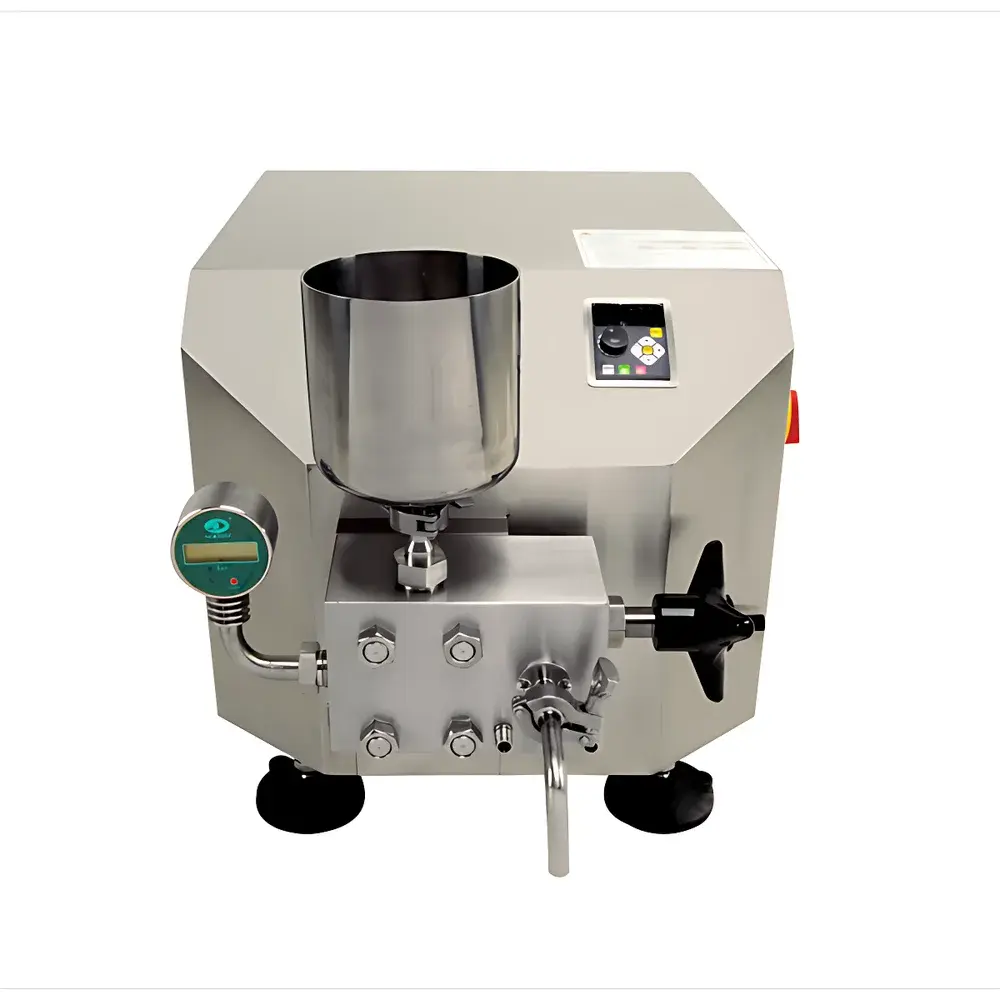
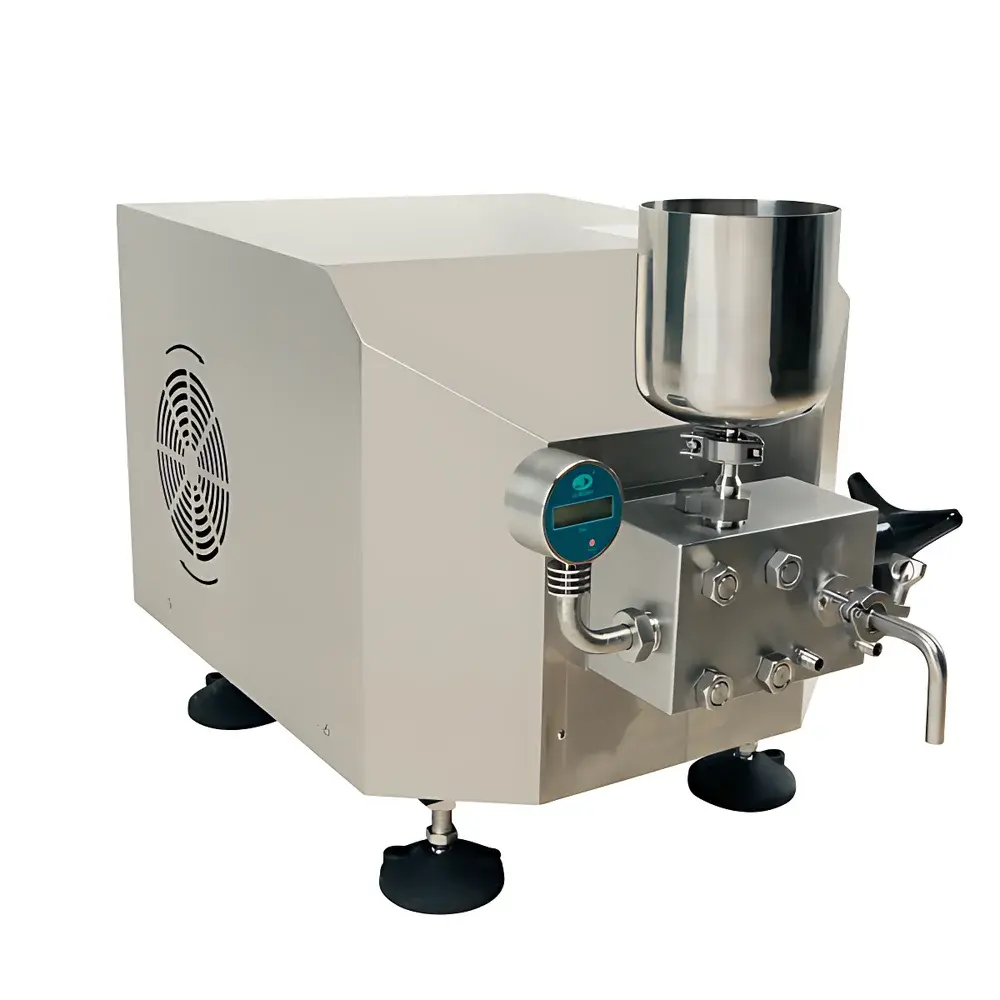
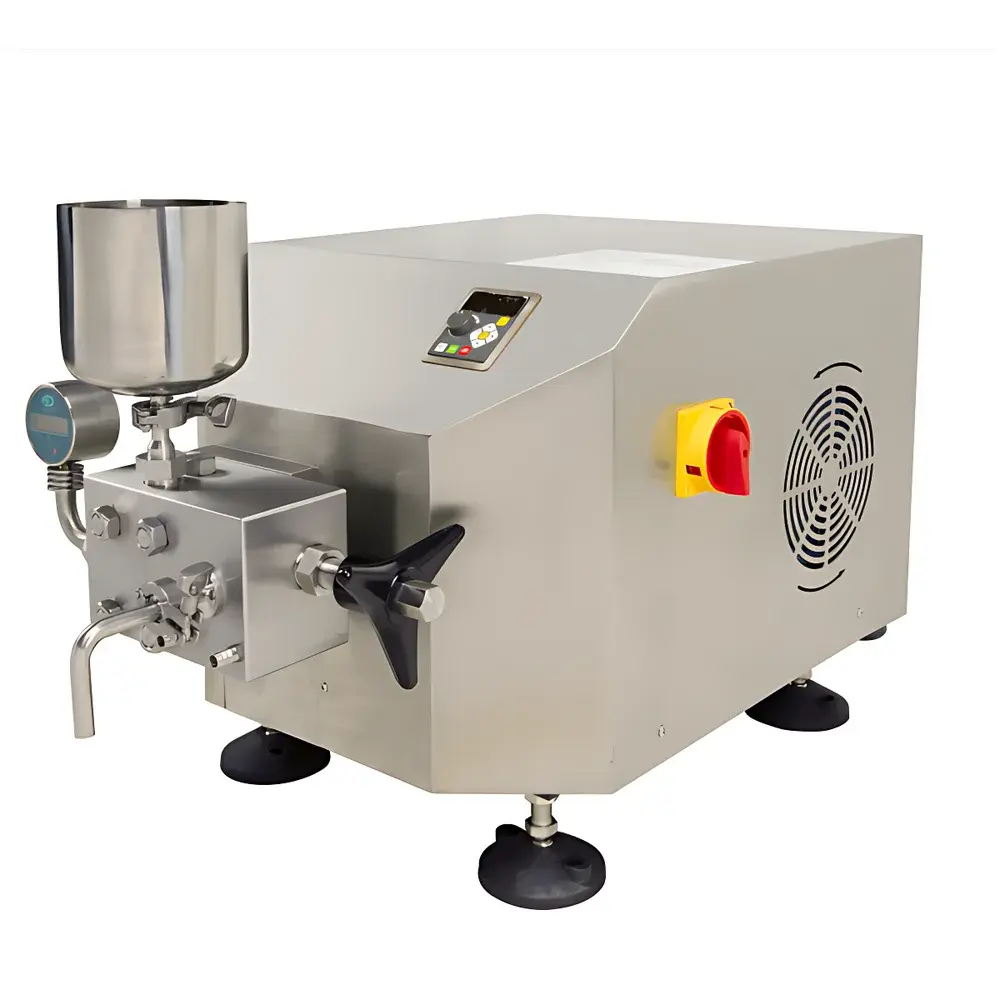
Ningbo Scientz SCIENTZ-150 Benchtop High-Pressure Homogenizer
| Brand | Ningbo Scientz |
|---|---|
| Origin | Zhejiang, China |
| Manufacturer Type | Original Equipment Manufacturer (OEM) |
| Product Category | Domestic |
| Model | SCIENTZ-150 |
| Instrument Type | High-Pressure Homogenizer |
| Dimensions (W×D×H) | 800 × 460 × 450 mm |
| Minimum Processing Volume | >30 mL |
| Operating Pressure Range | 0–150 bar |
| Temperature Control | Integrated + External Cooling Interface |
| Flow Rate | Variable via Frequency-Controlled Pump |
| Valve Options | Impact Valve (R), Spherical Valve (PS), Diamond Valve, Stellite Valve |
| Construction Material | ASTM A240 Grade 316L Stainless Steel |
| Particle Size Reduction | Down to <100 nm (typical under optimized conditions) |
| Cell Disruption Efficiency | >95% (validated for E. coli, S. cerevisiae, and Chlorella vulgaris) |
Overview
The Ningbo Scientz SCIENTZ-150 Benchtop High-Pressure Homogenizer is an engineered solution for controlled mechanical disruption and nano-scale dispersion in research and pilot-scale development environments. It operates on the principle of high-pressure fluid dynamics: sample suspension is pressurized by a precision reciprocating plunger pump and forced through a narrow, geometrically defined homogenization valve or impact chamber. Upon rapid pressure release, the liquid stream undergoes simultaneous cavitation, turbulent shear, and inter-particle collision—mechanisms proven effective for cell lysis, emulsification, nanoparticle deagglomeration, and submicron dispersion. Designed as a compact, benchtop system, the SCIENTZ-150 delivers reproducible results across diverse matrices—including viscous biological lysates, thermolabile protein solutions, and high-solids food emulsions—while maintaining strict thermal management through dual-stage cooling.
Key Features
- Adjustable operating pressure from 0 to 150 bar, enabling method optimization for fragile vs. robust samples
- Integrated water-cooled heat exchanger combined with external chiller interface (standard 6–12 °C inlet/outlet ports) to maintain outlet temperature below 10 °C during continuous operation
- Frequency-controlled peristaltic or piston-driven flow regulation (±1% repeatability), supporting consistent residence time and shear history control
- Valve interchangeability: impact-type (R) for high-efficiency microbial cell disruption; spherical (PS) for stable oil-in-water emulsion formation; optional diamond or stellite valves for extended service life with abrasive suspensions
- Full 316L stainless steel wetted path compliant with FDA 21 CFR Part 117 (food contact surfaces) and USP (non-sterile pharmaceutical compounding)
- Onboard air purge system for automatic degassing prior to processing—eliminating entrained bubbles that compromise homogenization uniformity and downstream filtration
Sample Compatibility & Compliance
The SCIENTZ-150 accommodates aqueous, organic, and mixed-phase systems with viscosities up to 5,000 cP and solid loadings ≤25 wt%. Validated applications include Gram-negative (E. coli), Gram-positive (Bacillus subtilis), yeast (S. cerevisiae), microalgal (Chlorella, Spirulina), and plant tissue extracts (soy, peanut, sweet potato proteins). In food science, it meets ISO 22000-aligned hygiene requirements for dairy (milk standardization, cream homogenization), beverage (juice cloud stabilization), and functional ingredient (vitamin E nanoemulsions) production. All fluid-contact components conform to ASME BPE-2022 surface finish standards (Ra ≤ 0.4 µm), and documentation supports GLP-compliant audit trails when integrated with validated LIMS or ELN platforms.
Software & Data Management
While the base SCIENTZ-150 operates via tactile HMI with real-time pressure, temperature, and flow display, optional RS-485/Modbus RTU or Ethernet/IP interfaces enable integration into centralized process control systems. Data logging (pressure, coolant temp, runtime, valve type) is timestamped and exportable in CSV format. When paired with Scientz’s optional Homogenizer Control Suite (v3.2+), users gain automated method recall, multi-step pressure ramping, and deviation alerts aligned with ISO/IEC 17025 calibration traceability requirements. Audit trail functionality complies with FDA 21 CFR Part 11 for electronic records in regulated environments.
Applications
- Biopharmaceutical R&D: Intracellular protein extraction, liposome formulation, viral vector purification support
- Food & Beverage Innovation: Cold-processed nut milk stabilization, enzymatically active probiotic beverages, clean-label emulsifiers
- Materials Science: Carbon black dispersion for conductive inks, pigment milling for ceramic glazes, nanocellulose fibrillation
- Agricultural Biotechnology: Plant-derived vaccine antigen delivery systems, phytochemical nanoencapsulation
- Academic Research: Standardized benchmarking for comparative lysis efficiency (vs. sonication, bead-beating)
FAQ
What is the minimum recommended sample volume for reliable pressure build-up and valve engagement?
A minimum of 30 mL is required to ensure full priming of the high-pressure circuit and avoid dry-running damage to the plunger seals.
Can the SCIENTZ-150 be used for sterile processing?
The unit itself is not autoclavable, but all wetted parts are compatible with SIP (steam-in-place) at ≤121 °C for 30 min when installed in a GMP-compliant skid; validation must be performed per ISO 13408-2.
Is third-party calibration available for pressure and temperature sensors?
Yes—NIST-traceable calibration certificates (ISO/IEC 17025 accredited) are offered annually by Scientz’s certified metrology lab or authorized partners in EU/US regions.
How does valve selection affect particle size distribution (PSD) reproducibility?
Impact valves yield narrower PSDs for biological lysis due to deterministic collision geometry; spherical valves provide broader but more stable droplet size distributions in emulsions—validated per ISO 13320 laser diffraction protocols.
Does the system meet CE marking requirements for laboratory equipment?
Yes—the SCIENTZ-150 complies with EU Machinery Directive 2006/42/EC, EMC Directive 2014/30/EU, and Low Voltage Directive 2014/35/EU, with full technical file available upon request.
Related Products



