
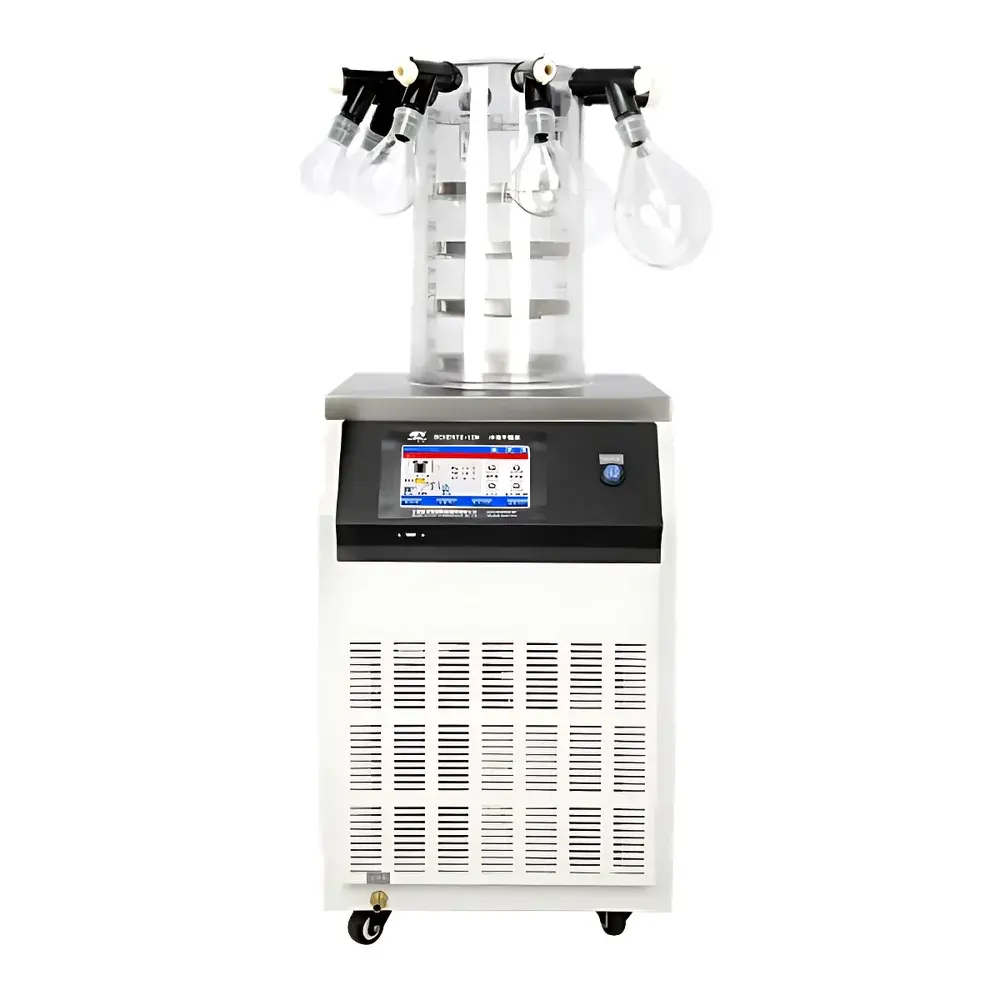
Ningbo Scientz SCIENTZ-12N/C Benchtop Manifold Freeze Dryer
| Brand | Ningbo Scientz |
|---|---|
| Origin | Zhejiang, China |
| Manufacturer Type | Direct Manufacturer |
| Product Category | Domestic |
| Model | SCIENTZ-12N/C |
| Instrument Type | Manifold (Stopcock) Configuration |
| Application Scope | Laboratory-Scale Lyophilization |
| Lyophilization Area | 0.12 m² |
| Ultimate Vacuum (No Load) | ≤5 Pa |
| Condensate Capacity (24 h) | 4 kg/24 h |
| Cold Trap Temperature (No Load) | ≤−56 °C |
| Dimensions (L×W×H) | 600 × 450 × 720 mm (main unit) + 440 mm (manifold height) |
Overview
The Ningbo Scientz SCIENTZ-12N/C is a benchtop manifold-style freeze dryer engineered for precision lyophilization of small-to-medium batch samples in academic, governmental, and industrial R&D laboratories. It operates on the fundamental principle of sublimation under deep vacuum: frozen aqueous or solvent-based samples are dried without passing through the liquid phase, preserving thermolabile structures—including proteins, enzymes, nucleic acids, live microorganisms, and nanomaterials—by maintaining structural integrity within the ice matrix. This process minimizes denaturation, aggregation, and chemical degradation, making it indispensable for biopharmaceutical formulation development, biomaterial stabilization, food science research, environmental sample preparation, and analytical chemistry workflows. The system integrates a high-efficiency single-stage or optionally dual-stage cascade refrigeration architecture, enabling stable cold trap operation at ≤−56 °C (standard) or −80 °C (with optional compressor upgrade), ensuring robust water vapor capture during primary drying across diverse sample matrices.
Key Features
- Compact footprint (600 × 450 × 720 mm main unit + 440 mm manifold height) optimized for space-constrained laboratory environments
- Imported high-reliability hermetic compressor with intelligent thermal management for rapid cooldown and sustained low-temperature stability
- 7-inch full-color TFT touchscreen interface with industrial-grade embedded OS, supporting real-time monitoring of cold trap temperature, chamber pressure, and manifold valve status
- Automated data logging: all critical parameters timestamped and stored internally; exportable via USB to PC for GLP-compliant documentation and traceability
- Optically transparent, one-piece polycarbonate drying chamber—chemically resistant, impact-tough, and fully sealable—enabling direct visual observation of sublimation progress and ice morphology
- Manifold configuration with eight standard 24/29 ground-glass stopcocks compatible with internationally standardized lyophilization flasks (e.g., 100–500 mL round-bottom, side-arm, or serum vials)
- Vacuum control logic: pump activation delayed until cold trap reaches user-defined setpoint (e.g., −45 °C), extending vacuum pump service life and reducing oil backstreaming risk
- Optional accessories include vacuum oil mist filter, automatic pressure-equalizing valve, electrothermal defrost system, and eutectic point measurement module for empirical drying cycle optimization
Sample Compatibility & Compliance
The SCIENTZ-12N/C accommodates a broad spectrum of sample types requiring gentle dehydration: microbial cultures (bacteria, yeast, viruses), mammalian cell pellets, tissue homogenates, serum/plasma derivatives, monoclonal antibodies, mRNA-LNP formulations, botanical extracts, food matrices (fruits, meats, herbs), soil/sediment suspensions, and catalytic nanoparticles. Its design supports compliance with routine quality assurance practices aligned with ISO 22000 (food safety), ISO 13485 (medical device manufacturing), and FDA 21 CFR Part 11 (electronic records and signatures) when paired with validated SOPs and audit-trail-enabled software configurations. While not certified as GMP-grade equipment, its repeatable performance, calibrated vacuum sensing, and temperature-stable cold trap make it suitable for pre-GMP feasibility studies, formulation screening, and reference material preparation under GLP conditions.
Software & Data Management
The embedded control system records time-stamped datasets at configurable intervals (1–60 s), capturing cold trap temperature, system vacuum level (via Pirani gauge), and manifold valve open/closed states. All freeze-drying profiles—including ramp rates, hold durations, and pressure modulation sequences—are programmable and storable in up to 100 user-defined protocols. Data exports in CSV format support post-processing in MATLAB, Python (Pandas), or commercial statistical packages. Optional PC-based supervisory software enables remote monitoring, multi-instrument fleet management, and integration into LIMS environments via TCP/IP. Audit trail functionality—including operator login, parameter modification history, and session start/stop timestamps—is available upon firmware activation per institutional validation requirements.
Applications
- Academic research: lyophilization of bacterial strains for long-term storage, viral vector preservation, protein crystallography sample prep, and cryo-EM grid preparation
- Pharmaceutical R&D: formulation screening of lyophilized injectables (e.g., vaccines, interferons, monoclonal antibodies), excipient compatibility testing, and stability-indicating method development
- Food science: nutrient retention analysis, shelf-life modeling of functional ingredients, and development of instant reconstitution powders
- Environmental analytics: moisture removal from soil, sludge, and airborne particulate filters prior to ICP-MS, GC-MS, or elemental analysis
- Materials science: synthesis and drying of MOFs, aerogels, and colloidal nanocrystals where solvent evaporation would induce irreversible agglomeration
- Diagnostic assay development: stabilization of enzyme conjugates, antigen-coated beads, and lateral flow test components
FAQ
What is the maximum batch capacity for this manifold freeze dryer?
The SCIENTZ-12N/C supports up to eight standard lyophilization flasks simultaneously, with total condensate capacity rated at 4 kg per 24-hour cycle under no-load conditions. Actual throughput depends on sample composition, initial moisture content, and drying protocol.
Is the cold trap temperature verified and traceable to national standards?
The integrated PT100 sensor is factory-calibrated; users may perform field verification using NIST-traceable dry-well calibrators. Documentation of calibration procedures is required for GLP/GMP alignment.
Can the system be integrated into an automated lab workflow?
Yes—RS-485 and Ethernet interfaces support Modbus TCP communication for integration with PLC-controlled environments or central laboratory automation platforms.
Does the instrument meet electromagnetic compatibility (EMC) requirements for EU laboratories?
It complies with EN 61326-1:2013 for laboratory equipment and carries CE marking for EMC and low-voltage directive conformity.
What maintenance intervals are recommended for the vacuum pump and refrigeration system?
Vacuum pump oil should be changed every 500 operating hours or semiannually; cold trap cleaning and O-ring inspection are advised quarterly. Full refrigeration system service is recommended every 24 months by authorized technicians.



