
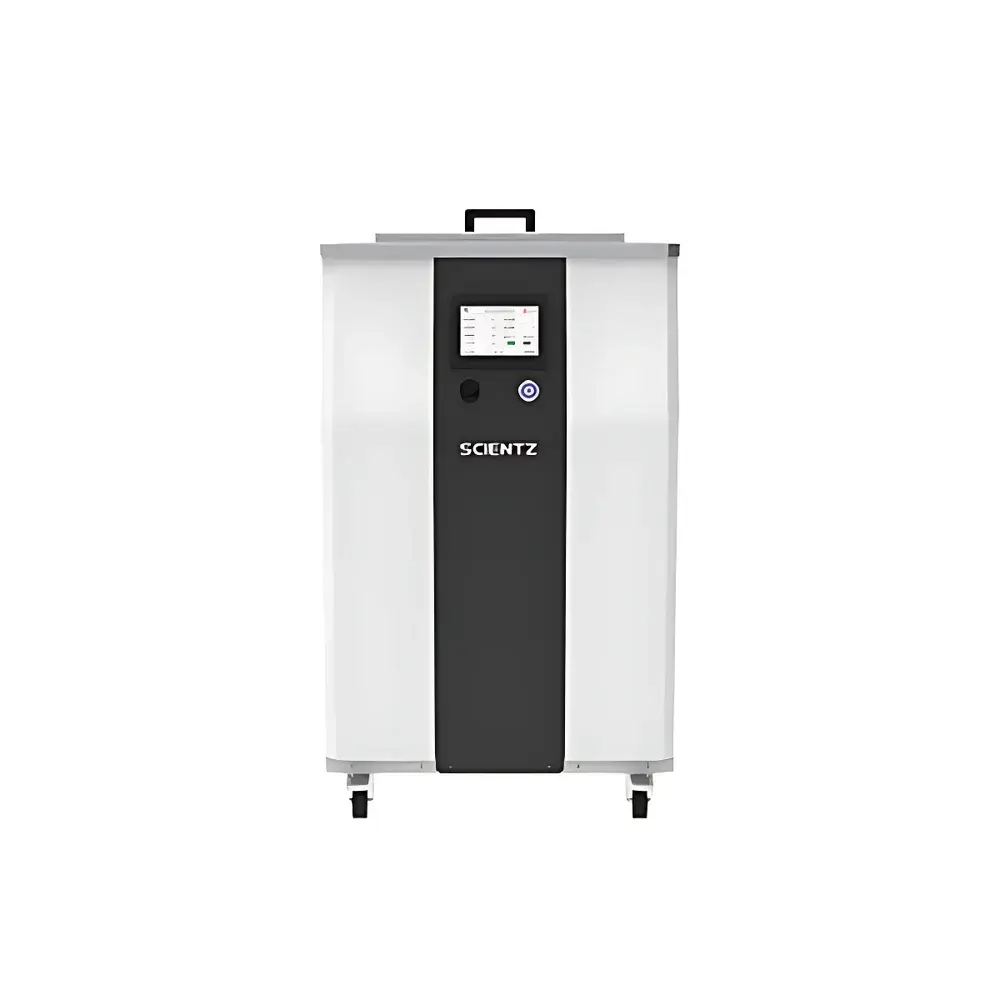
Ningbo Scientz SBL-72DT Benchtop Ultrasonic Cleaner with Heated Bath and Digital Touch Control
| Brand | Ningbo Scientz |
|---|---|
| Origin | Zhejiang, China |
| Manufacturer Type | OEM/ODM Manufacturer |
| Instrument Type | General-Purpose Ultrasonic Cleaner |
| Tank Capacity | 72 L |
| Ultrasonic Frequency | 40 kHz |
| Ultrasonic Power Output | 1200 W |
| Power Adjustment | Yes (1–99% continuous) |
| Temperature Control Range | 5–80 °C (with Peltier cooling & resistive heating) |
| Timer Range | 1–9999 min |
| Lid with Sound-Dampening Design | Yes |
| Drain/Fill Method | Manual |
Overview
The Ningbo Scientz SBL-72DT is a high-capacity, digitally controlled benchtop ultrasonic cleaner engineered for reproducible, non-destructive cleaning of laboratory and industrial components. It operates on the principle of acoustic cavitation: piezoelectric transducers convert high-frequency electrical energy (40 kHz) into mechanical vibrations transmitted through the stainless-steel tank wall into the cleaning medium—typically aqueous or solvent-based solutions. These vibrations generate transient microbubbles that grow and collapse violently (inertial cavitation), producing localized pressures exceeding 1000 atm and liquid jet velocities >400 m/s. This physical mechanism enables effective removal of particulate contaminants, organic residues (e.g., oils, greases, proteins), and biofilms from complex geometries—including blind holes, capillary channels, and microstructured surfaces—without mechanical abrasion or surface etching. The system integrates both resistive heating and thermoelectric (Peltier) cooling to maintain precise thermal control across the full operational range (5–80 °C), supporting applications requiring either accelerated dissolution kinetics or cold-sensitive sample integrity.
Key Features
- Digital touch interface with real-time display of elapsed time, set temperature, and actual bath temperature—enabling closed-loop thermal monitoring and validation-ready operation.
- Adjustable ultrasonic power output (1–99% in 1% increments), allowing optimization for delicate substrates (e.g., optical lenses, MEMS devices) or robust contamination loads (e.g., machined metal parts).
- Wide-temperature operating envelope (5–80 °C) achieved via dual-mode thermal management: Peltier-based active cooling ensures rapid cooldown after heated cycles; resistive heating provides stable, uniform bath temperature distribution (±1.5 °C at 60 °C).
- Sound-dampening hinged lid compliant with ISO 9241-307 ergonomic standards for noise reduction (<65 dB(A) at 1 m), minimizing ambient acoustic interference in shared lab environments.
- Non-volatile memory retains user-defined parameters (time, temperature, power) following power interruption—supporting GLP-compliant workflow continuity and audit traceability.
- 316L stainless-steel tank (72 L capacity) with reinforced corners and seamless welds, certified to ASTM A240 for corrosion resistance in aggressive cleaning chemistries including alkaline detergents and low-concentration acids.
Sample Compatibility & Compliance
The SBL-72DT accommodates a broad spectrum of sample types and materials: borosilicate glassware (vials, flasks, cuvettes), polymer-based consumables (centrifuge tubes, microplates), precision-engineered metallic components (surgical instruments, fuel injectors, watch gears), and optically sensitive elements (quartz cuvettes, microscope objectives). Its design adheres to IEC 61000-6-3 (EMC emissions), IEC 61010-1 (electrical safety for laboratory equipment), and ISO 13485-aligned manufacturing controls. While not classified as a medical device under FDA 21 CFR Part 820, its thermal and timing accuracy supports validation protocols required for ISO 17025-accredited labs performing cleaning efficacy verification per ASTM F3127 (standard guide for ultrasonic cleaning process validation).
Software & Data Management
The unit operates autonomously without external software dependency. All operational parameters are stored in embedded EEPROM with timestamped write cycles. For integration into regulated environments, optional RS-232 or USB-to-serial interfaces enable connection to LIMS or ELN systems for automated parameter logging and electronic record generation. Audit trails comply with ALCOA+ principles (Attributable, Legible, Contemporaneous, Original, Accurate) when paired with validated data acquisition software meeting FDA 21 CFR Part 11 requirements for electronic signatures and change control.
Applications
- Pre-analytical preparation: degassing HPLC mobile phases, cleaning GC vials and autosampler needles, removing residual solvents from reaction vessels.
- Biotechnology: decontamination of cell culture flasks and bioreactor components; dispersion of nanoparticle suspensions prior to DLS analysis.
- Materials science: removal of sintering aids from ceramic green bodies; cleaning of SEM/TEM sample stubs and electron-transparent foils.
- Quality control: validation of cleaning efficacy for reusable surgical instruments per AAMI ST79 and ISO 15883-1.
- Optics & photonics: residue-free cleaning of coated optical filters, laser cavity mirrors, and fiber optic connectors.
FAQ
Does the SBL-72DT support programmable multi-step cleaning sequences?
No—the instrument executes single-step protocols only. Complex sequences require external timer or PLC coordination.
Is the 40 kHz frequency fixed, or can it be changed?
The nominal operating frequency is fixed at 40 kHz. Dual-frequency or sweep-frequency variants (e.g., 40/80 kHz) are available under custom OEM configurations but not standard on the SBL-72DT model.
What is the maximum permissible liquid level for safe operation?
Fill level must remain between 30% and 90% of tank volume (21.6–64.8 L) to ensure optimal acoustic coupling and prevent transducer overheating.
Can this unit be used with flammable solvents?
Only with explosion-proof modifications and intrinsically safe controllers—standard SBL-72DT units are rated for aqueous and non-flammable solvent use per UL 61010-1 Class II.
How is temperature uniformity verified across the tank?
Scientz provides factory calibration certificates showing ±1.5 °C deviation measured at nine spatial points (per ASTM E220) using NIST-traceable Pt100 probes.



