
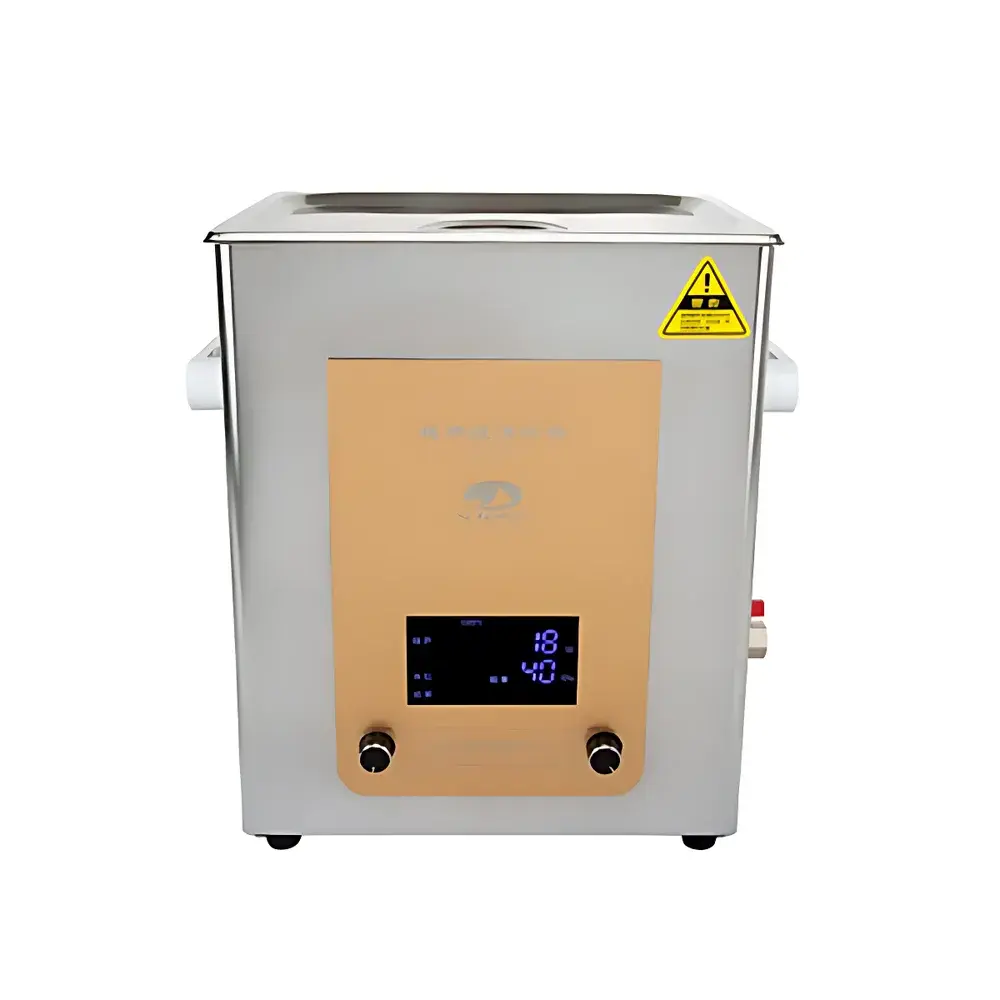
Ningbo Scientz SB-4200D Ultrasonic Cleaner
| Brand | Ningbo Scientz |
|---|---|
| Origin | Zhejiang, China |
| Manufacturer Type | Direct Manufacturer |
| Product Category | Domestic |
| Model | SB-4200D |
| Instrument Type | General-Purpose Ultrasonic Cleaner |
| Tank Capacity | 14.4 L |
| Ultrasonic Frequency | 40 kHz |
| Ultrasonic Power Output | 400 W |
| Power Adjustment | Fixed |
| Temperature Control | Not Available |
| Timer Range | 1–600 min |
| Sound-Dampening Lid | Included |
| Drain & Fill Fitting | Equipped |
Overview
The Ningbo Scientz SB-4200D Ultrasonic Cleaner is a robust, general-purpose laboratory cleaning system engineered for high-reproducibility removal of particulate contaminants, organic residues, and adsorbed films from complex-surface components. It operates on the principle of acoustic cavitation: high-frequency (40 kHz) ultrasonic energy—generated by piezoelectric transducers bonded to the tank bottom—is transmitted uniformly through an aqueous or solvent-based cleaning medium. This induces transient microcavities that grow and collapse violently during successive pressure cycles, generating localized shockwaves (~1000 atm) and liquid microjets (>400 m/s) at solid–liquid interfaces. These hydrodynamic forces effectively dislodge sub-micron particles from blind holes, narrow lumens, threaded surfaces, and textured substrates without mechanical abrasion or thermal degradation—making it especially suitable for delicate optics, microfluidic devices, and precision instrumentation.
Key Features
- Stainless steel construction: Both inner tank and outer housing fabricated from grade 304 stainless steel for corrosion resistance, long-term structural integrity, and compatibility with common lab solvents (e.g., isopropanol, acetone, aqueous alkaline detergents).
- Integrated sound-dampening lid: Reduces airborne noise emission to <55 dB(A) at 1 m distance, improving ergonomic conditions in shared lab environments.
- Precision digital timer: Programmable from 1 to 600 minutes (10-hour maximum), with real-time countdown display and automatic shutdown upon completion.
- Fixed-power, fixed-frequency architecture: Delivers consistent 400 W nominal acoustic output at 40 kHz—optimized for broad-spectrum contaminant removal while minimizing standing-wave interference and hot-spot formation across the 14.4 L tank volume.
- Drain-and-fill port: Standard 1/2″ NPT fitting enables rapid solution exchange and integration into closed-loop rinsing workflows.
- Power interruption memory: Automatically retains last-used timer setting after power loss, reducing operator reconfiguration overhead during routine use.
Sample Compatibility & Compliance
The SB-4200D accommodates a wide range of sample geometries and materials, including but not limited to borosilicate glassware (vials, cuvettes, pipette tips), stainless steel surgical instruments, titanium orthopedic implants, quartz optical components, silicon wafers, and polymer-based microplates. Its non-contact cleaning mechanism ensures no surface scratching or dimensional alteration—critical for metrology-grade calibration tools and certified reference standards. While the unit itself does not include heating or degassing modules, its tank geometry and transducer layout comply with ASTM D2603–22 (Standard Test Method for Sonic Shear Stability of Lubricating Oils) and ISO 13852–2 (Ultrasonics — Equipment — Part 2: Field measurement procedures for determining acoustic output power). When operated with validated cleaning protocols and documented parameter logs, the system supports GLP-compliant cleaning validation per ICH Q5A(R2) and FDA guidance on equipment qualification (IQ/OQ/PQ).
Software & Data Management
The SB-4200D is a standalone hardware platform with no embedded firmware or network connectivity. All operational parameters are set via front-panel membrane switches and displayed on a dual-digit LED screen. No software installation, driver configuration, or cloud synchronization is required—minimizing cybersecurity exposure and ensuring uninterrupted operation in regulated environments where IT policy restricts peripheral device enumeration. For auditability, users are advised to record timer settings, bath composition, lot numbers of cleaning agents, and post-cleaning inspection results in laboratory notebooks or electronic lab notebooks (ELNs) compliant with 21 CFR Part 11 requirements. Optional external data loggers (e.g., USB-connected temperature/humidity sensors) may be deployed alongside the unit for environmental monitoring during critical cleaning cycles.
Applications
- Pre-analytical preparation: Degassing HPLC mobile phases, removing entrapped air from syringes and filters, and cleaning LC-MS sample vials to prevent carryover.
- Biomedical device reprocessing: Validation-supported cleaning of endoscopes, dental handpieces, and reusable laparoscopic trocars prior to sterilization (EN ISO 15883–1).
- Materials science: Deburring MEMS structures, removing photoresist residues from etched wafers, and dispersing nanomaterial suspensions for TEM grid preparation.
- Quality control laboratories: Routine cleaning of volumetric flasks, burettes, and titration electrodes to eliminate residual analyte cross-contamination.
- Museum conservation labs: Gentle removal of oxidation layers from silver artifacts and soiling from historical optical lenses without altering patina or surface morphology.
FAQ
Is the SB-4200D compatible with flammable solvents?
Yes—provided appropriate ventilation (e.g., fume hood use), grounding, and solvent flashpoint considerations are observed. The unit lacks intrinsic safety certification; therefore, Class I, Division 1 hazardous location operation is not permitted.
Can I use this cleaner for sterilization?
No. Ultrasonic cleaning removes bioburden but does not achieve sterility. It must be followed by validated sterilization methods (e.g., autoclaving, ethylene oxide, or hydrogen peroxide plasma) per ISO 17664–1.
What is the recommended cleaning solution for optical components?
A mixture of deionized water and 0.5% non-ionic surfactant (e.g., Triton X-100), sonicated at room temperature for 5–10 minutes, followed by two sequential DI water rinses and nitrogen drying.
Does the unit include a heater or temperature feedback sensor?
No. The SB-4200D is a non-heated model. Temperature-sensitive applications require external thermostatic baths or post-cleaning thermal stabilization steps.
How often should transducers be inspected or serviced?
Under normal usage (≤8 h/day), transducer performance remains stable for ≥5 years. Visual inspection for epoxy delamination or ceramic chip cracking is recommended quarterly; replacement kits are available directly from Ningbo Scientz.



