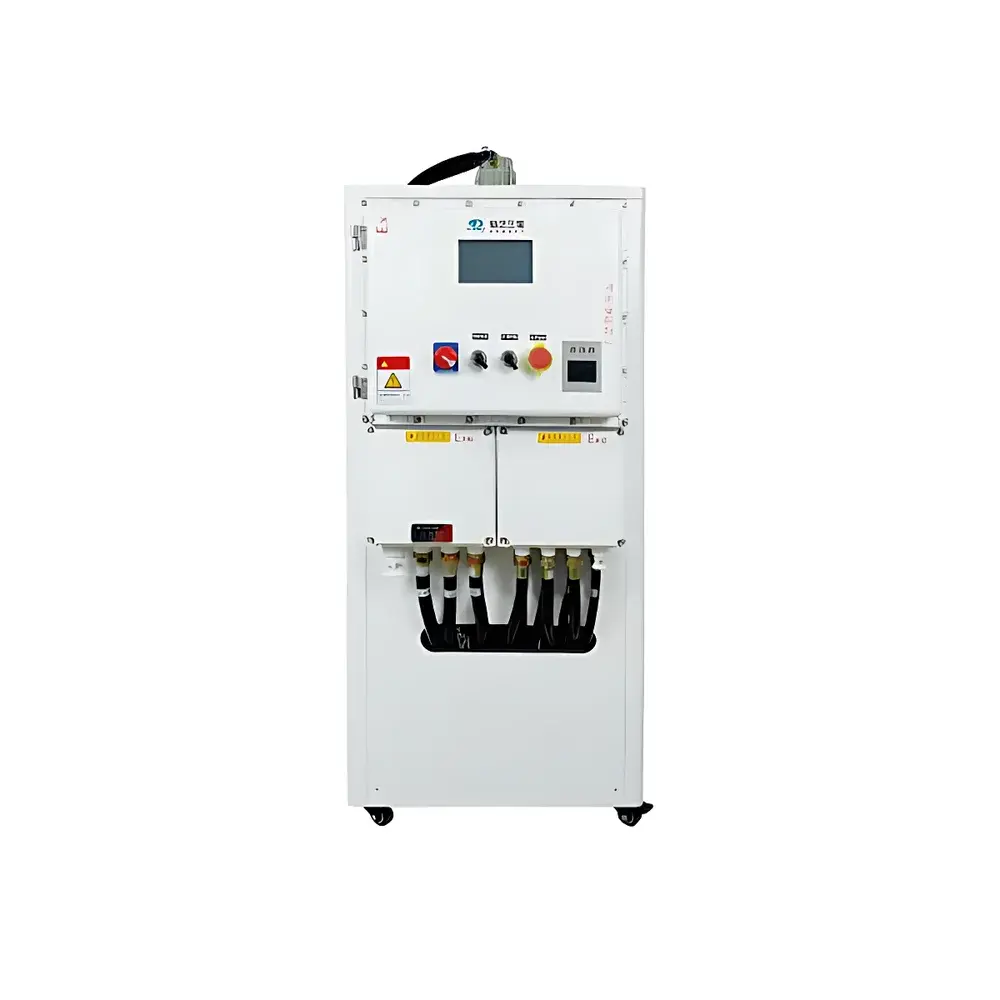
Scientz HL25W-620 Series Low-Temperature to High-Temperature Circulating Chiller System
| Brand | Scientz |
|---|---|
| Origin | Zhejiang, China |
| Manufacturer Type | Direct Manufacturer |
| Country of Origin | China |
| Model | HL25W-620 Series |
| Temperature Control Range | −60 °C to 200 °C |
| Temperature Accuracy | ±0.5 °C |
| Heat Transfer Medium Temperature Range | −25 °C to 200 °C |
| Control Interface | 7-inch color touchscreen with real-time temperature curve display and logging |
| Communication Protocol | MODBUS RTU over RS-485 |
| Control Logic | PID fuzzy control |
| Programmability | Up to 5 programs, each with up to 30 segments |
| Temperature Feedback Points | Three PT100 sensors (unit internal temperature, outlet temperature, external process material temperature) |
| Safety Protections | Compressor overload protection, high-pressure switch, thermal relay, overtemperature sensor fault detection, low-fluid-level alarm, high-temperature cutoff |
| System Design | Fully sealed closed-loop circulation |
Overview
The Scientz HL25W-620 Series is an engineered low-temperature to high-temperature circulating chiller system designed for precise, stable, and programmable thermal management in demanding laboratory and pilot-scale bioprocess, chemical synthesis, and materials testing environments. Operating across a continuous range from −60 °C to 200 °C, the system employs a single-fluid, fully sealed closed-loop architecture to eliminate vapor loss at elevated temperatures and moisture ingress at sub-ambient conditions. Its core thermodynamic performance is governed by a dual-stage refrigeration circuit combined with electric heating elements and PID-based fuzzy logic control—ensuring rapid ramp rates, minimal overshoot, and high reproducibility in both heating and cooling phases. Unlike open-bath or dual-fluid systems, the HL25W-620 maintains consistent thermal transfer efficiency across its entire operational envelope without requiring medium exchange or system purging. It is specifically configured for integration with jacketed reactors, microchannel reactors, environmental test chambers, and battery module thermal validation rigs—serving as a primary temperature source for GLP-compliant process development and regulatory submission studies.
Key Features
- Fully sealed closed-loop circulation design prevents oil mist generation above 100 °C and atmospheric moisture absorption below 0 °C, ensuring long-term fluid integrity and system stability.
- PID fuzzy control algorithm dynamically adjusts compressor speed, heater output, and flow rate to maintain ±0.5 °C accuracy at the heat transfer medium outlet—and ±1.0 °C at the process material interface when paired with an external PT100 sensor.
- Triple-point temperature monitoring via three independently calibrated PT100 sensors: internal bath temperature, outlet temperature, and externally mounted process temperature—enabling differential control modes (e.g., ΔT between jacket and reactor core).
- 7-inch industrial-grade color touchscreen HMI supports real-time multi-curve plotting, on-device data logging (≥30 days at 1-second intervals), and USB export of CSV-formatted temperature profiles.
- Programmable logic with up to five independent temperature protocols, each supporting 30 configurable segments—including ramp/soak steps, dwell times, and conditional triggers based on measured ΔT or time elapsed.
- Comprehensive safety architecture compliant with IEC 61000-6-2/6-4 EMC standards, including high-pressure cut-off switches, compressor thermal overload relays, low-level fluid detection, and redundant overtemperature sensing.
Sample Compatibility & Compliance
The HL25W-620 interfaces seamlessly with standard jacketed glass and stainless-steel reactors (1–100 L volume), microstructured reaction plates (e.g., Corning AFR, Chemtrix systems), and automotive component test fixtures. Its MODBUS RTU (RS-485) interface enables bidirectional communication with PLC-controlled test benches and SCADA platforms used in ISO/IEC 17025-accredited laboratories. The system supports audit-ready operation under FDA 21 CFR Part 11 requirements when deployed with validated third-party data acquisition software—providing electronic signatures, change tracking, and immutable log files. All thermal control sequences are traceable to NIST-traceable PT100 calibration certificates (available upon request). The unit meets CE marking requirements per Machinery Directive 2006/42/EC and Low Voltage Directive 2014/35/EU.
Software & Data Management
Local operation is managed entirely through the embedded Linux-based HMI firmware, which stores temperature logs internally and allows direct export via USB flash drive. For networked deployment, optional Scientz Link™ OPC UA server software (sold separately) provides secure TLS-encrypted connectivity to LabArchives, Empower, or custom LIMS environments. All logged data includes timestamp (with RTC backup), sensor ID, setpoint, actual value, and status flags (e.g., “Heating Active”, “Compressor Stalled”). Event-driven alarms—such as deviation >±2.0 °C for >30 seconds—are recorded with full context and can trigger email/SMS notifications via integrated SMTP gateway configuration.
Applications
- Chemical Process Development: Precise exothermic reaction control in nitration, sulfonation, and hydrogenation; crystallization profiling under variable cooling gradients; polymerization kinetics studies requiring sub-zero initiation temperatures.
- Biopharmaceutical Manufacturing Support: Jacket temperature stabilization during mammalian cell culture harvest operations; cold-chain validation for intermediate storage vessels; controlled thawing of cryopreserved cell banks.
- Advanced Materials Testing: Thermal cycling of lithium-ion battery modules per UN 38.3 and ISO 12405-2; coefficient of thermal expansion (CTE) measurement of composite substrates; accelerated aging of encapsulants under −40 °C to +85 °C profiles.
- Microreactor Optimization: Rapid screening of residence time–temperature matrices for photochemical and enzymatic reactions; parallelized condition testing across multiple chip-based reactors using manifold distribution.
FAQ
What is the minimum recommended heat transfer fluid for operation at −60 °C?
Scientz recommends a certified low-viscosity silicone oil (e.g., DC-200 series, kinematic viscosity ≤50 cSt at −60 °C) or specialized low-temperature synthetic hydrocarbon blend meeting ASTM D6792 specifications.
Can the system operate unattended for extended periods (e.g., 72+ hours)?
Yes—the unit features continuous self-diagnostic routines, non-volatile program memory, and automatic recovery from brief power interruptions (with optional UPS integration). All safety interlocks remain active during autonomous operation.
Is remote monitoring supported out-of-the-box?
Basic MODBUS RTU telemetry is included; Ethernet/WiFi connectivity and cloud-based dashboards require Scientz Link™ software licensing and hardware add-on modules.
How is calibration verification performed?
Users may perform field verification using a NIST-traceable reference thermometer at the outlet port; full factory calibration (including all three PT100 channels) is available as a service with documented uncertainty budgets per ISO/IEC 17025.
Does the system meet explosion-proof requirements for solvent-based chemistry?
The HL25W-620 is rated for general laboratory use (Class I, Division 2, Group D per NEC); for hazardous area deployment, consult Scientz Engineering for ATEX/IECEx-certified variants with intrinsically safe signal isolation.