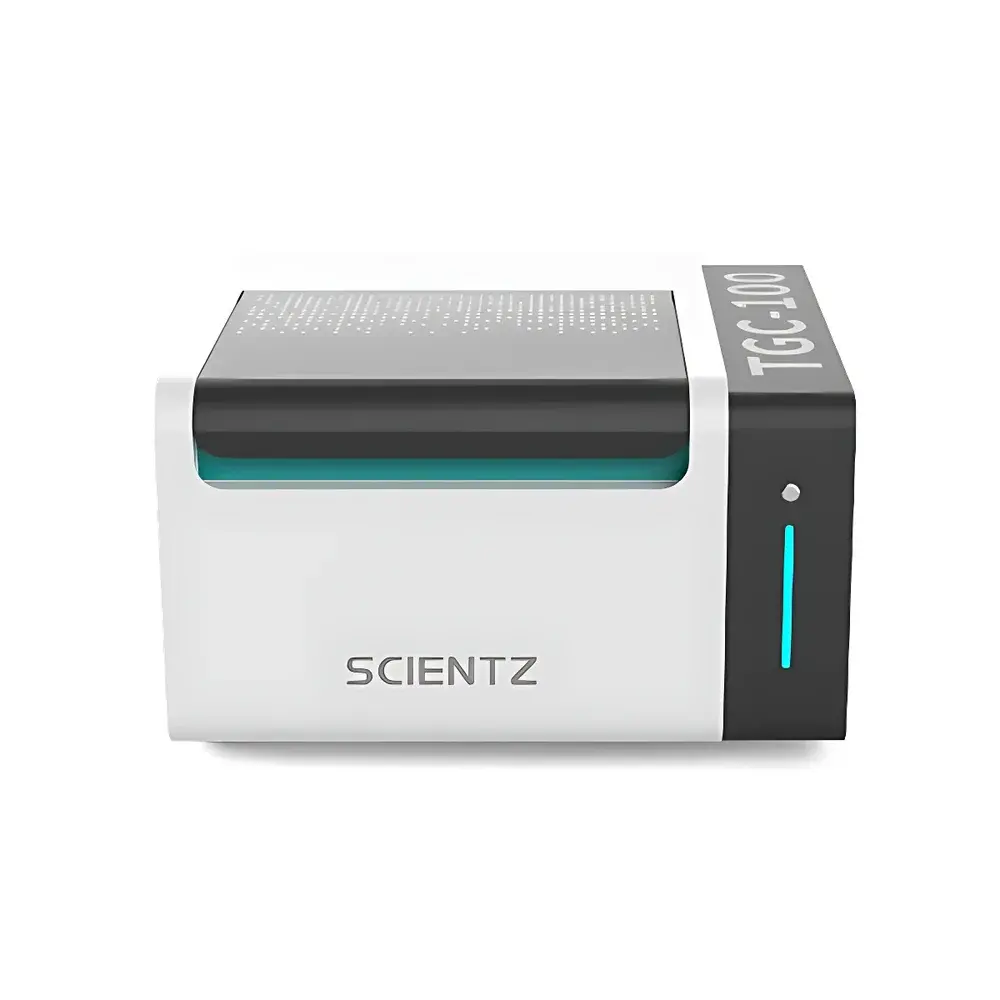
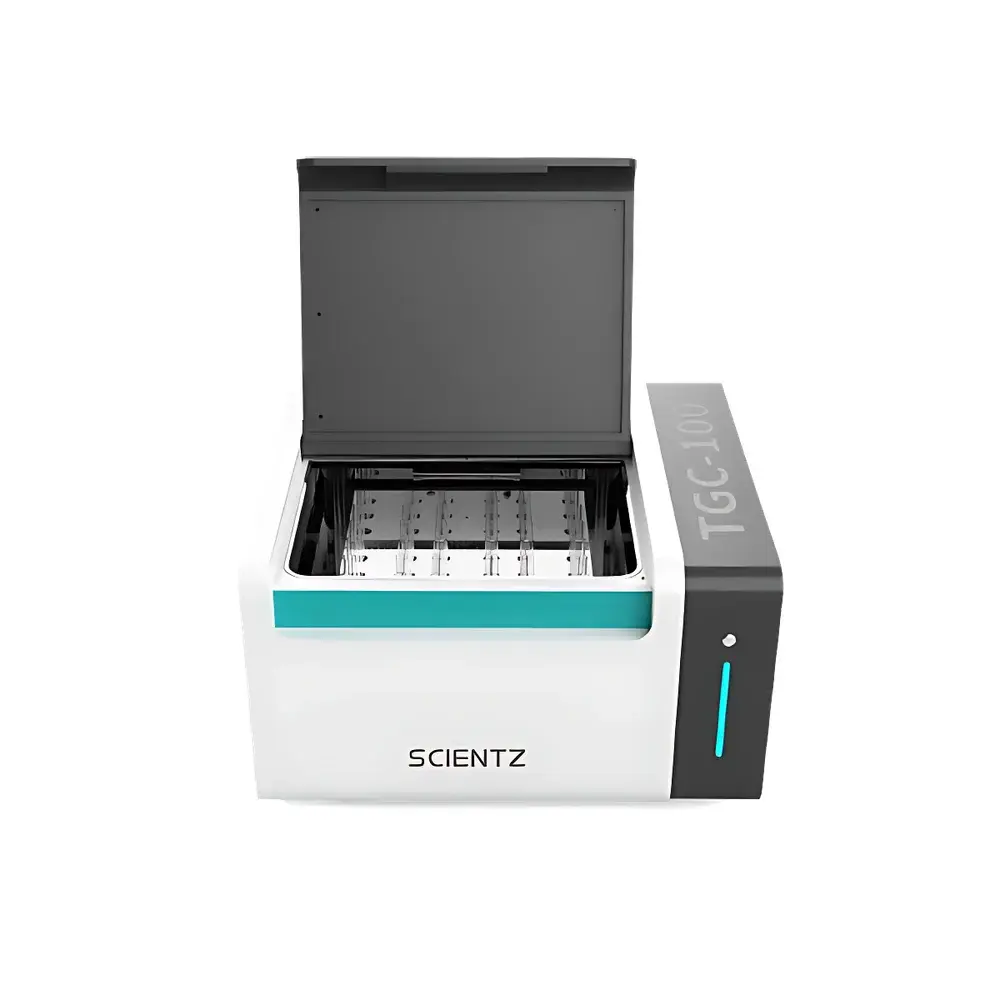
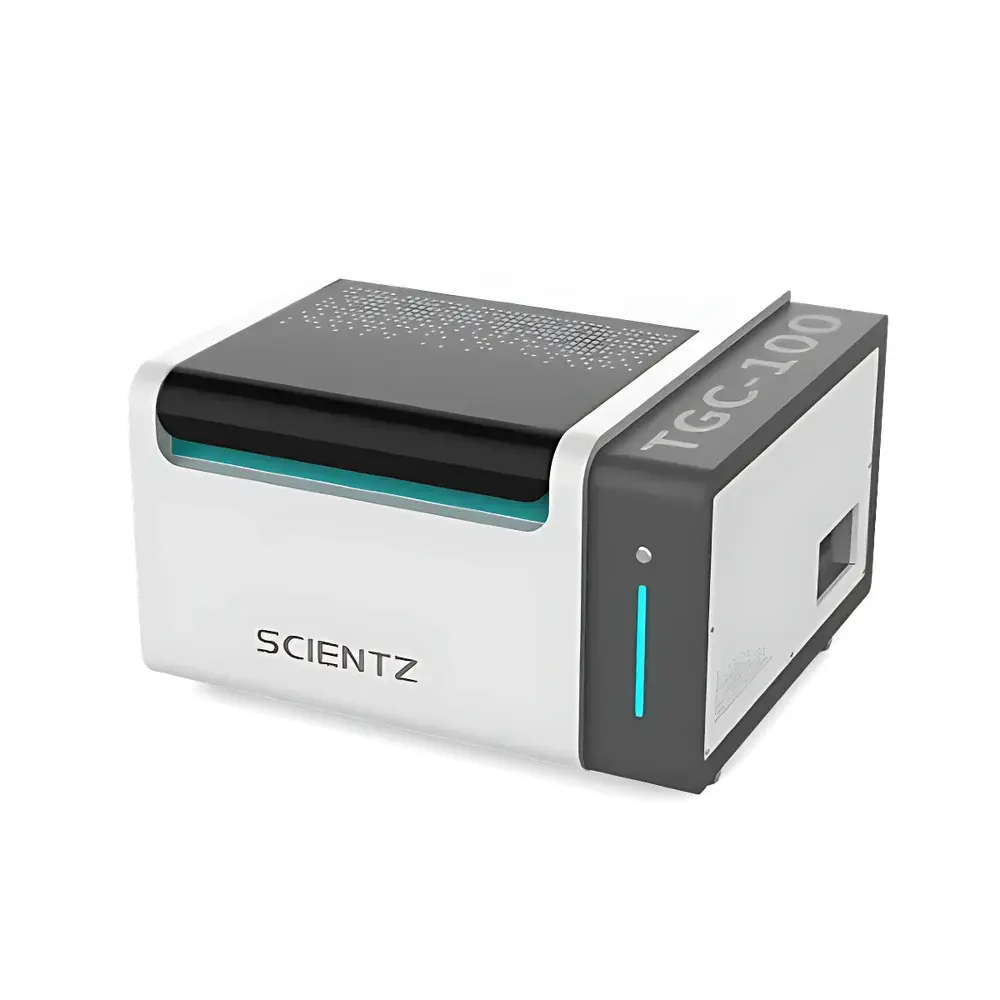
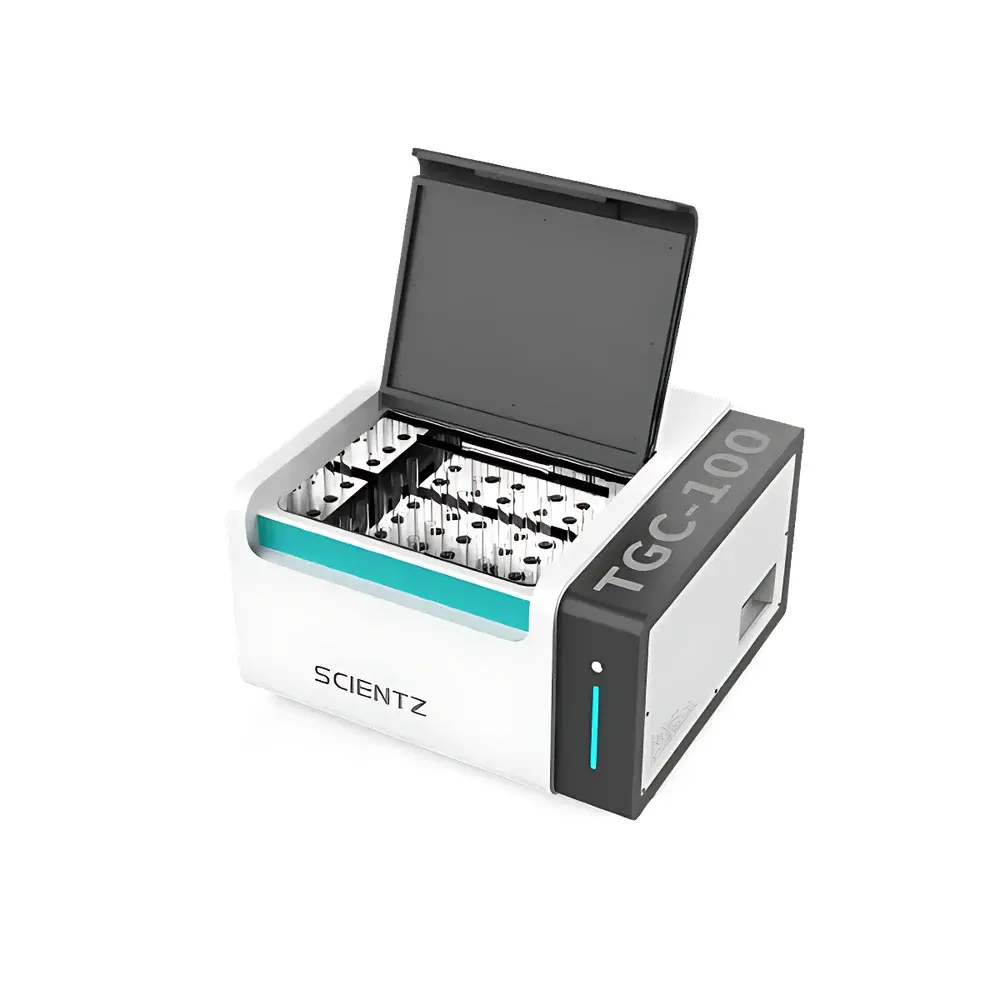
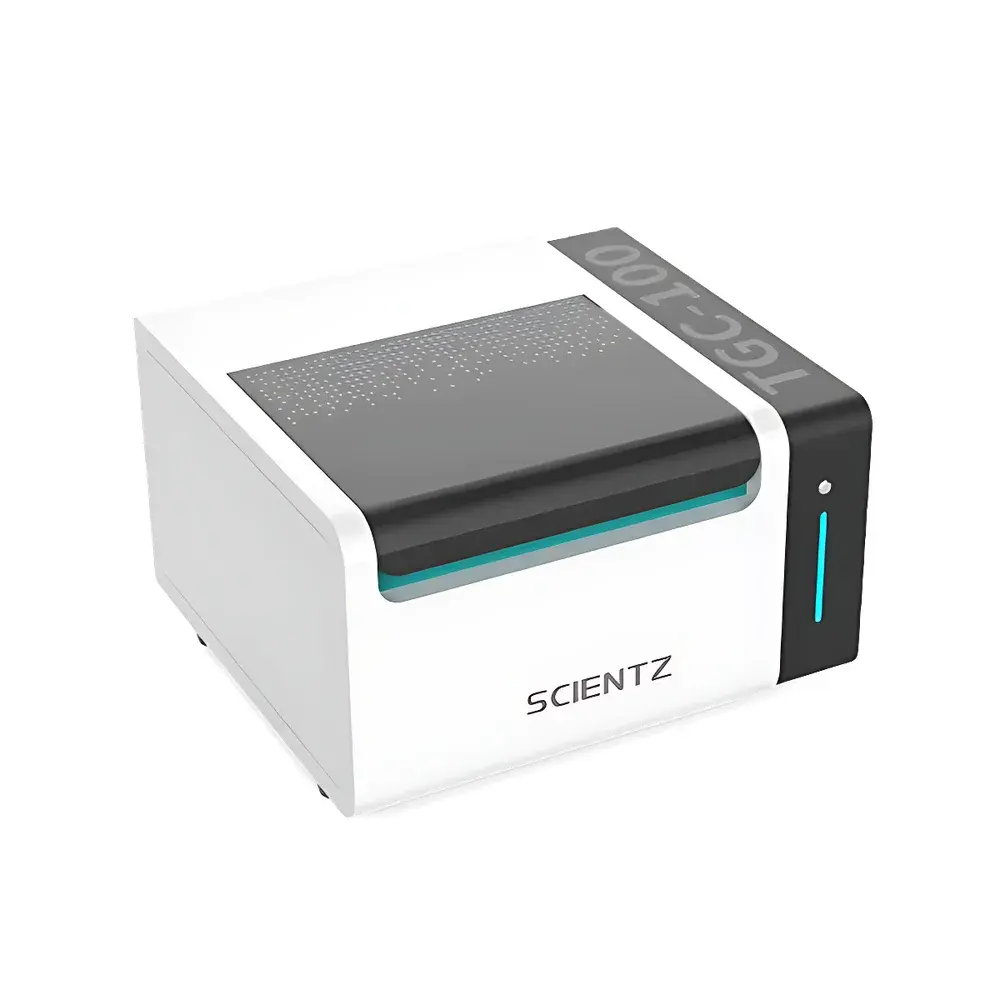
Scientz TGC-100 Microbial Growth Curve Analyzer
| Brand | Scientz |
|---|---|
| Model | TGC-100 |
| Origin | Zhejiang, China |
| Manufacturer Type | Direct Manufacturer |
| Detection Wavelength | 600 nm |
| Sample Capacity | 36 × test tubes (3–20 mL) |
| Optical Detection Method | Dual-channel transmission + scattering photometry |
| Temperature Control Range | 4–60 °C (±0.2 °C stability) |
| Shaking Speed | 0–800 rpm (adjustable) |
| Illumination System (optional) | 6 independent RGBW modules, 0–300,000 lux (≈0–5,000 µmol·m⁻²·s⁻¹), programmable light/dark cycles |
| Data Acquisition | Fully automated, reference-based OD normalization, real-time curve generation |
| Software Interface | Embedded GUI + optional mobile app (iOS/Android) |
| Compliance | Designed for GLP-compliant workflows |
Overview
The Scientz TGC-100 Microbial Growth Curve Analyzer is an engineered platform for label-free, real-time, high-throughput monitoring of microbial growth kinetics in standard glass test tubes. Unlike conventional spectrophotometers relying solely on transmission-based optical density (OD600) measurements — which deviate significantly under high-cell-density conditions due to light scattering and nonlinearity governed by the Beer–Lambert law — the TGC-100 implements a dual-optical-path architecture. It simultaneously quantifies both transmitted and scattered light at 600 nm, enabling robust OD estimation across an extended dynamic range (up to OD600 ≈ 15–20, depending on cell morphology). This eliminates the need for manual dilution, reduces sampling-induced contamination risk, and preserves physiological relevance during late-log and stationary phases — critical for fermentation optimization, antibiotic susceptibility testing, and metabolic engineering studies.
Key Features
- High-throughput capacity: Simultaneous monitoring of 36 independent culture tubes (3–20 mL volume range), compatible with standard 16 × 100 mm or 18 × 150 mm borosilicate glass tubes — no proprietary consumables required.
- Dual-optical detection: Integrated transmission + forward-scatter photometry at 600 nm, coupled with proprietary signal-fusion algorithms to extend linear OD measurement range and improve reproducibility across heterogeneous cultures.
- Precise environmental control: Peltier-based temperature regulation from 4 °C to 60 °C (±0.2 °C accuracy), with programmable ramping and mid-experiment setpoint changes to model thermal stress responses or induce phase-specific metabolite production.
- Controlled agitation: Motor-driven orbital shaking (0–800 rpm, ±5 rpm resolution) ensures homogeneous suspension without foaming or shear damage — optimized for bacterial, yeast, and filamentous fungal cultures.
- Optional RGBW illumination system: Six independently addressable light modules enable spectral tuning (450 nm blue, 525 nm green, 630 nm red, 4500 K white), intensity control (0–300,000 lux), and programmable L/D cycles — validated for microalgal photobioreactor mimicry and circadian rhythm studies.
- Embedded data integrity architecture: All measurements are timestamped, referenced to initial tube baseline (not external blank), and stored with operator ID, experiment metadata, and version-stamped firmware logs — compliant with ALCOA+ principles for regulated environments.
Sample Compatibility & Compliance
The TGC-100 accommodates diverse microbiological systems including Gram-positive/negative bacteria (e.g., E. coli, B. subtilis), yeasts (S. cerevisiae, P. pastoris), lactic acid bacteria, cyanobacteria, and eukaryotic microalgae (C. reinhardtii, N. oceanica). Its open-tube design avoids membrane interference or evaporation artifacts common in sealed microplate readers. The instrument meets mechanical and electrical safety requirements per IEC 61010-1 and is designed to support workflows aligned with ISO/IEC 17025, USP , and FDA 21 CFR Part 11 when paired with validated software configurations. Raw data export (CSV, Excel) includes full audit trails: acquisition time, temperature/shake setpoints, illumination status, and raw photodiode voltage outputs.
Software & Data Management
The embedded Linux-based interface provides intuitive touchscreen operation with multilingual support (English default). Real-time growth curves update every 1–30 minutes (user-configurable), with overlay visualization for comparative analysis across all 36 channels. Data can be exported in machine-readable formats for downstream statistical modeling (e.g., Gompertz, Logistic, Baranyi fitting). Optional Scientz CloudLink mobile application (iOS/Android) delivers push notifications for endpoint detection, temperature excursions, or system errors — enabling remote experiment supervision without local workstation dependency. All software versions undergo regression testing; firmware updates preserve backward compatibility with historical datasets.
Applications
- Microbial physiology & bioprocess development: Quantification of lag phase duration, maximum specific growth rate (µmax), yield coefficients, and substrate inhibition thresholds under varied carbon/nitrogen sources or pH gradients.
- Antimicrobial susceptibility testing: Determination of MIC (Minimum Inhibitory Concentration), MBC (Minimum Bactericidal Concentration), and time-kill kinetics per CLSI M07-A11 guidelines — eliminating subjective colony counting.
- Fermentation process optimization: Rapid screening of starter cultures for dairy (yogurt, cheese), brewing (ale/lager yeasts), and condiment (soy sauce, fish sauce) industries.
- Algal biotechnology: Photosynthetic efficiency profiling under spectral or diurnal light regimes; toxicity screening of heavy metals or pesticides in aquatic ecotoxicology assays (OECD 201).
- Strain engineering validation: High-resolution phenotyping of CRISPR-edited mutants or synthetic biology constructs under controlled stress conditions (e.g., osmotic, oxidative, thermal).
FAQ
Does the TGC-100 require calibration with standard suspensions before each run?
No. The system performs automatic zero-reference correction using the initial optical state of each tube as its native baseline, eliminating inter-batch variability from commercial OD standards.
Can I integrate TGC-100 data into my existing LIMS or ELN platform?
Yes. CSV exports include structured headers and ISO 8601 timestamps; API access (RESTful JSON) is available under enterprise licensing for direct LIMS synchronization.
Is the illumination module necessary for bacterial growth monitoring?
Not required for heterotrophic cultures, but essential for phototrophic organisms (cyanobacteria, microalgae) and recommended for circadian or photoinducible expression studies.
How is contamination prevented during long-term runs (e.g., 72+ hours)?
By eliminating manual sampling, maintaining sealed tube caps, and operating within laminar flow hoods or isolators — the TGC-100’s fully enclosed optical chamber prevents aerosol ingress during measurement cycles.
What maintenance is required for sustained accuracy?
Annual verification of photodiode linearity and temperature sensor traceability against NIST-certified references is recommended; routine cleaning of optical windows with ethanol-dampened lens tissue suffices for daily use.