
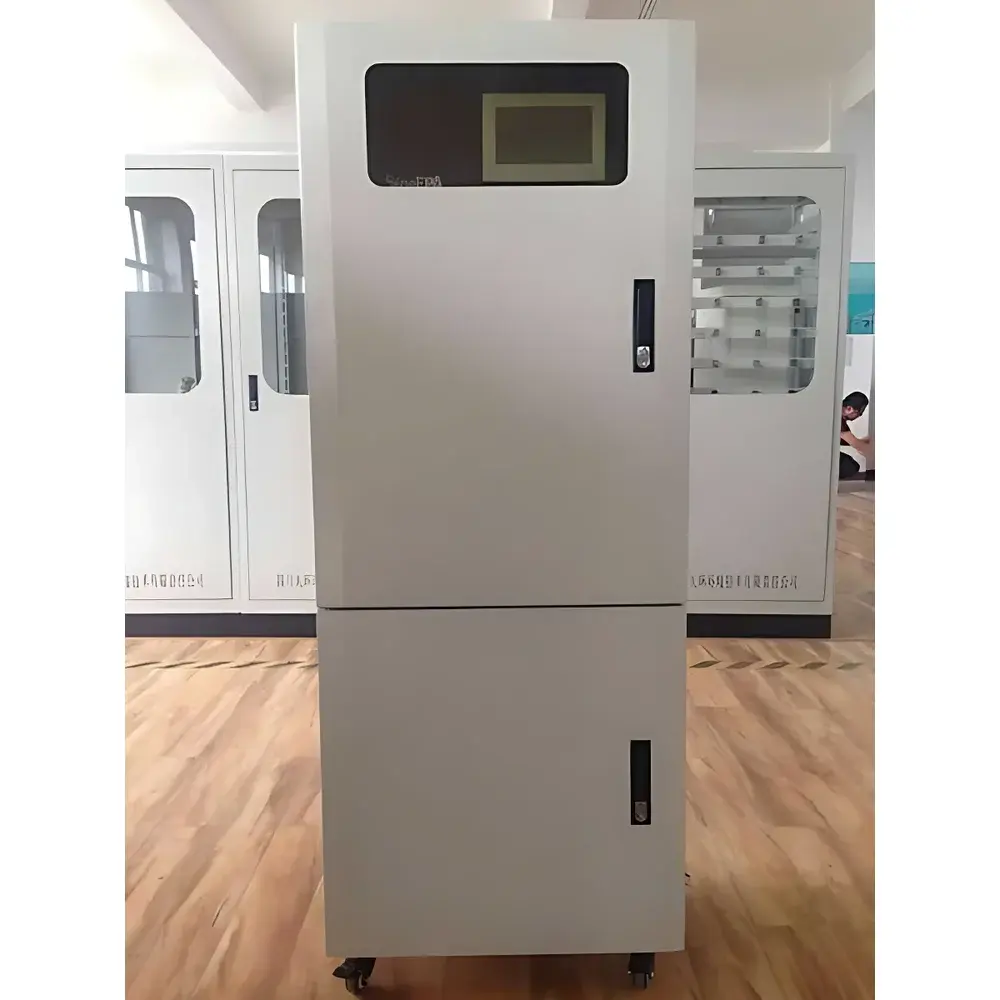
SAIL HERO SERES 2000 Cu Automated Online Copper Analyzer
| Brand | SAIL HERO |
|---|---|
| Origin | Hebei, China |
| Manufacturer Type | Original Equipment Manufacturer (OEM) |
| Country of Origin | China |
| Model | SERES 2000 Cu |
| Instrument Type | Online Analyzer |
| Detection Principle | Bathocuproine-based Photometric Method with High-Temperature Acid Oxidation |
| Target Analyte | Total Copper (Cu) |
| Analysis Time | ≤ 40 min per cycle |
| Accuracy/Precision | ±10% RSD |
| Detection Resolution | 0.01 mg/L |
| Optical Wavelength | 480 nm |
| Sample Introduction | Non-contact Peristaltic Sampling with Modified PTFE Tubing |
| Digestion System | High-temperature, high-pressure Acid Oxidation Module |
| Reagent Delivery | High-precision Infrared Photoelectric Metering System |
| Valve System | Imported Multi-port Rotary Valve |
| Temperature Control | PID-regulated Heating Block with ±0.5 °C Stability |
Overview
The SAIL HERO SERES 2000 Cu is an automated online analyzer engineered for continuous, unattended quantification of total copper (Cu) in aqueous environmental and industrial effluent streams. It operates on a validated photometric principle combining high-temperature acid oxidation with selective complexation using bathocuproine (BC), a highly sensitive and Cu+-specific chromogenic reagent. Prior to colorimetric detection, the instrument performs complete matrix digestion under controlled acidic, elevated temperature, and pressure conditions—ensuring full conversion of organically bound, colloidal, and particulate-associated copper into soluble Cu2+. Subsequent reduction by hydroxylamine hydrochloride yields Cu+, which forms a stable orange-yellow complex with bathocuproine. Absorbance is measured precisely at 480 nm using a high-stability optical path and thermally stabilized photodiode detector. This methodology conforms to core principles outlined in EPA Method 200.7 and ISO 11885 for total recoverable metals, and supports regulatory monitoring under national water quality standards (e.g., China’s GB 3838–2002, EU WFD Annex V, and US Clean Water Act discharge criteria).
Key Features
- Robust high-temperature/pressure digestion module enabling >95% recovery of total copper across diverse water matrices—including wastewater, surface water, groundwater, and industrial cooling water.
- Non-contact peristaltic sampling system with imported modified PTFE tubing, resistant to aggressive reagents (HNO3, HCl, H2O2) and rated for >12 months of continuous operation without degradation or leaching.
- High-precision infrared photoelectric reagent metering system delivering volumetric accuracy within ±0.5% full scale, eliminating mechanical wear and drift associated with piston-driven dosing.
- Thermally stabilized spectrophotometric cell with dual-beam referencing and automatic zero/slope calibration routines to minimize baseline drift and photodetector aging effects.
- Integrated multi-port rotary valve (imported OEM grade) with ceramic rotor and chemically inert flow paths—designed for >500,000 switching cycles and compatibility with acidic, oxidizing, and chelating reagents.
- Embedded microprocessor control with real-time fault diagnostics, self-calibration logs, and event-triggered maintenance alerts compliant with IEC 61508 functional safety guidelines for continuous emission monitoring systems (CEMS).
Sample Compatibility & Compliance
The SERES 2000 Cu accepts raw, filtered, or pre-sedimented liquid samples with turbidity up to 100 NTU and suspended solids < 50 mg/L. It accommodates pH ranges from 2.0 to 10.5 post-digestion and handles chloride concentrations up to 2,000 mg/L without interference. The system meets design requirements for EN 14181 (QAL1/QAL2 verification), supports GLP/GMP data integrity protocols via audit-trail-enabled firmware, and provides electronic records traceable to ISO/IEC 17025 calibration standards. All wetted materials—including digestion coil, reaction chamber, and fluidic manifolds—are constructed from quartz, PTFE, and titanium alloys to prevent copper adsorption or catalytic loss.
Software & Data Management
The analyzer runs on embedded Linux-based firmware with web-accessible HMI (HTTP/HTTPS) and Modbus TCP/RTU interfaces for integration into SCADA, DCS, or LIMS platforms. Measurement data—including absorbance values, calibration coefficients, temperature logs, and reagent consumption—are timestamped, digitally signed, and stored locally for ≥90 days. Software supports configurable alarm thresholds (LOQ, exceedance, calibration drift), automated QC spike recovery reporting, and export of CSV/Excel-compatible files compliant with FDA 21 CFR Part 11 requirements for electronic records and signatures. Remote firmware updates and diagnostic telemetry are secured via TLS 1.2 encryption.
Applications
- Real-time compliance monitoring at municipal wastewater treatment plant (WWTP) final effluent outfalls.
- Continuous surveillance of copper discharge from electroplating, PCB manufacturing, and mining leachate facilities.
- Early-warning detection in drinking water distribution networks following pipe corrosion events.
- Process control feedback in hydrometallurgical copper recovery circuits and acid mine drainage treatment units.
- Research-grade longitudinal studies of copper speciation dynamics in estuarine and riverine ecosystems.
FAQ
What sample pretreatment is required prior to analysis?
No filtration or acid preservation is required for most applications; however, samples with >50 mg/L suspended solids should be gravity-settled or passed through a 10-µm mesh screen to prevent clogging.
Can the SERES 2000 Cu measure dissolved copper only?
No—it is configured exclusively for total copper determination via hot-acid digestion. Dissolved copper measurement requires optional inline 0.45-µm filtration upstream of the analyzer inlet.
Is the system compatible with third-party remote monitoring platforms?
Yes—Modbus TCP, OPC UA (via gateway), and MQTT v3.1.1 protocols are supported out-of-the-box for integration with cloud-based environmental dashboards and enterprise asset management systems.
How often does the system require calibration verification?
Initial calibration is performed using NIST-traceable Cu standard solutions; subsequent verification is recommended every 72 hours or after 20 sample cycles, per ISO 8466-1 guidance for automated analyzers.
What maintenance intervals are specified for critical components?
PTFE tubing: replace every 12 months; multi-port valve rotor: inspect every 6 months, replace every 24 months; digestion coil: lifetime >3 years under normal operation; photometer lamp: 20,000-hour rated lifespan.







