
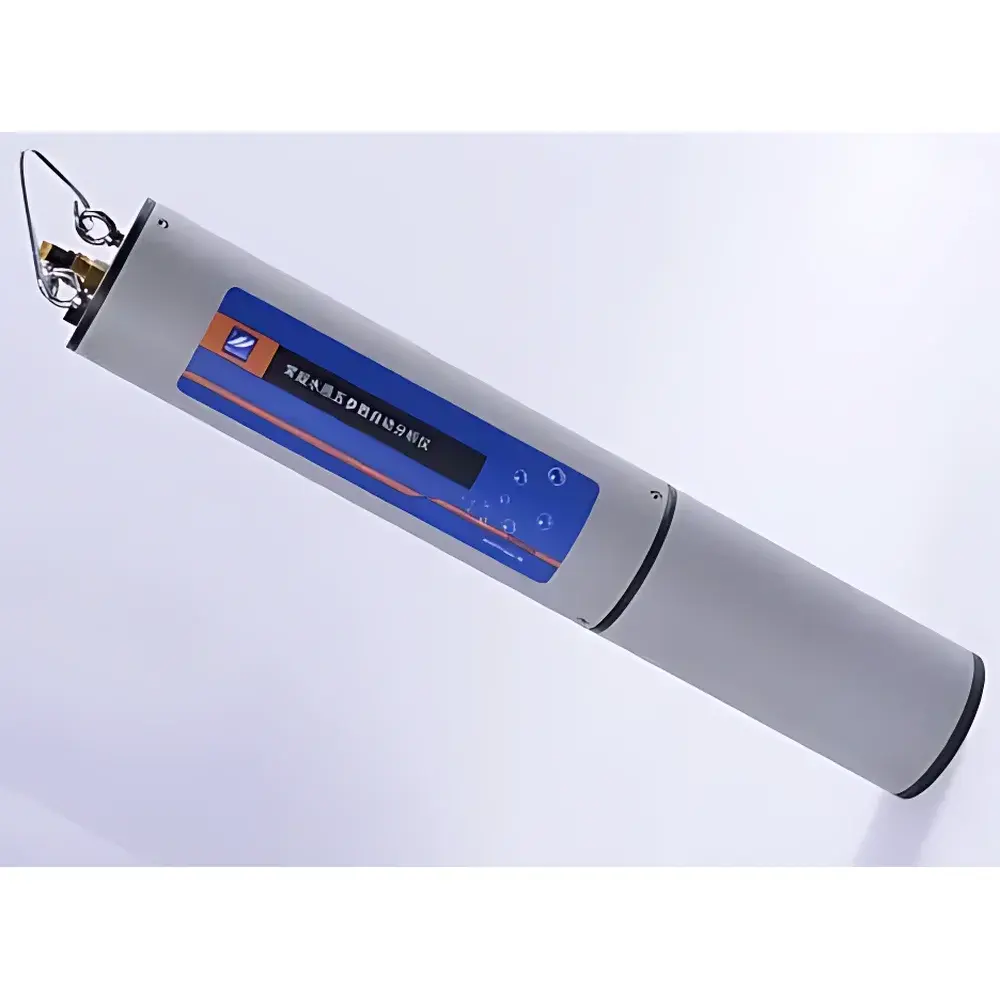
SAIL HERO XHUV-90A UV Absorption Online Water Quality Monitor
| Brand | SAIL HERO |
|---|---|
| Origin | Hebei, China |
| Manufacturer | Yes |
| Country of Origin | China |
| Model | XHUV-90A |
| Measurement Wavelength | 254 nm (UV) + Visible Reference |
| Compensation | Temperature & Visible-Light Baseline Correction |
| Measurement Ranges | 0–200 m⁻¹ |
| Repeatability | ±1.5% FS |
| Zero Drift | ±1.5% FS |
| Span Drift | ±1.5% FS |
| Linearity | ±4% FS |
| Power Supply | AC 220 V, 50 Hz |
| Output Interfaces | RS232/RS485 digital communication |
| Display | Touchscreen LCD with Chinese UI |
Overview
The SAIL HERO XHUV-90A UV Absorption Online Water Quality Monitor is a dedicated in-situ instrument engineered for continuous, real-time quantification of ultraviolet absorbance at 254 nm in aqueous matrices. Based on the well-established principle of UV-Vis spectrophotometry, it measures the attenuation of monochromatic 254 nm light as it passes through a water sample—directly correlating to the concentration of aromatic organic compounds, including humic substances, phenols, and certain industrial contaminants. A concurrent visible-light reference channel compensates for turbidity-induced scattering and particulate interference, while integrated temperature sensing enables automatic thermal correction of absorbance values—ensuring metrological consistency across seasonal or diurnal fluctuations. Designed for unattended operation in harsh environmental conditions, the XHUV-90A adheres to fundamental optical path integrity requirements defined in ISO 7027 for turbidity-related interference mitigation and aligns with the measurement rationale underpinning EPA Method 415.3 and DIN 38404-4 for UV absorption-based organic load estimation.
Key Features
- Dual-wavelength optical architecture: 254 nm UV LED source paired with visible-light reference detection for robust turbidity compensation
- Temperature-controlled measurement cell with integrated Pt100 sensor for real-time thermal correction per ASTM D5907 guidelines
- Modular flow-through cuvette design optimized for low-fouling performance in raw surface water and secondary effluent
- Automated periodic cleaning protocol via programmable solenoid valve actuation—compatible with industry-standard citric acid or enzymatic cleaning solutions
- Industrial-grade touchscreen HMI with localized Chinese interface, supporting parameter configuration, calibration logging, and alarm threshold setting
- Comprehensive power resilience: brownout tolerance, non-volatile memory retention, and auto-resume functionality following AC interruption
- Configurable analog output (4–20 mA isolated loop or 0–5/0–10 V) compliant with IEC 61000-6-2 EMC standards
Sample Compatibility & Compliance
The XHUV-90A is validated for continuous monitoring of natural waters—including rivers, lakes, reservoirs, and groundwater—as well as municipal wastewater influent/effluent and process streams from pharmaceutical, brewing, chemical synthesis, and fertilizer manufacturing facilities. Its optical path geometry and flow dynamics meet the hydraulic residence time and bubble exclusion criteria specified in EN 14185-1 for online UV absorbance instrumentation. While not certified to CE-MD or UKCA as a medical device, its construction complies with IP65 enclosure rating (IEC 60529), RoHS Directive 2011/65/EU, and REACH Annex XVII restrictions. Data integrity safeguards—including timestamped event logs and write-protected calibration records—support alignment with GLP documentation practices and pre-audit readiness for ISO/IEC 17025-accredited laboratories.
Software & Data Management
The embedded firmware supports Modbus RTU over RS485 and ASCII protocol over RS232 for seamless integration into SCADA, DCS, or PLC-based supervisory systems. All measurement data—including raw absorbance (m⁻¹), compensated UV-A value, temperature, and system status flags—are timestamped with millisecond precision and stored locally for ≥30 days (circular buffer). Remote configuration and diagnostic access are available via optional Ethernet module (not included), enabling secure SSH/Telnet session management. Audit trail functionality captures operator-initiated actions (e.g., zero calibration, range switch, cleaning trigger) with user ID and UTC timestamp—facilitating compliance with FDA 21 CFR Part 11 principles where electronic records are subject to regulatory review.
Applications
- Early-warning detection of organic pollution events in drinking water source protection zones
- Real-time surrogate monitoring of COD and DOC in municipal wastewater treatment plants (correlation models require site-specific validation)
- Process control feedback for activated carbon contactor regeneration cycles
- Effluent compliance verification against discharge permits referencing UV₂₅₄ as a proxy parameter
- Long-term trend analysis of dissolved organic carbon (DOC) dynamics in watershed management programs
- Quality assurance during purified water production in pharmaceutical manufacturing (as supplementary indicator per USP )
FAQ
What does UV₂₅₄ absorbance indicate in water quality assessment?
UV₂₅₄ absorbance serves as a rapid, reagent-free indicator of aromatic organic content—particularly humic and fulvic acids—and correlates empirically with parameters such as DOC, COD, and specific UV absorbance (SUVA). It is not a direct chemical assay but a robust optical surrogate for oxidizable organic load.
Can the XHUV-90A be calibrated using NIST-traceable standards?
Yes—calibration is performed using aqueous potassium permanganate (KMnO₄) or nitrate (NO₃⁻) solutions with certified absorbance values traceable to NIST SRM 2034 (Absorbance Standard) or equivalent national metrology institute references.
Is temperature compensation mandatory for accurate UV₂₅₄ readings?
Yes—absorbance coefficients of organic chromophores exhibit measurable thermal dependence. The built-in Pt100 sensor and firmware algorithm apply polynomial correction per ISO 7027 Annex B recommendations to maintain measurement stability across 0–40 °C operating range.
How frequently should the optical windows be cleaned?
Cleaning interval depends on suspended solids concentration and biofouling potential; typical field deployments schedule automated cleaning every 2–24 hours. The system logs cleaning events and allows conditional triggering based on drift thresholds.
Does the instrument support remote firmware updates?
Firmware upgrades require local physical access via USB or serial connection; no over-the-air (OTA) update capability is implemented to preserve system integrity and cybersecurity boundaries in critical infrastructure environments.







