
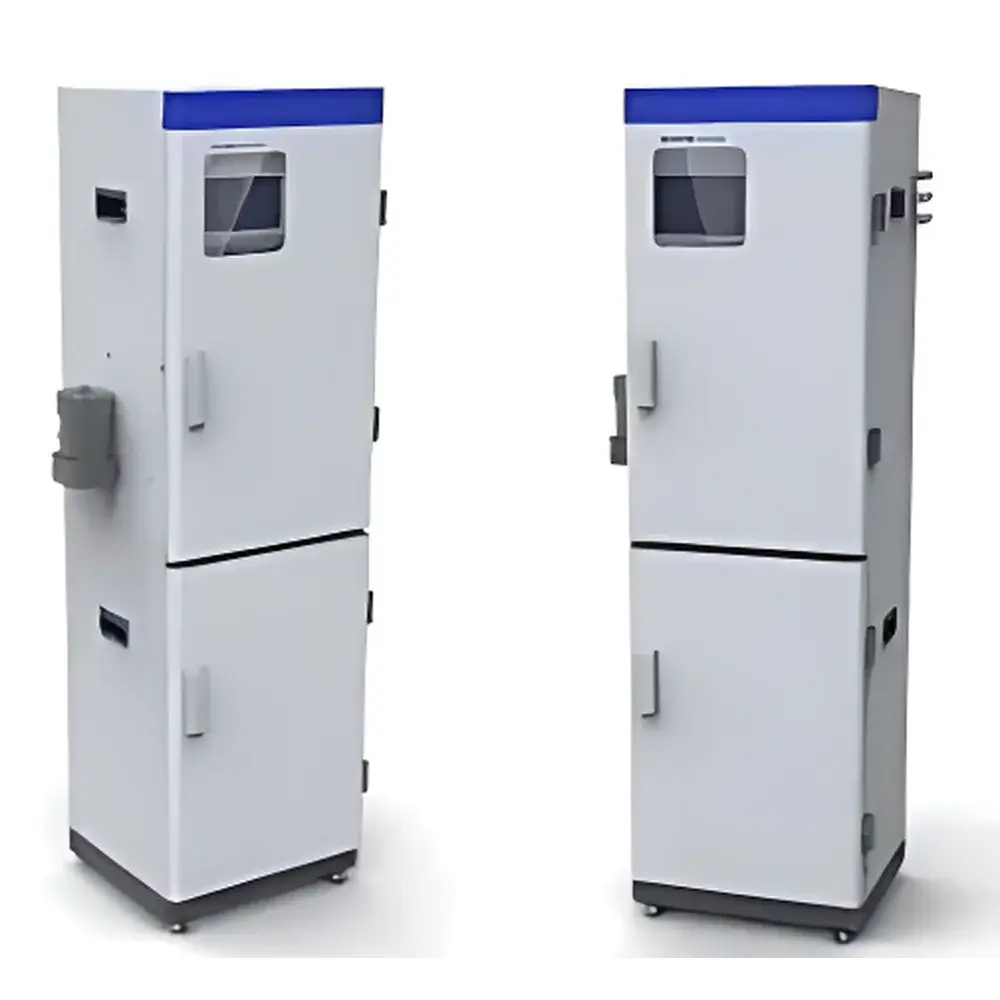
SAIL HERO XHCODMn-90 Permanganate Index (CODMn) Online Analyzer
| Brand | SAIL HERO |
|---|---|
| Origin | Hebei, China |
| Manufacturer Type | Direct Manufacturer |
| Country of Origin | China |
| Model | XHCODMn-90 |
| Measuring Principle | Acidic Potassium Permanganate Oxidation with Photometric Endpoint Detection |
| Range | 0–20 mg/L (expandable) |
| Repeatability | ±4% |
| Accuracy | ±4% |
| LOD | 0.1 mg/L |
| Resolution | 0.01 mg/L |
| Analysis Time per Cycle | 40–60 min |
Overview
The SAIL HERO XHCODMn-90 Permanganate Index (CODMn) Online Analyzer is an automated, laboratory-grade water quality monitoring instrument engineered for continuous, unattended determination of the permanganate index—a standardized surrogate for oxygen-demanding organic and inorganic substances in low-to-moderately polluted water matrices. Unlike dichromate-based COD (CODCr) methods, CODMn employs acidic potassium permanganate oxidation under controlled thermal conditions (typically 100 °C), followed by photometric quantification of residual permanganate at 525 nm. This method is specified in ISO 8467:1993, GB/T 11892–1989, and APHA Standard Methods 5210 B, and is widely adopted for source water, drinking water distribution systems, reservoirs, lakes, and clean river monitoring where strong oxidants are unsuitable. The XHCODMn-90 implements a fully integrated sequential injection analysis (SIA) architecture—distinct from conventional flow injection or discrete analyzers—enabling precise reagent metering, zero-dead-volume fluidics, and thermally stabilized reaction kinetics.
Key Features
- Patented integrated digestion-colorimetric-stirring module (Invention Patent CN104535401A; Utility Model CN204286910U) ensuring consistent thermal profile during both oxidation and endpoint titration
- Sequential injection platform with ≥90% module interchangeability across SAIL HERO’s water quality analyzer family—reducing spare part inventory and technician training burden
- Digital precision temperature control system with ±0.1 °C stability across digestion, titration, and photometric cells
- Microfluidic reagent delivery: consumables reduced to ≤10% of conventional batch-method volumes—typical KMnO4 usage < 50 µL per analysis
- Photometric endpoint detection eliminates electrode drift, manual titration, and associated calibration dependencies
- Baseline optical compensation algorithm corrects for cuvette fouling and light-source aging without manual intervention
- Automatic KMnO4 concentration drift correction using dual-wavelength reference measurement
- Multi-mode operation: continuous, time-scheduled, event-triggered (dry contact or Modbus RTU), remote-commanded, or manual initiation
- Zero-liquid-waste rinse protocol: uses ≤5 L ultra-pure water per month; no acid/base neutralization waste stream
- Comprehensive self-diagnostic suite including reagent level monitoring, flow path integrity checks, photometer dark-current validation, and thermal sensor redundancy verification
Sample Compatibility & Compliance
The XHCODMn-90 is validated for use with raw and treated potable water, surface water (Class I–III per China’s GB 3838–2002), and groundwater with turbidity < 10 NTU and chloride < 300 mg/L. It meets functional requirements of ISO/IEC 17025:2017 for automated analyzers used in environmental testing laboratories. Data integrity conforms to ALCOA+ principles (Attributable, Legible, Contemporaneous, Original, Accurate, Complete, Consistent, Enduring, Available) and supports audit-ready electronic records when deployed with optional secure logging firmware. While not FDA 21 CFR Part 11-certified out-of-the-box, its event-logged operation mode—including user authentication, change history, and immutable audit trail export—facilitates GMP/GLP-aligned deployment in regulated municipal and utility QA/QC environments.
Software & Data Management
Embedded Linux-based controller runs proprietary SAIL HERO AquaOS v4.x firmware featuring role-based access control (admin/operator/viewer), encrypted local data storage (≥30 days raw + processed data), and dual-channel communication: RS-485 (Modbus RTU) and optional Ethernet (TCP/IP with HTTP/HTTPS REST API). Calibration and verification logs include timestamped metadata (operator ID, ambient temperature, reagent lot numbers, optical baseline values). Export formats include CSV (with ISO 8601 timestamps), PDF summary reports, and XML for integration into SCADA, LIMS, or national environmental monitoring platforms (e.g., China’s National Surface Water Monitoring System). Remote firmware updates are signed and verified to prevent unauthorized modification.
Applications
- Real-time surveillance of drinking water intakes and distribution network entry points
- Early-warning detection of organic contamination events in reservoirs and lakes
- Long-term trend analysis for watershed management and ecological status assessment
- Compliance reporting for municipal water utilities subject to GB 5749–2022 (Drinking Water Quality Standards)
- Supporting ISO 5667-3:2018 sampling program design via high-frequency temporal resolution
- Calibration traceability anchor for field-portable CODMn test kits used in routine patrols
FAQ
What regulatory standards does the XHCODMn-90 comply with for CODMn measurement?
It implements the methodology defined in ISO 8467:1993 and GB/T 11892–1989, with performance verification aligned to ISO/IEC 17025:2017 clause 7.2.2 for automated analyzers.
Can the instrument operate during power or water supply interruption?
Yes—it includes non-volatile memory retention, battery-backed real-time clock, and automatic recovery upon restoration of power/water, preserving all configuration and last valid measurement.
Is external calibration standard required for routine operation?
No. The system performs periodic autocalibration using factory-characterized internal reference points; certified standard solutions are only needed for annual verification or after major maintenance.
How is data security ensured during remote transmission?
All network communications support TLS 1.2 encryption; local storage uses AES-256 full-disk encryption; audit logs are write-once and tamper-evident.
What maintenance intervals are recommended for unattended operation?
Preventive maintenance every 3 months includes optical window cleaning, pump tube replacement, and reagent line inspection—average uptime exceeds 99.2% in multi-year field deployments.
Related Products







