
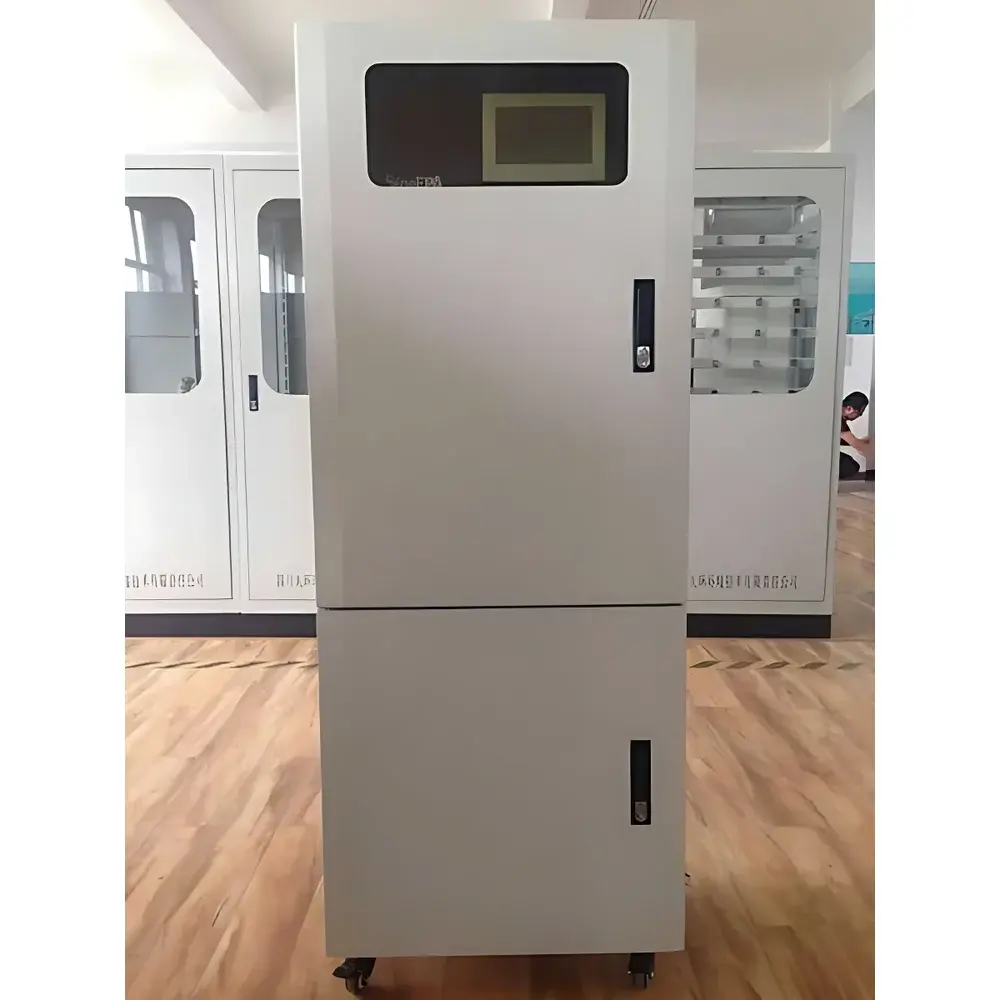
SAIL HERO SERES 2000 As Automated Online Arsenic Analyzer
| Brand | SAIL HERO |
|---|---|
| Origin | Hebei, China |
| Manufacturer Type | Original Equipment Manufacturer (OEM) |
| Country of Origin | China |
| Model | SERES 2000 As |
| Instrument Type | Online Water Quality Analyzer |
| Target Analyte | Total Arsenic (As) |
| Detection Principle | High-Temperature Oxidation Coupled with Ternary Complexation Spectrophotometry |
| Wavelength | 545 nm |
| Reagent Delivery | Infrared Photoelectric Precision Metering System |
| Sample Introduction | Non-Contact Peristaltic Sampling |
| Tubing Material | Modified PTFE |
| Digestion System | High-Pressure/High-Temperature Acid Oxidation |
| Temperature Control Accuracy | ±0.3 °C |
| Compliance | Designed for ISO 10566, EPA Method 200.8 (adapted), and GB/T 32217–2015 |
Overview
The SAIL HERO SERES 2000 As Automated Online Arsenic Analyzer is an industrial-grade, continuous-monitoring instrument engineered for the reliable quantification of total arsenic (As) in aqueous matrices under unattended operation. It implements a validated, two-stage analytical protocol grounded in high-temperature acid oxidation followed by ternary complex formation and spectrophotometric detection. In the first stage, samples undergo complete oxidation in a pressurized digestion chamber at elevated temperature (≥120 °C) and controlled acidity, ensuring quantitative conversion of all inorganic and organoarsenical species—including arsenite (As(III)), arsenate (As(V)), monomethylarsonic acid (MMA), and dimethylarsinic acid (DMA)—into As(V). The oxidized effluent is then neutralized and reacted with molybdate and crystal violet under precisely buffered conditions to form a stable, water-soluble ternary complex exhibiting maximal absorbance at 545 nm. This wavelength-specific photometric measurement—performed using a high-stability tungsten-halogen light source and thermoelectrically stabilized photodiode detector—enables trace-level quantification with sub-ppb sensitivity and inter-day repeatability <3% RSD.
Key Features
- Non-contact peristaltic sampling architecture eliminates direct fluid-path contact between reagents and critical electromechanical components, significantly reducing corrosion-induced drift and extending mean time between failures (MTBF) beyond 18 months.
- Imported multi-position selection valve with ceramic rotor seals ensures long-term sealing integrity and positional accuracy over >500,000 actuation cycles; modular design permits field replacement without system recalibration.
- Infrared photoelectric reagent metering system delivers volumetric precision of ±0.5 µL per dispense across full reagent range (10–500 µL), independent of fluid viscosity or ambient temperature fluctuations.
- High-precision thermostatic control (±0.3 °C) applied to both digestion and colorimetric reaction zones minimizes kinetic variability and suppresses baseline drift during extended deployments.
- Modified PTFE peristaltic tubing exhibits chemical resistance to concentrated HNO₃, H₂SO₄, and KMnO₄ solutions, with service life exceeding 9 months under continuous 24/7 operation at 30 rpm.
- Integrated self-diagnostic routines monitor optical path cleanliness, reagent depletion status, digestion pressure profile, and flow integrity—triggering configurable alarm outputs via Modbus TCP or 4–20 mA analog interface.
Sample Compatibility & Compliance
The SERES 2000 As is validated for use with raw influent and treated effluent from municipal wastewater treatment plants, electroplating rinse streams, semiconductor fab ultrapure water loops, and mining-impacted surface waters. It accommodates suspended solids up to 50 mg/L and chloride concentrations ≤2,000 mg/L without interference. All wetted materials comply with USP Class VI biocompatibility standards and FDA 21 CFR 177.1550 (fluoropolymer specifications). Data acquisition and storage meet GLP/GMP audit-trail requirements: timestamps, operator IDs, calibration logs, and raw absorbance values are retained locally for ≥12 months and exportable in CSV/Excel format. The analyzer supports configuration lockout, electronic signature authentication, and user-role-based access control aligned with FDA 21 CFR Part 11 Annex 11 expectations.
Software & Data Management
Embedded firmware (v3.2+) provides web-based HMI accessible via HTTPS on any modern browser, supporting remote parameter adjustment, method scheduling, and real-time trend visualization. The onboard database records every measurement event—including blank correction, calibration verification points, and QC spike recoveries—with immutable hashing for data integrity. Optional cloud integration enables secure TLS 1.2 transmission to centralized SCADA platforms or LIMS systems via MQTT or OPC UA protocols. All spectral data (full 300–800 nm scans) are archived alongside processed results, enabling retrospective spectral deconvolution and interference diagnostics.
Applications
- Continuous compliance monitoring of arsenic discharges against national discharge limits (e.g., China’s GB 8978–1996, EU Industrial Emissions Directive 2010/75/EU).
- Process control in hydrometallurgical arsenic removal units, including coagulation-flocculation and ion exchange train optimization.
- Early-warning detection of arsenic breakthrough in groundwater remediation systems utilizing zero-valent iron or activated alumina columns.
- Long-term environmental impact assessment at legacy smelting sites where arsenic leaching dynamics require sub-daily resolution.
- Reference-grade validation of portable XRF or ICP-MS field screening data through synchronized grab-sample correlation studies.
FAQ
What sample pretreatment is required prior to analysis?
No filtration or centrifugation is needed; the integrated 100-µm inline sieve removes coarse particulates. Samples with turbidity >100 NTU should be pre-filtered using 0.45-µm membrane filters to avoid optical scattering artifacts.
Can the instrument measure speciated arsenic (e.g., As(III)/As(V))?
No—it reports total arsenic only. Speciation requires coupling with HPLC-ICP-MS or hydride-generation separation modules, which are outside the scope of this platform.
How often must calibration standards be refreshed?
Certified arsenic standard solutions (10–100 µg/L) remain stable for 72 hours when stored at 4 °C in amber glass vials with sodium thiosulfate preservative; daily bracketing calibration is recommended for regulatory reporting.
Is the digestion system compliant with EPA Method 3052?
While not identical, the high-pressure/acid-oxidation protocol achieves equivalent oxidative completeness for organoarsenic compounds as defined in EPA Method 3052, verified via SRM 1643f recovery testing (94–102%).
What cybersecurity safeguards are implemented?
Firmware includes TLS 1.2 encryption for remote access, disabled default credentials, automatic session timeout (<15 min), and firmware signature verification prior to OTA updates.
Related Products







