
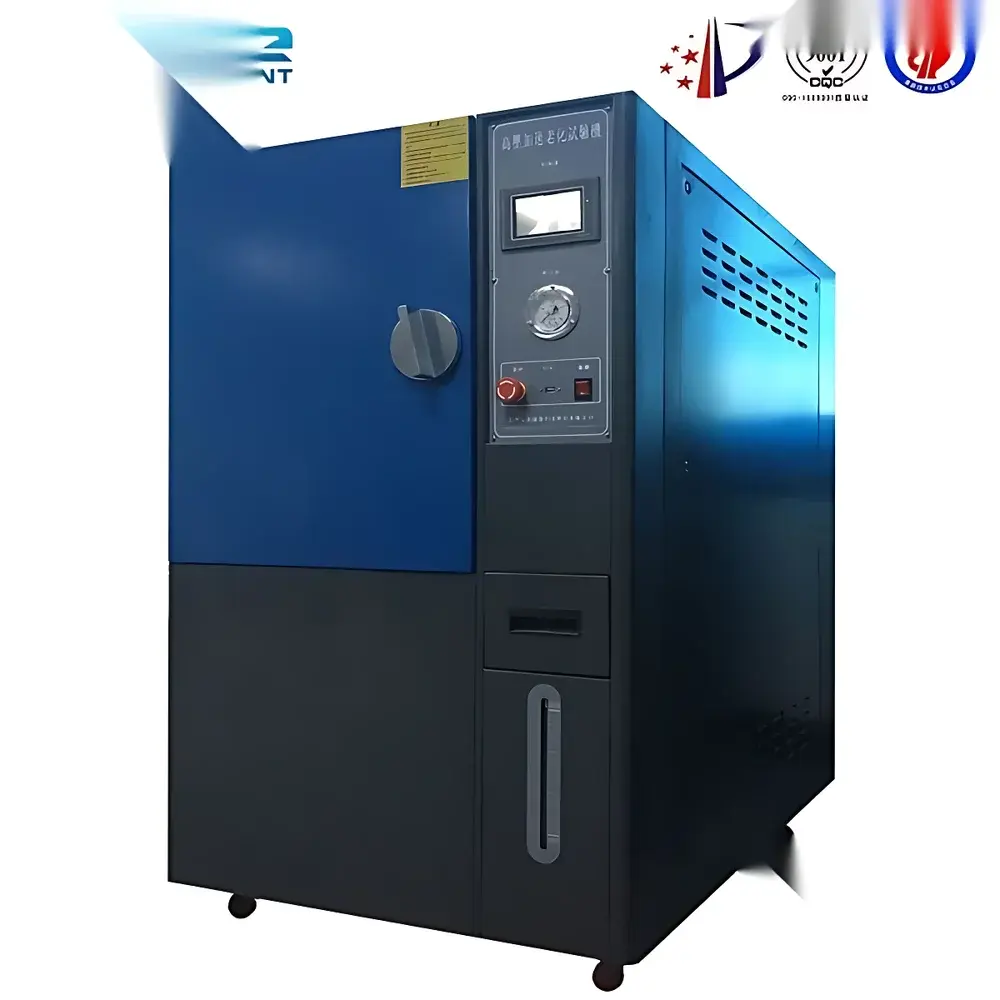
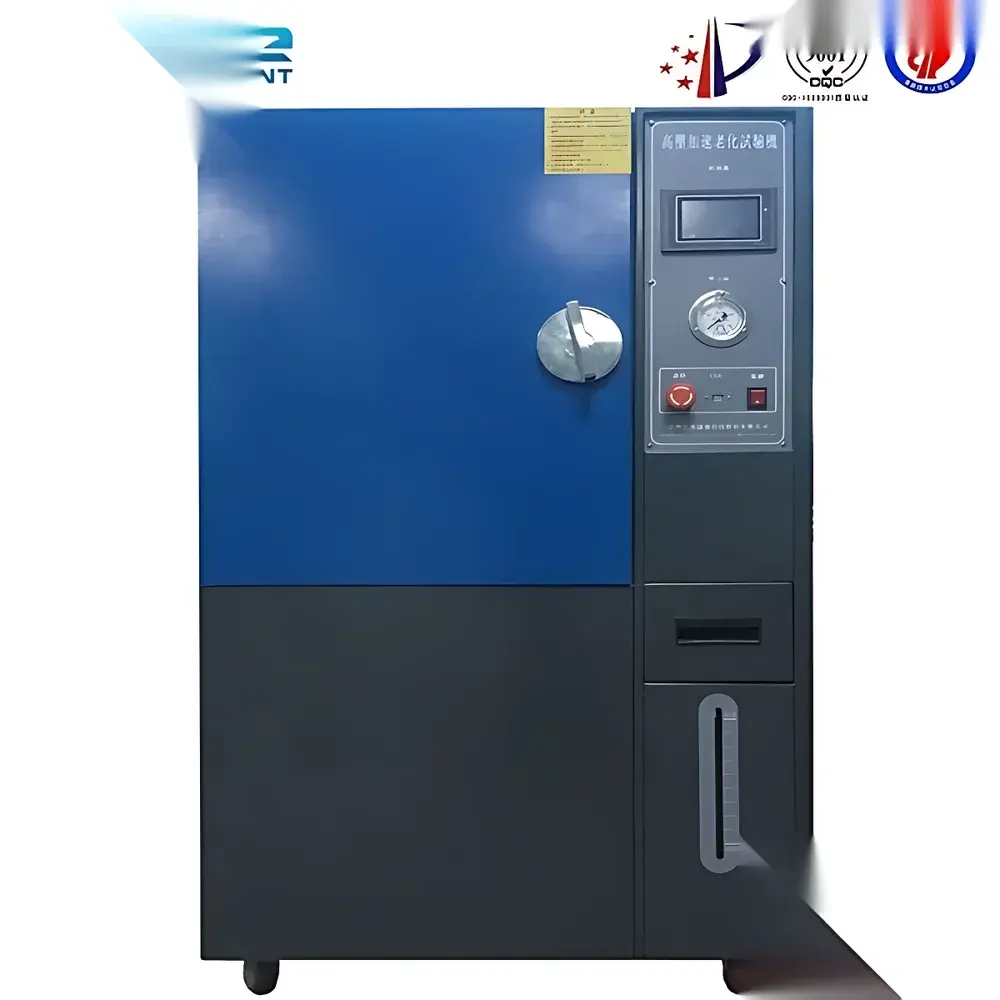
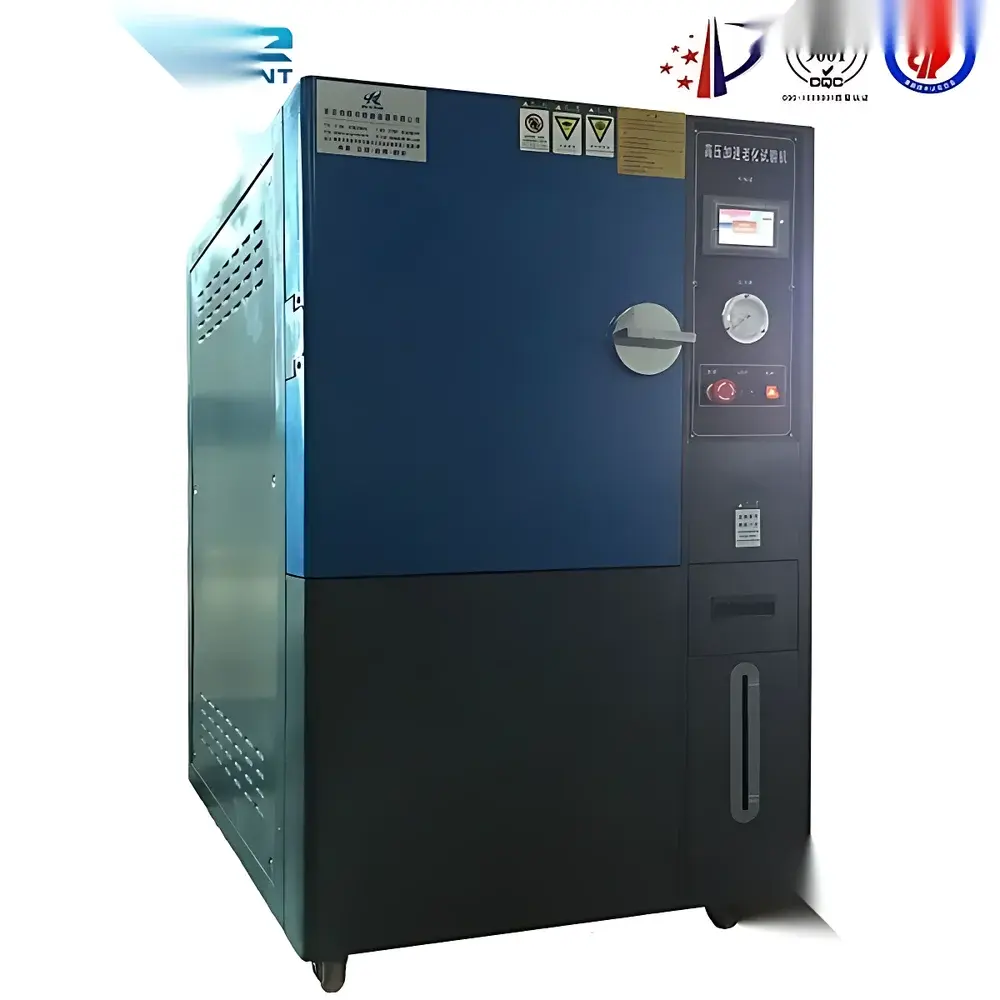
Stacked PCT Aging Test Chamber
| Brand | Other Brands |
|---|---|
| Origin | Imported |
| Manufacturer Type | General Distributor |
| Price | USD 3,950 (FOB) |
| Temperature Range | 105–132 °C (setpoint) |
| Temp. Uniformity | ±2.0 °C |
| Temp. Stability | ±0.5 °C |
| Humidity Control | 100 % RH (setpoint) |
| Humidity Stability | ±2.5 % RH |
| Humidity Uniformity | ±5.0 % RH |
| Pressure Range | 0.05–0.196 MPa (0.5–2 kgf/cm²) |
| Heating Rate | 35 min (ambient to 132 °C) |
| Pressurization Rate | 40 min (ambient to 0.196 MPa) |
Overview
The Stacked PCT Aging Test Chamber is a precision-engineered environmental stress test system designed for accelerated reliability evaluation of hermetically sealed and moisture-sensitive components under high-pressure saturated steam conditions. Operating on the principle of Pressure Cooker Test (PCT) per JEDEC JESD22-A102 and IPC-TM-650 2.6.25 standards, it subjects samples to elevated temperature, full saturation humidity (100 % RH), and controlled overpressure—accelerating moisture ingress and interfacial degradation mechanisms such as wire bond corrosion, delamination, and popcorning in plastic-encapsulated microelectronics. Its stacked configuration enables efficient vertical space utilization in QC labs and R&D facilities without compromising chamber integrity or thermal-hygrometric performance.
Key Features
- Triple-parameter closed-loop control: independent regulation of temperature (105–132 °C), relative humidity (100 % RH), and pressure (0.05–0.196 MPa) with real-time feedback via calibrated PT100 sensors and piezoresistive transducers.
- High-stability thermal architecture: insulated double-wall stainless steel construction with PID-controlled electric heating elements and forced convection airflow ensures ±0.5 °C temperature stability and ±2.0 °C uniformity across working volume.
- Saturated steam generation system: integrated boiler with automatic water level monitoring and replenishment prevents dry-out during extended cycles; non-saturated vapor is continuously purged to maintain thermodynamic equilibrium and consistent dew point.
- Digital operation interface: LED-based temperature controller and programmable timer initiate countdown only after chamber reaches setpoint—ensuring accurate exposure duration per test protocol (e.g., 96 h at 130 °C/0.18 MPa/100 % RH).
- Robust sealing design: one-piece molded silicone door gasket with compression-limited clamping mechanism achieves >10⁵ Pa differential pressure retention and exceeds 10,000-cycle durability per ISO 10993-12 validation guidelines.
- Corrosion-resistant interior: electropolished AISI 316L stainless steel chamber walls and shelves resist chloride-induced pitting and facilitate residue-free cleaning between qualification runs.
Sample Compatibility & Compliance
This chamber accommodates standard JEDEC trays (JEDEC MO-118), 200 mm wafers (with optional carrier fixtures), PCB assemblies up to 450 × 450 mm, and encapsulated semiconductor packages including QFP, BGA, and WLP formats. It supports test methodologies aligned with MIL-STD-883 Method 1008.3 (Moisture Resistance), AEC-Q200 stress requirements for passive components, and IEC 60068-2-66 (damp heat, steady state, accelerated). All operational parameters are traceable to NIST-calibrated reference instruments, and the system supports GLP-compliant audit trails when paired with external data loggers meeting FDA 21 CFR Part 11 requirements.
Software & Data Management
While the base model features standalone digital controllers, optional RS485/Modbus RTU interface enables integration into centralized lab management systems (LIMS) or MES platforms. Logged parameters—including chamber temperature, pressure, humidity, elapsed time, and alarm status—are timestamped and exportable in CSV format. For regulated environments, third-party validation packages (IQ/OQ/PQ) are available, including documented sensor calibration certificates, uncertainty budgets per ISO/IEC 17025, and deviation reporting templates compliant with ISO 9001:2015 Clause 8.7.
Applications
- Qualification of automotive-grade ICs prior to AEC-Q100 release.
- Failure mode analysis of multi-layer ceramic capacitors (MLCCs) under bias-HAST conditions.
- Seal integrity verification of medical device housings per ISO 11607-1.
- Process window development for conformal coating curing and adhesion testing.
- Accelerated aging of OLED display modules to assess cathode oxidation kinetics.
- Reliability screening of power modules used in EV inverters under combined thermal-mechanical-humidity stress.
FAQ
What standards does this chamber comply with for PCT testing?
It meets the environmental profile requirements of JEDEC JESD22-A102, IPC-TM-650 2.6.25, and MIL-STD-883 Method 1008.3. Full compliance documentation—including uncertainty analysis and sensor calibration reports—is provided upon request.
Can the chamber operate unattended for 96-hour qualification cycles?
Yes. The auto-replenishment system, redundant overtemperature/overpressure cutouts, and non-volatile timer memory ensure safe, uninterrupted operation. An optional remote monitoring module provides email/SMS alerts for critical alarms.
Is the interior suitable for testing chlorine-containing polymers?
The electropolished 316L stainless steel chamber and steam-generation path are resistant to chloride ion attack at operating temperatures and pressures; however, post-test neutralization and passivation are recommended per ASTM A967 for extended service life.
How is steam quality verified during operation?
Saturated steam purity is maintained by continuous venting of superheated fractions via a thermostatically actuated purge valve, with in-chamber dew point monitored indirectly through concurrent T/P/RH correlation per IAPWS-95 formulation.



