
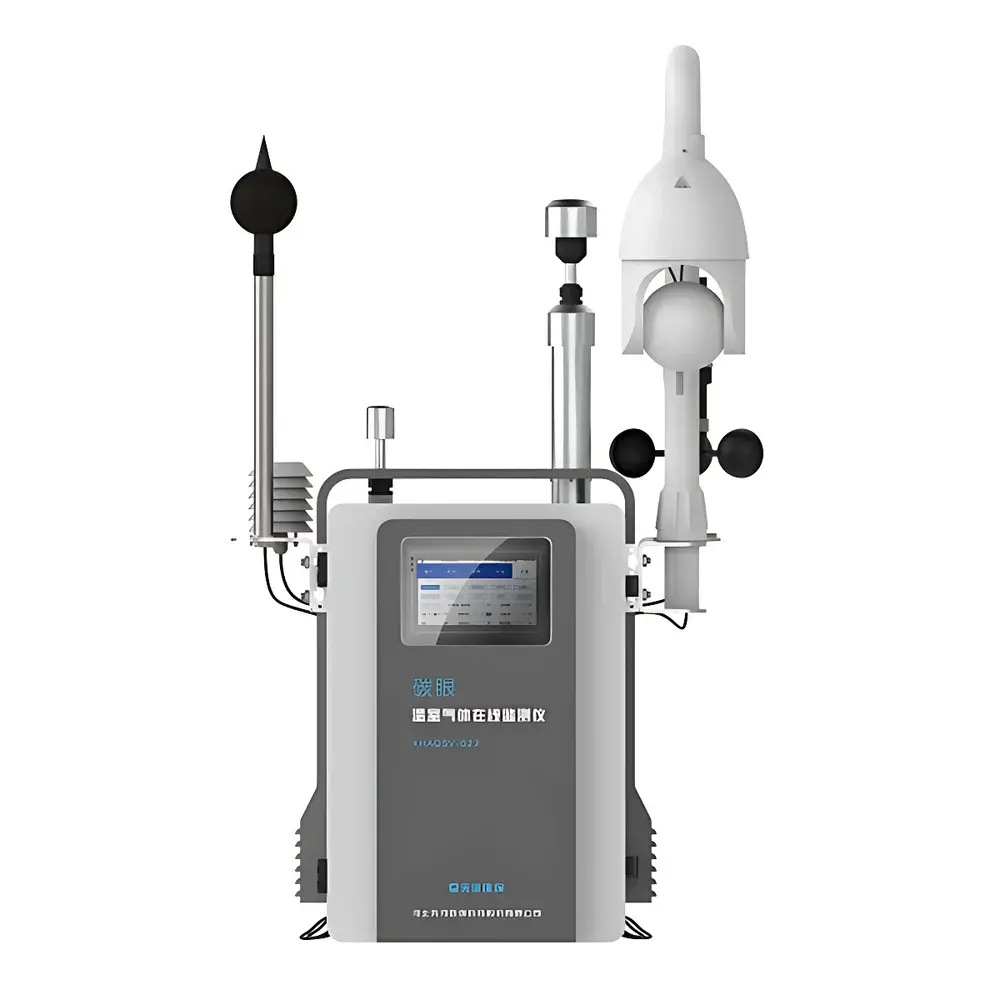
SAIL HERO XHAQSV-622 Continuous Greenhouse Gas Monitoring System
| Brand | SAIL HERO |
|---|---|
| Origin | Hebei, China |
| Manufacturer Type | Original Equipment Manufacturer (OEM) |
| Country of Origin | China |
| Model | XHAQSV-622 |
| Detection Principle | High-Precision Non-Dispersive Infrared (NDIR) Spectroscopy |
| Target Gases & Ranges | CO₂ (0–5000 ppm), optionally configurable for CH₄ (0–1000 ppm), N₂O (0–50 ppm), CO (0–100 ppm) |
| Response Time (T90) | ≤60 s |
| Repeatability | ±5% of reading |
| Data Storage | Local storage ≥5 years |
| Communication Interfaces | 4G (optional 5G), Ethernet, Wi-Fi, Bluetooth, USB |
| Environmental Monitoring Integration | Ambient temperature, relative humidity, atmospheric pressure, wind speed/direction, noise, and optional video surveillance |
| Calibration Modes | On-site span gas calibration + remote cloud-based calibration |
| Power Recovery | Automatic restart upon power restoration |
| Display | Integrated capacitive touch screen with local data visualization |
| GPS Positioning | Built-in GNSS module for georeferenced deployment |
| Data Transmission | Multi-center upload with breakpoint resume capability |
| System Diagnostics | Real-time subsystem health monitoring |
| Compliance Support | Designed to support ISO 14064-3 verification workflows and EPA Method TO-15/TO-11A-aligned operation (when configured per site-specific QA/QC protocols) |
Overview
The SAIL HERO XHAQSV-622 Continuous Greenhouse Gas Monitoring System is an integrated, field-deployable environmental instrumentation platform engineered for long-term, unattended quantification of key anthropogenic greenhouse gases (GHGs) in ambient air. Utilizing dual-beam, temperature-stabilized non-dispersive infrared (NDIR) spectroscopy, the system delivers trace-level detection of carbon dioxide (CO₂) as its primary analyte, with modular sensor bays enabling simultaneous or sequential measurement of methane (CH₄), nitrous oxide (N₂O), and carbon monoxide (CO)—a critical co-pollutant and indirect GHG precursor. Unlike point-sampling laboratory analyzers, the XHAQSV-622 employs a pump-suction sampling architecture with heated sample lines and dynamic flow control to ensure representative intake across variable meteorological conditions. Its design aligns with the technical requirements of continuous emissions monitoring systems (CEMS) used in regulatory compliance contexts, while also supporting scientific applications such as urban flux studies, landfill perimeter monitoring, and agricultural emission characterization.
Key Features
- Thermally regulated NDIR optical cells with active temperature stabilization (±0.1 °C) and integrated humidity compensation algorithms to minimize cross-sensitivity and drift under varying ambient conditions.
- Pump-driven, positive-pressure sampling manifold with particulate filtration, condensate trap, and flow-rate feedback control—optimized for stability in high-humidity or dusty environments.
- Embedded GNSS receiver providing real-time geographic coordinates (latitude/longitude/elevation) for spatially referenced data logging and geofencing-enabled alerting.
- Multi-protocol telemetry stack supporting concurrent 4G LTE (with optional 5G NR upgrade), Ethernet, Wi-Fi, and Bluetooth 5.0—enabling redundant data transmission paths and remote firmware updates.
- Onboard industrial-grade ARM Cortex-A53 processor running a real-time Linux OS, managing sensor acquisition, diagnostics, calibration routines, and secure TLS 1.2 encrypted data uploads.
- Capacitive touch HMI with 7-inch sunlight-readable display, supporting local trend visualization, alarm acknowledgment, manual calibration initiation, and diagnostic menu navigation without external devices.
- Comprehensive local data retention: internal eMMC storage holds ≥5 years of second-resolution time-series data (gas concentrations, meteorological parameters, system status logs) with SHA-256 checksum integrity verification.
Sample Compatibility & Compliance
The XHAQSV-622 is validated for use in outdoor ambient air monitoring scenarios compliant with ISO 14064-3 guidance on GHG assertion verification and consistent with the analytical performance expectations outlined in EPA Method TO-11A (for CO, CH₄) and TO-15 (for NMOCs, with appropriate GC-MS confirmation). While not certified as a reference method per EN 14625 or EPA PS-15, its NDIR modules meet the precision and response criteria required for Tier 2 inventory reporting under IPCC 2006 Guidelines. The system supports audit-ready data management through immutable timestamped records, electronic signature-capable calibration logs, and configurable audit trails aligned with GLP principles. All firmware and configuration files are digitally signed to prevent unauthorized modification.
Software & Data Management
Data acquisition and system orchestration are managed via SAIL HERO’s proprietary EdgeOS firmware, which implements a publish-subscribe architecture over MQTT v3.1.1 for scalable integration into central environmental data platforms. Raw sensor outputs undergo on-device linearization, zero/span correction, and interference correction using factory-characterized spectral response matrices. The system generates standardized JSON payloads containing ISO 8601 timestamps, IUPAC-compliant gas identifiers (e.g., “CO2”, “CH4”), uncertainty estimates, and metadata flags (e.g., “calibration_active”, “flow_low”, “temp_out_of_range”). Cloud synchronization includes automatic resumption from last acknowledged packet following network interruption. Remote calibration validation is supported via secure API endpoints requiring OAuth 2.0 authentication and role-based access control.
Applications
- Urban air quality networks tracking CO₂ plumes correlated with traffic density and building energy consumption patterns.
- Landfill and wastewater treatment plant boundary monitoring to quantify fugitive CH₄ emissions against regulatory thresholds.
- Agricultural research sites assessing soil-atmosphere exchange of N₂O under varying fertilizer regimes and irrigation schedules.
- Industrial facility perimeter monitoring for early detection of process leaks involving CO or CO₂-rich off-gas streams.
- Smart city infrastructure where GHG data is fused with meteorological and acoustic metrics to model microclimate impacts and inform low-carbon planning.
- Educational and citizen science deployments leveraging its modular expandability and open data interface for curriculum-integrated environmental measurement projects.
FAQ
Does the XHAQSV-622 comply with EPA or EU regulatory certification requirements for official emissions reporting?
The instrument is designed to meet the performance specifications referenced in EPA Methods TO-11A and TO-15 for field-deployed analyzers but is not individually certified as a Reference Method. Regulatory acceptance depends on site-specific QA/QC protocols, including co-location with certified reference instruments and documented uncertainty budgets.
Can the system operate autonomously during extended power outages?
It features automatic recovery upon AC power restoration; however, sustained operation requires external uninterruptible power supply (UPS) integration. Battery backup duration is application-dependent and must be specified during system configuration.
Is raw spectral data accessible for third-party algorithm development?
Yes—full-resolution interferogram data and calibrated absorbance spectra are available via secure SSH access for qualified research partners under NDA-bound data use agreements.
What maintenance intervals are recommended for field deployment?
Filter replacement every 3 months, annual NDIR cell verification using certified span gases, and biannual full-system functional check per SAIL HERO Maintenance Manual Rev. 4.2.
How is data security ensured during wireless transmission?
All telemetry uses TLS 1.2 encryption with certificate pinning; device authentication employs X.509 client certificates; no default credentials are shipped, and password policies enforce minimum entropy requirements.







