
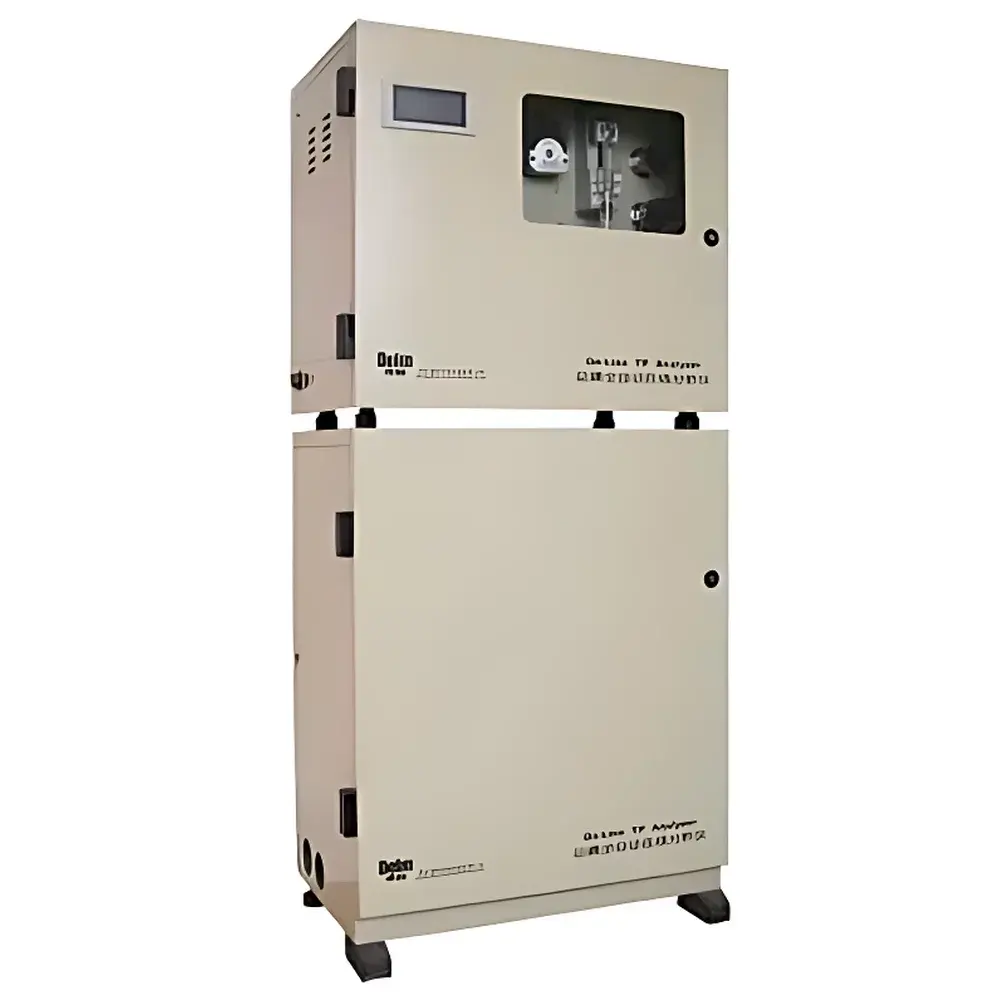
XHZ2004 Total Phosphorus Online Analyzer
| Origin | Hebei, China |
|---|---|
| Manufacturer Type | Authorized Distributor |
| Origin Category | Domestic (China) |
| Model | XHZ2004 |
| Price | Available Upon Request |
| Measurement Principle | Flow Injection Analysis (FIA) with High-Temperature Acid Digestion |
| Range | 0.05–50 mg/L TP |
| Detection Limit | 0.05 mg/L |
| Resolution | 0.01 mg/L |
| Accuracy & Precision | ±10% of Full Scale (FS) |
| Minimum Cycle Time | 12 min |
| Digestion Conditions | 130 °C, 0.7 MPa |
| Dimensions (W×H×D) | 620 × 1500 × 500 mm |
| Weight | 110 kg |
| Power Supply | 220 V AC, 50 Hz |
| Power Consumption | 250 W |
| Sample Handling | Direct injection—no pretreatment or post-run cleaning required |
| Maintenance Interval | >6 months under continuous operation |
Overview
The XHZ2004 Total Phosphorus Online Analyzer is an industrial-grade, fully automated water quality monitoring system engineered for continuous, unattended determination of total phosphorus (TP) in natural surface waters, municipal drinking water supplies, wastewater effluents, and activated sludge process streams. It operates on the validated principle of flow injection analysis (FIA) coupled with high-temperature, high-pressure acid digestion—ensuring complete oxidation of all organic and inorganic phosphorus species (orthophosphate, condensed phosphates, organophosphates) into measurable orthophosphate prior to colorimetric detection. Unlike segmented flow or discrete batch analyzers, the FIA architecture delivers superior reproducibility, reduced reagent carryover, and precise temporal resolution—critical for real-time compliance monitoring and process control in regulated environments.
Key Features
- True online FIA-based methodology—globally unique in its integration of pressurized thermal digestion (130 °C, 0.7 MPa) directly within the fluidic path, eliminating offline digestion steps and associated contamination risks.
- Wide dynamic measurement range: 0.05–50 mg/L TP, supporting both low-level environmental surveillance (e.g., oligotrophic lakes) and high-concentration industrial discharge monitoring.
- No sample filtration, centrifugation, or acidification required—raw water samples are introduced directly; the system’s integrated peristaltic sampling module ensures representative intake without clogging or sediment interference.
- Ultra-low operational cost: Reagent consumption is optimized to ≤$0.004 USD per analysis (based on standard phosphomolybdate blue method chemistry), enabling sustainable long-term deployment.
- Passive maintenance design: Sealed digestion chamber, corrosion-resistant wetted materials (PTFE, quartz, borosilicate glass), and industrial-grade electrical components (including certified IEC 61000-4 EMC-compliant power supplies and UL-listed solenoid valves) ensure >6 months mean time between interventions (MTBI).
- Compact footprint (620 × 1500 × 500 mm) and modular chassis facilitate wall-mounting or integration into existing SCADA-controlled cabinet systems.
Sample Compatibility & Compliance
The XHZ2004 accepts untreated aqueous samples with turbidity ≤200 NTU and suspended solids ≤150 mg/L—typical of raw influent, secondary effluent, and reservoir water. It complies with core methodological requirements of ISO 15681-1:2003 (Water quality — Determination of phosphorus — Part 1: Spectrometric determination after digestion), and aligns with the analytical rigor expected under EPA Method 365.4 and ASTM D515-89 (Standard Test Methods for Phosphorus in Water). While not pre-certified for regulatory reporting, its performance characteristics—including ±10% FS accuracy, 0.05 mg/L detection limit, and <2% RSD repeatability over 72 h—meet data quality objectives (DQOs) for Class II and III monitoring under EU Water Framework Directive (WFD) Annex V and China’s HJ 670–2013 standard for online TP analyzers.
Software & Data Management
Embedded firmware supports Modbus RTU/TCP and OPC UA protocols for seamless integration into plant-wide automation networks. Local data logging stores ≥30 days of 10-minute interval results (timestamped TP concentration, digestion temperature/pressure, reagent usage, fault codes) with cyclic overwrite. Optional cloud gateway enables encrypted HTTPS transmission to centralized dashboards (e.g., Grafana, Ignition SCADA). Audit trails comply with GLP/GMP principles: all parameter changes, calibration events, and maintenance logs are time-stamped, user-ID tagged, and immutable. No FDA 21 CFR Part 11 electronic signature capability is included by default; optional validation packages available upon request.
Applications
- Real-time TP trending at wastewater treatment plant (WWTP) influent/effluent points for nutrient removal optimization and regulatory discharge reporting.
- Early-warning monitoring of eutrophication risk in reservoirs and river basins—correlating TP spikes with algal bloom precursors.
- Performance verification of tertiary phosphorus removal units (e.g., iron salt dosing, sand filtration, membrane bioreactors).
- Compliance support for national discharge permits (e.g., China’s GB 18918–2002, US NPDES permits) requiring hourly or sub-hourly TP data.
- Research-grade longitudinal studies requiring high-frequency TP profiling under varying hydrological conditions.
FAQ
Does the XHZ2004 require daily calibration or standardization?
No—factory-calibrated photometric cell and stable FIA flow dynamics enable drift-free operation for up to 7 days; weekly verification with NIST-traceable phosphate standards is recommended.
Can it measure total phosphorus in seawater or brackish water?
Not without dilution and matrix-matched calibration; high chloride content interferes with molybdenum blue complex formation—application-specific validation required.
What is the expected lifetime of the digestion reactor and optical cell?
The fused quartz digestion tube exhibits >5-year service life under continuous 130 °C operation; the LED-photodiode detection module is rated for 50,000 hours MTBF.
Is remote diagnostics supported?
Yes—via secure SSH access to embedded Linux OS; diagnostic mode provides live flow rate, pressure trace, temperature stability metrics, and valve actuation status.
How does it handle air bubbles or particulate entrainment?
Integrated ultrasonic degassing and dual-stage particle traps (10 µm + 5 µm) upstream of the injector prevent optical interference and flow disruption.
Related Products







