
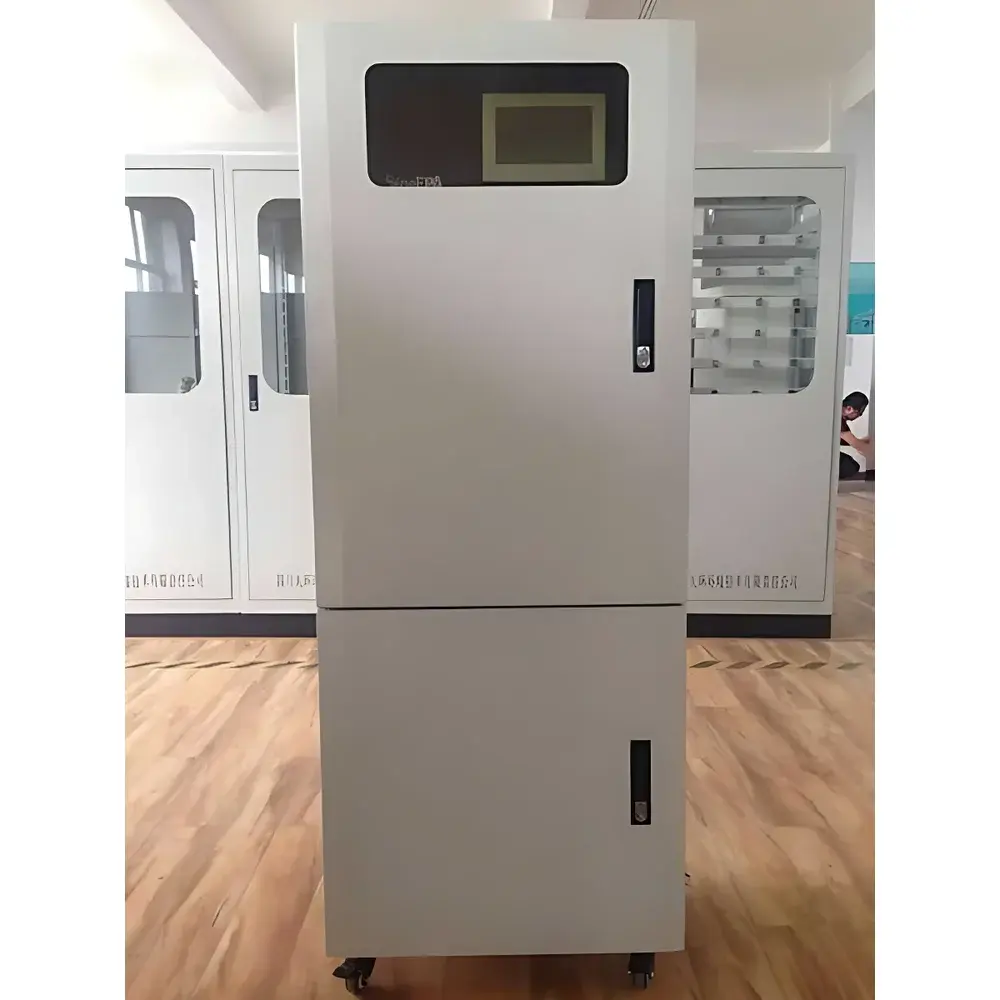
SAIL HERO SERES 2000 Pb Automated Online Lead Analyzer for Water Quality
| Brand | SAIL HERO |
|---|---|
| Origin | Hebei, China |
| Manufacturer Type | Direct Manufacturer |
| Product Origin | Domestic (China) |
| Model | SERES 2000 Pb |
| Instrument Type | Online Analyzer |
| Detection Principle | Spectrophotometry (High-Temperature Oxidation + Porphyrin-Based Colorimetry) |
| Target Analyte | Lead (Pb) |
| Analysis Time | ≤30 min per cycle |
| Accuracy/Precision | ±10% of full scale |
| Resolution | 0.01 mg/L |
| Detection Range | 0.05–5.00 mg/L (typical, configurable per regulatory requirements) |
| Sample Inlet | Non-contact peristaltic pumping with modified PTFE tubing |
| Digestion System | High-temperature, high-pressure oxidation module (up to 120 °C, 0.3 MPa) |
| Photometric Unit | High-stability dual-beam spectrophotometer with 520 nm LED source and thermoelectrically stabilized detector |
| Reagent Delivery | Infrared optical reagent metering system with <±0.5% volumetric repeatability |
| Valve System | Imported multi-position selection valve (ceramic rotor, chemically inert) |
| Temperature Control | PID-regulated thermal management (±0.3 °C stability over operating range) |
Overview
The SAIL HERO SERES 2000 Pb is an automated online analyzer engineered for continuous, unattended determination of total lead (Pb) in aqueous matrices including industrial effluents, municipal wastewater, surface water, and treated discharge streams. It operates on a validated two-stage analytical principle: first, high-temperature oxidative digestion converts all lead species—including organolead compounds, colloidal Pb, and particulate-bound fractions—into soluble Pb²⁺ ions; second, the liberated Pb²⁺ reacts quantitatively with a proprietary porphyrin-based chromogenic reagent under controlled pH and surfactant-free conditions to form a stable, orange-yellow complex. This complex exhibits maximal absorbance at 520 nm, enabling precise photometric quantification via a thermally stabilized dual-beam spectrophotometric cell. The system complies with foundational methodological frameworks referenced in ISO 6627 (water quality — determination of lead — spectrophotometric method), EPA Method 200.7 (ICP-AES), and supports equivalency validation against US EPA Method 7000B (colorimetric) when configured with certified reference materials and documented calibration protocols.
Key Features
- Robust high-pressure, high-temperature digestion module (up to 120 °C / 0.3 MPa) ensures complete oxidation of refractory lead species, delivering representative total Pb measurement in complex wastewater matrices.
- Ceramic-core multi-position selection valve enables reliable, low-maintenance fluidic routing with >500,000 actuation cycles lifetime and resistance to aggressive reagents and suspended solids.
- Infrared optical reagent metering system eliminates mechanical wear and delivers volumetric precision better than ±0.5%, minimizing drift and enhancing long-term calibration stability.
- Non-contact peristaltic sampling with fluoropolymer-modified PTFE tubing resists chemical degradation from acidic digestates and oxidizing agents, extending service intervals beyond 12 months under typical operational loads.
- Dual-beam photometric architecture with temperature-stabilized LED source and thermoelectrically cooled photodiode detector ensures <0.002 AU baseline stability over 8-hour continuous operation.
- Integrated PID-controlled thermal management maintains reaction and detection zones within ±0.3 °C, reducing temperature-induced spectral variance and supporting compliance with GLP traceability requirements.
Sample Compatibility & Compliance
The SERES 2000 Pb accepts raw or pre-filtered (≤80 µm) liquid samples with turbidity up to 500 NTU and chloride concentrations ≤10,000 mg/L. It is designed for deployment in Class I–III monitoring stations per China’s HJ 353–2019 standard for online water quality analyzers, and its measurement traceability aligns with ISO/IEC 17025:2017 general requirements for competence of testing and calibration laboratories. Data integrity safeguards include audit-trail-enabled event logging, user-access-level permissions, and optional 21 CFR Part 11-compliant electronic signature modules for regulated environments. All reagents are supplied in sealed, barcode-labeled cartridges to support inventory tracking and expiration-aware usage.
Software & Data Management
The embedded Linux-based control platform runs SAIL HERO’s AquaView™ firmware, providing real-time status visualization, automatic calibration scheduling (daily zero/span checks), and adaptive fault diagnostics. Raw absorbance data, temperature logs, valve actuation history, and reagent consumption metrics are timestamped and stored locally for ≥90 days. Export formats include CSV, Modbus TCP, and OPC UA for seamless integration into SCADA, DCS, or central EMS platforms. Remote configuration and firmware updates are supported via secure TLS 1.2–encrypted HTTP(S) interface, with optional SNMP v3 trap generation for network-level alerting.
Applications
- Continuous compliance monitoring of Pb discharges from electroplating, battery manufacturing, and metal finishing facilities under local environmental permits.
- Early-warning detection of lead leaching in municipal wastewater treatment plant influent and effluent streams.
- Long-term trend analysis in riverine and reservoir monitoring networks where anthropogenic Pb contamination must be distinguished from geogenic background levels.
- Support for ISO 14001 environmental management systems through automated, auditable data capture and report generation (daily/weekly/monthly summary PDFs with QC flagging).
- Integration into smart water grid architectures for predictive maintenance modeling based on historical reagent consumption, digestion efficiency decay, and photometric signal-to-noise trends.
FAQ
What sample pretreatment is required prior to analysis?
No filtration or acidification is required for most wastewater applications; however, samples with >100 mg/L suspended solids should pass through an 80 µm inline filter to prevent clogging of the digestion chamber inlet.
Does the system support multi-analyte expansion?
The SERES 2000 platform architecture allows modular addition of Cd, Cr(VI), or As analysis modules via shared fluidics and power bus—though each requires dedicated reagent kits and wavelength-specific photometric cells.
How often must calibration standards be verified?
A three-point calibration (zero, mid-range, high-range) is recommended weekly using NIST-traceable Pb standard solutions; daily zero/span verification is performed automatically during idle cycles.
Can the instrument operate in unheated outdoor enclosures?
Yes—the SERES 2000 Pb operates continuously within 5–40 °C ambient temperature; integrated thermal insulation and heater elements maintain internal setpoints down to −10 °C enclosure ambient when paired with optional climate-controlled housing.
Is remote diagnostic support available?
Yes—via encrypted SSH tunnel and built-in VNC server; SAIL HERO’s technical support team can perform live system health checks, log review, and parameter optimization with customer authorization.







