
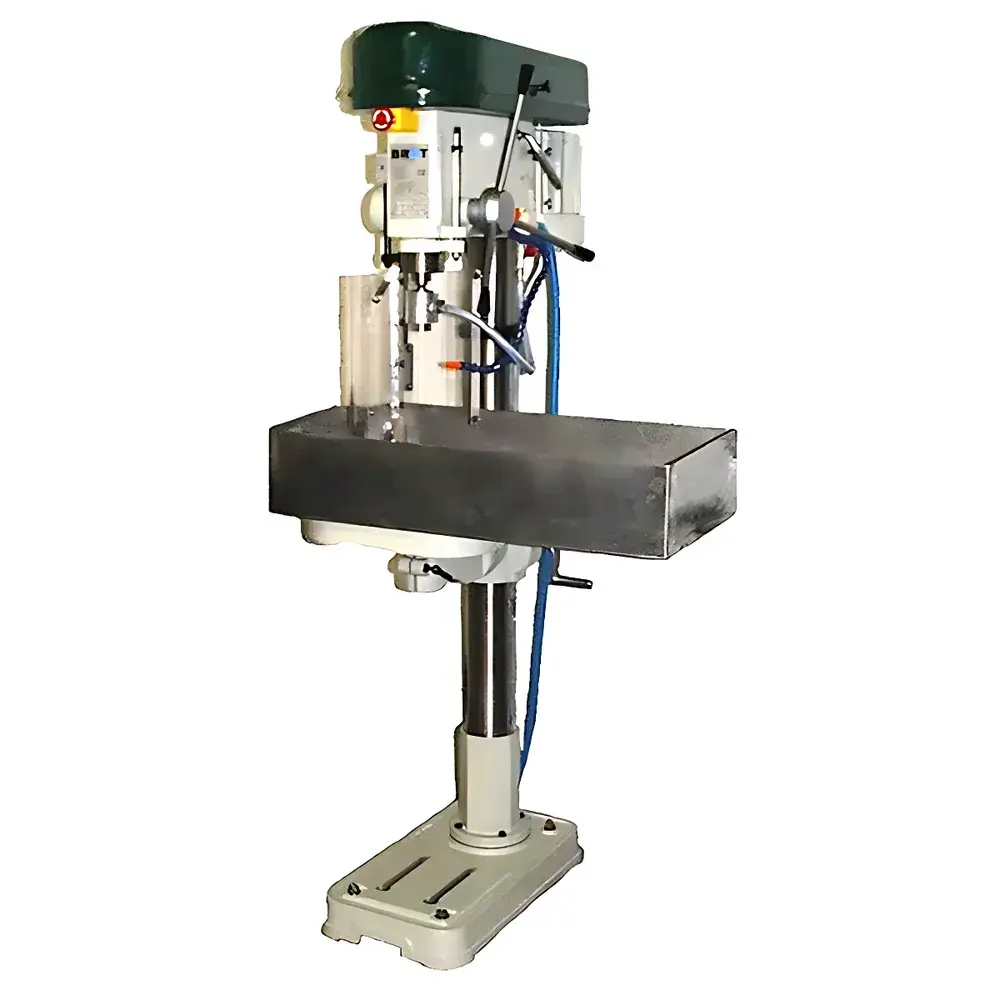
BROT J-22-10 Core Drilling Machine for Petrographic Thin Section Preparation
| Origin | France |
|---|---|
| Supplier Type | Authorized Distributor |
| Import Status | Imported |
| Model | D2210 |
| Power Supply | 400 V, 3-phase |
| Frequency | 50/60 Hz |
| Main Motor | 750 W |
| Coolant Pump Motor | 150 W |
| Rotational Speed | 1800 / 2500 / 3500 rpm (3-step adjustable) |
| Core Diameter Range | Φ4″–Φ6″ (101.6–152.4 mm) |
| Core Length Capacity | 0.5″–3″ (12.7–76.2 mm) |
| Sample Stage Adjustment | X-Y translation + ±45° tilt |
| Maximum Core Height | 120 mm |
| Noise Level | <70 dB(A) |
| Net Weight | 150 kg |
| Dimensions (L×W×H) | 1000 × 800 × 2000 mm |
Overview
The BROT J-22-10 Core Drilling Machine is a precision-engineered system designed specifically for the preparation of petrographic and reservoir rock thin sections in geological laboratories, core analysis centers, and petroleum research facilities. It employs diamond-impregnated coring bits operating under controlled rotational shear and continuous coolant delivery to extract intact cylindrical cores from consolidated sedimentary, igneous, and metamorphic rock specimens. The machine adheres to the fundamental principles of mechanical core drilling—where torque, axial feed rate, and thermal management are balanced to minimize microfracturing and preserve textural integrity. Its modular architecture supports both internal (through-coolant) and external (peripheral coolant) drilling configurations, enabling consistent core recovery across heterogeneous lithologies including sandstones, carbonates, shales, and volcanic tuffs. Designed for compliance with ISO 9001-certified laboratory workflows, the J-22-10 integrates seamlessly into standardized core logging and petrophysical evaluation protocols used by upstream E&P teams and academic geoscience departments.
Key Features
- Diamond-tipped coring tools with optimized bond matrix for extended bit life and minimal grain pull-out during rock penetration
- Three-step variable-speed motor (1800 / 2500 / 3500 rpm) allowing selection of optimal rotational velocity based on rock hardness (e.g., lower speed for brittle shales, higher speed for dense limestones)
- Integrated coolant circulation system featuring a dedicated 150 W pump and flexible high-pressure hose routing for both internal drill-bit cooling and external surface lubrication
- Adjustable sample stage with independent X- and Y-axis translation (±50 mm range) and ±45° angular tilt capability—enabling precise orientation control for anisotropic sampling and bedding-plane parallel/core-perpendicular drilling
- Robust cast-iron frame with vibration-damping base and full polycarbonate safety guard compliant with EN 61000-6-2 (EMC) and EN 60204-1 (machine safety)
- Electrical system rated for industrial 400 V three-phase supply, incorporating thermal overload protection, emergency stop circuitry, and noise suppression below 70 dB(A) at operator position
Sample Compatibility & Compliance
The J-22-10 accommodates rock specimens up to 1 m in length and accommodates standard core diameters ranging from 4 inches (101.6 mm) to 6 inches (152.4 mm), aligning with ASTM D4543 (Standard Practice for Preparing Rock Core Specimens) and ISO 14689-1 (Geotechnical Investigation and Testing — Identification and Classification of Rock). Core lengths between 0.5″ and 3″ (12.7–76.2 mm) are supported without re-fixturing, facilitating rapid batch processing of multiple samples for SEM-EDS, porosity/permeability testing, or cathodoluminescence analysis. All mechanical adjustments—including stage tilt, lateral positioning, and vertical clearance—are lockable via stainless steel clamps to ensure positional repeatability within ±0.1° angular tolerance and ±0.2 mm linear resolution. The system meets CE marking requirements and is compatible with GLP-compliant documentation practices when paired with traceable calibration logs and maintenance records.
Software & Data Management
While the J-22-10 operates as a standalone electromechanical system without embedded firmware or touchscreen interface, it is fully compatible with third-party laboratory information management systems (LIMS) through its standardized electrical I/O signals (24 V DC trigger outputs for start/stop and coolant activation). Operators may log drilling parameters—including selected speed setting, coolant flow status, total operational time, and specimen ID—using paper-based SOP forms or digital templates aligned with ISO/IEC 17025 accreditation requirements. Optional integration with barcode-scanned sample tracking modules enables audit-ready linkage between physical core output and digital metadata repositories. All safety interlocks and emergency cutoff functions comply with IEC 61508 functional safety standards for Category 3 architectures.
Applications
- Preparation of oriented thin sections for optical microscopy and polarized light analysis in structural geology studies
- Extraction of representative plugs for routine core flooding experiments and relative permeability measurements
- Sampling of cemented formations for pore network characterization using micro-CT scanning
- Targeted coring of fossiliferous or vuggy intervals to preserve biogenic structures prior to geochemical microsampling
- Quality assurance drilling for certified reference materials (CRMs) used in inter-laboratory proficiency testing programs
FAQ
What core diameters does the J-22-10 support?
It accepts standard rock core diameters of 4 inches (101.6 mm) and 6 inches (152.4 mm), with optional adapter kits available for intermediate sizes.
Is coolant delivery mandatory during operation?
Yes—continuous coolant flow is required to prevent thermal damage to both the diamond bit and rock sample; the integrated 150 W pump ensures stable pressure and flow rate across all speed settings.
Can the machine be used for non-rock materials such as concrete or asphalt?
While primarily engineered for geological specimens, the J-22-10 may process hardened cementitious or bituminous materials provided appropriate diamond bit geometry and feed rate adjustments are applied per ASTM C42/C1093 guidelines.
Does the system include calibration certification?
Factory calibration certificates for motor speed accuracy, stage positioning repeatability, and acoustic emission levels are supplied with each unit and conform to ISO/IEC 17025 traceability requirements.
What maintenance intervals are recommended?
Lubrication of linear guide rails every 200 operational hours, coolant filter replacement every 500 hours, and annual verification of electrical grounding resistance and emergency stop functionality are advised per the manufacturer’s service manual.





