
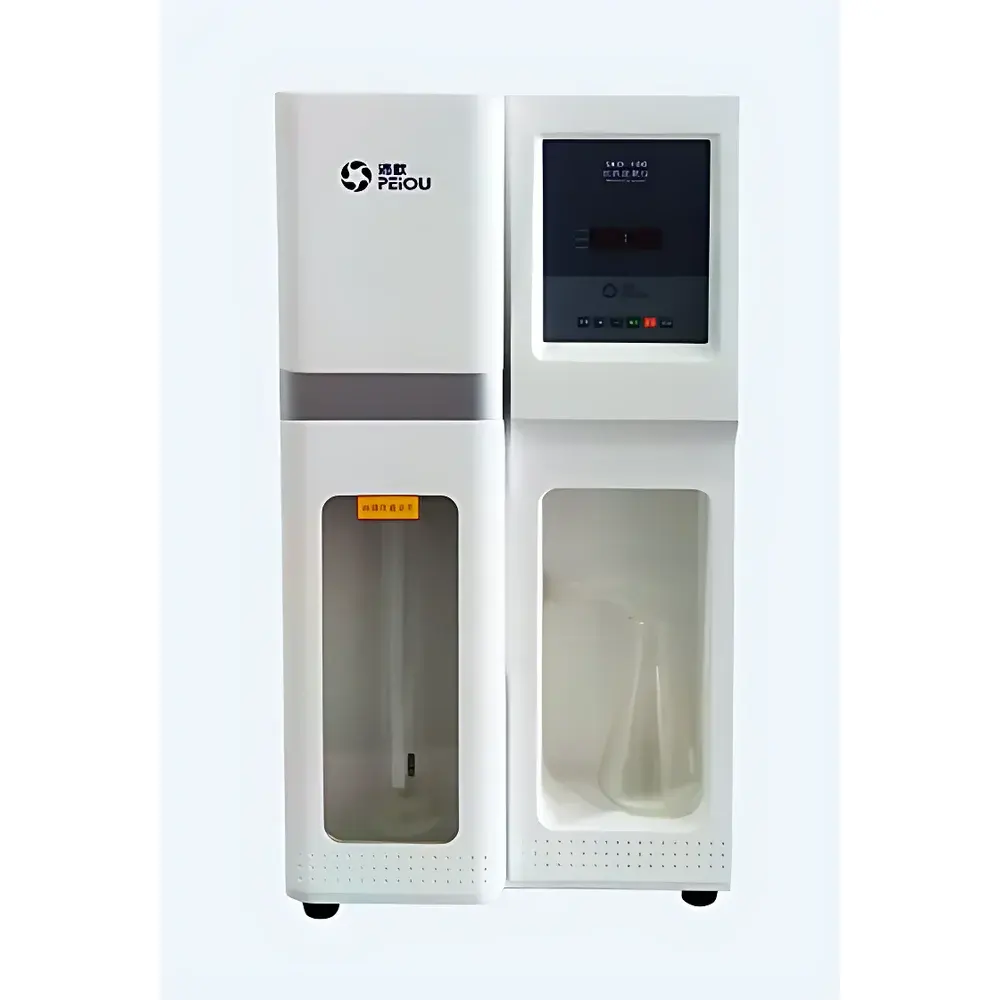
Peiou SKD-100 Automated Kjeldahl Nitrogen Determinator
| Brand | Peiou |
|---|---|
| Origin | Shanghai, China |
| Manufacturer Type | Authorized Distributor |
| Country of Origin | China |
| Model | SKD-100 |
| Instrument Type | Kjeldahl Nitrogen Determinator |
| Automation Level | Semi-Automatic |
| Nitrogen Determination Range | 0.1–240 mg N |
| Distillation Time | 3–8 min per sample |
| Repeatability | RSD ≤ 0.5% |
| Sample Weight Capacity | ≤6 g (solid) / ≤16 mL (liquid) |
| Nitrogen Recovery Rate | >99.5% |
| Power Consumption | 750–1500 W |
| Dimensions (L×W×H) | 370 × 300 × 680 mm |
| Display | LED digital display |
| Alkali Addition Time | 0–99 s |
| Distillation Volume Control | 14–28 mL/min |
| Programmable Programs | 10 pre-set distillation/alkali addition protocols |
| Safety Features | Overpressure protection, dry-run prevention via real-time liquid level monitoring, emergency stop function |
| Housing Material | Integrated molded ABS engineering plastic |
| Tubing Material | PEIOU proprietary acid-/alkali-/heat-resistant polymer tubing |
| Weight | 15 kg |
| Power Supply | AC 220 V ±10%, 50 Hz |
| Water Supply Requirement | ≥0.15 MPa pressure, ≤20 °C inlet temperature |
Overview
The Peiou SKD-100 Automated Kjeldahl Nitrogen Determinator is a semi-automated benchtop instrument engineered for precise and reproducible quantification of total nitrogen content in organic and inorganic samples via the classical Kjeldahl digestion–distillation–titration methodology. It operates on the principle of acid digestion (typically using concentrated H2SO4 with catalysts), followed by alkaline distillation to liberate ammonium ions as ammonia gas, which is then trapped in boric acid solution and quantified by titration or colorimetric detection. Designed for routine analysis in regulated and research environments, the SKD-100 delivers high recovery (>99.5%) and exceptional repeatability (RSD ≤ 0.5%) across diverse matrices—including foodstuffs, feedstuffs, soils, wastewater, pharmaceutical excipients, and botanical materials—while maintaining full compliance with internationally recognized standard methods including AOAC 984.27, ISO 8968-1, ISO 1871, USP , and GB/T 5009.5.
Key Features
- Integrated ABS engineering plastic housing—molded as a single unit—to eliminate galvanic corrosion, electrical leakage risks, and structural degradation in aggressive acidic/alkaline operational environments.
- Proprietary high-performance polymer tubing system rated for continuous exposure to hot concentrated sulfuric acid, sodium hydroxide, and steam; validated for ≥3 years of service without replacement.
- Pressure-driven alkali delivery system: eliminates conventional peristaltic or diaphragm alkali pumps, removing a major failure point while ensuring consistent volumetric dosing and minimizing carryover between runs.
- Intelligent steam generation control with real-time overpressure regulation and balanced vapor output—prevents sample back-suction, foaming, and cross-contamination during distillation.
- Microcontroller-based operation enabling programmable sequences for preheating, washing, alkali addition, distillation time (0–99 min), and distillate volume (14–28 mL/min).
- Dual safety architecture: integrated liquid-level sensing prevents dry-heating of the distillation flask; hardware-level emergency stop provides immediate thermal and fluidic shutdown.
Sample Compatibility & Compliance
The SKD-100 accommodates solid samples up to 6 g and liquid samples up to 16 mL per run, supporting both macro- and semi-micro Kjeldahl workflows. Its robust design meets essential requirements for GLP-compliant laboratories conducting nitrogen analysis under ISO/IEC 17025-accredited testing programs. While the instrument itself does not embed electronic audit trails, its programmable method storage (10 user-defined protocols), deterministic alkali dosing, and repeatable distillation kinetics facilitate full traceability when paired with external LIMS or paper-based SOP documentation. All wetted components conform to USP Class VI biocompatibility standards and are compatible with cleaning-in-place (CIP) procedures using dilute nitric or citric acid solutions.
Software & Data Management
The SKD-100 features an embedded microcontroller interface with LED digital display—providing real-time feedback on operating status, elapsed time, and active program phase. No external PC or proprietary software is required for basic operation. All 10 programmable distillation/alkali profiles—including parameters such as alkali addition duration (0–99 s), steam power modulation (up to 1500 W), and condensate volume thresholds—are stored non-volatile memory and recalled via front-panel navigation. For regulatory environments requiring electronic records, the device supports manual transcription into compliant data systems; optional RS-232 or USB-to-serial adapters (sold separately) enable integration with third-party titrators or laboratory information management systems (LIMS) that support ASCII-based command protocols.
Applications
- Food & Feed Industry: Crude protein estimation in cereals, dairy products, meat, pet food, and plant-based alternatives per AOAC and Codex Alimentarius guidelines.
- Agricultural & Environmental Labs: Total nitrogen determination in soil extracts, compost, manure, and wastewater effluents per EPA Method 351.2 and ISO 14256-1.
- Pharmaceutical Quality Control: Quantitative assessment of nitrogen-containing active pharmaceutical ingredients (APIs), excipients, and residual ammonium salts in final dosage forms.
- Academic & Research Settings: Teaching Kjeldahl methodology in analytical chemistry curricula; supporting nitrogen balance studies in nutrition, agronomy, and environmental science.
- Tobacco & Textile Testing: Volatile basic nitrogen (VBN) and ammoniacal nitrogen profiling in cured leaf and fiber processing streams.
FAQ
Is the SKD-100 compliant with FDA 21 CFR Part 11?
No—the SKD-100 is a stand-alone hardware controller without electronic signature capability, audit trail generation, or user access controls. It may be used in Part 11-regulated environments only when operated within documented paper-based or LIMS-integrated workflows that satisfy predicate rule requirements.
What maintenance intervals are recommended for tubing and seals?
PEIOU specifies no scheduled replacement for the proprietary acid/alkali-resistant tubing under normal use conditions; field validation confirms ≥36 months of uninterrupted service. O-rings and flask gaskets should be inspected quarterly and replaced if compression set or cracking is observed.
Can the SKD-100 be connected to an automatic titrator?
Yes—via optional serial interface (RS-232 or USB-to-serial), the SKD-100 can trigger titration start upon distillate collection completion using TTL-level or ASCII command signaling, provided the titrator supports configurable external initiation.
Does the instrument include digestion module functionality?
No—the SKD-100 is a dedicated distillation unit. Sample digestion must be performed externally using a separate Kjeldahl digester (e.g., PEIOU SKD-200 series or equivalent) prior to loading digested samples into the SKD-100.
What is the maximum allowable digest volume for injection into the distillation chamber?
The distillation flask accepts up to 100 mL of digest solution. Users must ensure digest clarity and absence of particulates to prevent clogging of the alkali inlet or steam dispersion nozzle.
Related Products






