
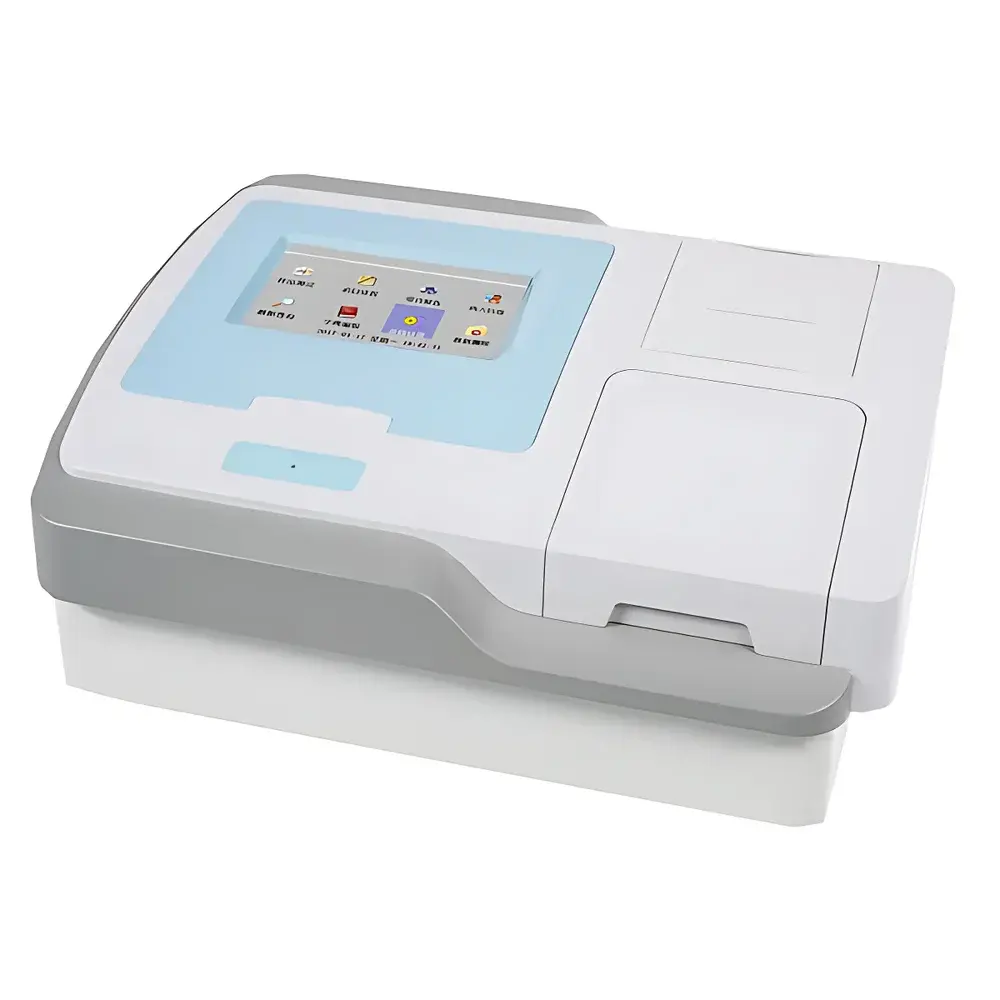

Peiou 318C+ Microplate Reader
| Brand | Peiou |
|---|---|
| Origin | Shanghai, China |
| Manufacturer Type | Authorized Distributor |
| Product Origin | Domestic (China) |
| Model | 318C+ |
| Price Range | USD 4,200–7,000 (FOB) |
| Functionality | Multimode |
| Automation Level | Fully Automated |
| Assay Methods | Absorbance, Coefficient Concentration, Standard Concentration, Linear Standard Curve, Single-Threshold (Pass/Fail), Dual-Threshold (Pass/Borderline/Fail), Categorical Classification, Column Subtraction |
| Curve Fitting | Polynomial, Linear, Log-Log, 4-Parameter Logistic (4PL), 5-Parameter Logistic (5PL) |
| Detector Light Source | Imported Halogen Lamp |
| Wavelength Range | 400–800 nm (Standard Filters: 405, 450, 492, 630 nm |
| Absorbance Range | 0.000–4.000 A |
| Linearity Range | 0.000–4.000 A (R² ≥ 0.999) |
| Measurement Speed | 5 s per 96-well plate (single wavelength), 10 s (dual wavelength) |
| Absorbance Resolution | 0.001 A |
| Photometric Accuracy | ±0.01 A (0 ≤ A < 1.0) |
| Photometric Precision | ≤0.2% CV (0 ≤ A ≤ 1.5) |
| Stability | ±0.003 A over 30 min |
| Plate Agitation | Three-speed orbital shaking (low/medium/high) |
| Onboard Storage | 200 assay protocols + >1,000 full 96-well plate datasets |
| Display | 7-inch TFT LCD touchscreen (Chinese/English UI) |
| Built-in Thermal Printer | 57 mm width |
| Interface | RS-232 (9-pin D-sub), optional USB-to-serial adapter for modern PC integration |
| Dimensions (L×W×H) | 320 × 286 × 170 mm |
| Power Input | AC 100–240 V, 50/60 Hz |
| Power Consumption | ≤90 VA |
Overview
The Peiou 318C+ Microplate Reader is a fully automated, absorbance-based multimode detection system engineered for precision and reproducibility in ELISA, protein quantification, enzyme kinetics, and endpoint immunoassays. It operates on the principle of photometric measurement via transmitted light through microplate wells, utilizing a stabilized halogen lamp and high-transmission interference filters to deliver accurate, traceable absorbance values across the visible spectrum (400–800 nm). Designed for compliance with core laboratory quality frameworks—including CLIA, ISO 15189 pre-analytical requirements, and GLP-aligned documentation practices—the 318C+ supports method validation, audit-ready data retention, and routine QC in clinical diagnostics, public health laboratories, food safety testing, and academic research environments. Its optical architecture minimizes stray light and thermal drift, enabling reliable measurements up to 4.000 A with linearity maintained across the full dynamic range.
Key Features
- Fully integrated 7-inch capacitive touchscreen interface with bilingual (English/Chinese) menu navigation—no external PC required for routine operation
- High-throughput 96-well scanning: 5 seconds per plate at single wavelength; 10 seconds for dual-wavelength ratiometric correction (e.g., background subtraction at 630 nm)
- Modular optical design supporting up to eight user-installable interference filters (standard set: 405, 450, 492, 630 nm), facilitating assay flexibility without hardware modification
- Onboard data processing engine with 12 validated calculation algorithms—including 4-parameter logistic (4PL) and 5-parameter logistic (5PL) curve fitting—enabling compliant dose-response modeling per USP & EP guidelines
- Three-level orbital shaking with programmable duration and intensity, optimized for uniform antigen-antibody binding in ELISA wash-and-incubation workflows
- Built-in thermal printer (57 mm) for immediate hardcopy output of results, protocol parameters, and calibration logs—supporting paper-based audit trails where electronic signatures are not yet mandated
- RS-232 serial interface compliant with legacy LIS/HIS systems; compatible with Windows-based data export tools via terminal emulation or custom Python/Node.js serial listeners
Sample Compatibility & Compliance
The 318C+ accommodates standard 96-well polystyrene, PVC, and high-binding microplates (flat, U-, or V-bottom), including commercially available ELISA kits from leading vendors (e.g., R&D Systems, Abcam, Thermo Fisher). It meets mechanical and photometric performance criteria aligned with ASTM E2537-22 (Standard Practice for Verification of Microplate Readers) and supports documentation required for ISO/IEC 17025 accreditation in testing laboratories. All absorbance measurements are traceable to NIST-calibrated neutral density filters, and onboard stability verification (±0.003 A over 30 min) satisfies internal QC frequency requirements under CLSI EP10-A3. The instrument’s electrical design conforms to IEC 61010-1:2010 for laboratory equipment safety.
Software & Data Management
Data acquisition, analysis, and reporting are managed via embedded firmware with non-volatile memory storage for ≥200 assay configurations and >1,000 full plate datasets. Each result file includes timestamp, operator ID (optional login), plate map, raw OD values, fitted curve parameters (R², EC50, slope), and pass/fail flags per well—structured for manual review or CSV export. While no native LIMS integration is provided, the RS-232 output format is ASCII-delimited and parseable by third-party middleware (e.g., LabVantage, STARLIMS via serial gateway). Audit trail functionality includes immutable logging of calibration events, filter changes, and critical parameter edits—meeting FDA 21 CFR Part 11 “electronic record” expectations when paired with procedural controls.
Applications
- Clinical serology: Quantitative IgG/IgM detection in TORCH panels, hepatitis B/C screening, HIV confirmatory assays
- Infectious disease surveillance: Rapid ELISA-based pathogen detection in CDC-accredited public health labs
- Food safety compliance: Screening for melamine, aflatoxin B1, organophosphate pesticides, chloramphenicol, and enrofloxacin residues per GB/T, AOAC, and EU Commission Regulation methods
- Academic research: Cell viability (MTT/CCK-8), cytokine profiling, kinase activity assays, and recombinant protein expression titration
- Quality control in biomanufacturing: In-process monitoring of ELISA-based potency assays for monoclonal antibodies and vaccine antigens
FAQ
Is the 318C+ compliant with FDA 21 CFR Part 11?
It supports foundational elements—audit trails, electronic records, and operator authentication—but requires supplementary procedural controls (e.g., SOPs, access logs) to achieve full Part 11 compliance.
Can custom wavelengths outside 400–800 nm be installed?
No. Optical path and detector response are validated only within the specified visible range; UV or NIR filters are not supported.
What is the maximum allowable plate height for compatibility?
The reader accepts plates up to 21.5 mm tall, accommodating standard deep-well and skirted formats used in high-volume sample prep.
Does the system support kinetic (time-resolved) measurements?
No—it is designed exclusively for endpoint absorbance reading. Kinetic assays require dedicated readers with integrated incubation and multi-timepoint triggering.
How is photometric accuracy verified during routine use?
Users may run NIST-traceable neutral density filters or certified ELISA reference standards (e.g., WHO International Standards) to validate OD accuracy per CLSI EP15-A3 protocols.





