
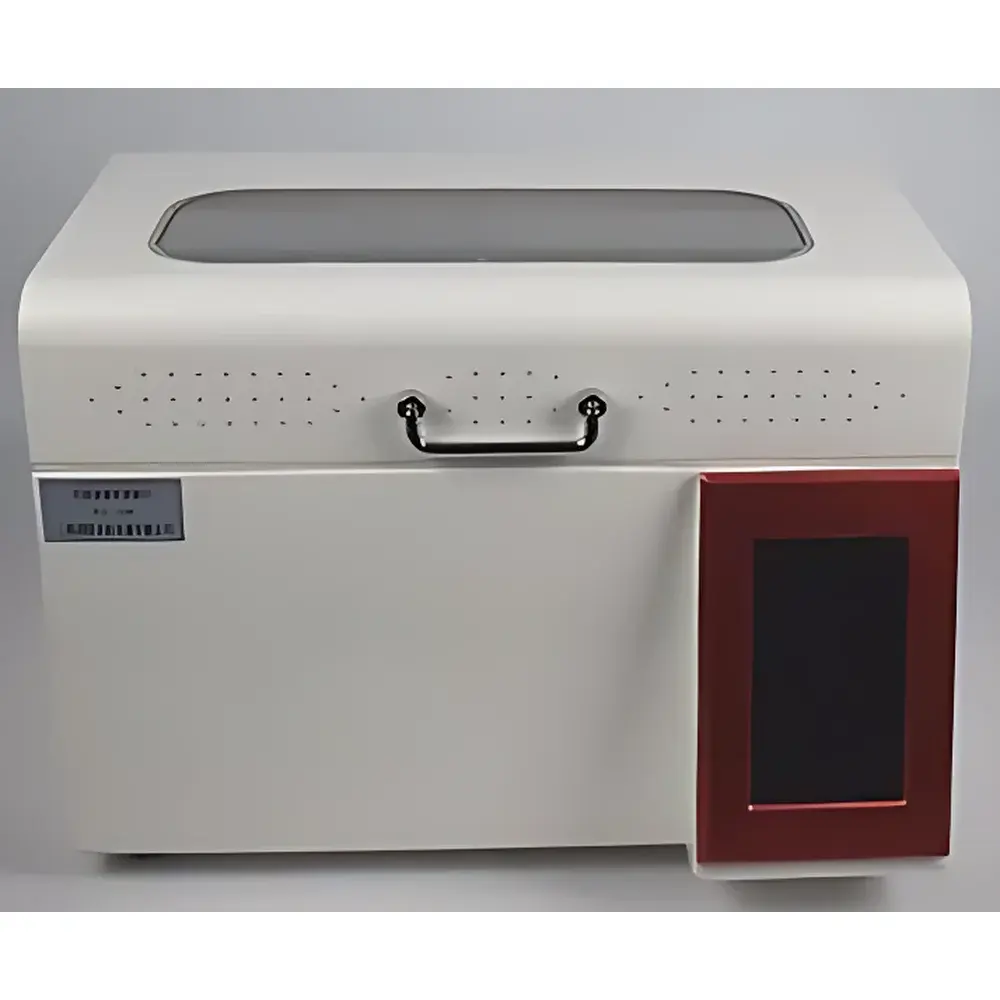
Peiou SDC-1000 Automated Nitrogen Evaporator
| Brand | Peiou |
|---|---|
| Origin | Shanghai, China |
| Model | SDC-1000 |
| Sample Capacity | 1–12 positions |
| Concentration Vessels | 50 mL, 150 mL, and 200 mL |
| Endpoint Detection | Optical dryness sensor per channel |
| Endpoint Volume Options | 1.0 mL, 0.5 mL, or near-dry (~0.1 mL) |
| Water Bath Temperature Range | Room temperature +5 °C to 100 °C (±0.3 °C) |
| Nitrogen Blow Time | 0–9999 min |
| Nitrogen Pressure Control | 0–0.10 MPa (10-step adjustable, 0.01 MPa increments) with auto-regulation |
| Inlet Nitrogen Supply Pressure | 0.20–0.80 MPa |
| Max Allowable Inlet Pressure | 1.00 MPa |
| Gas Consumption | ~500 mL/min per channel at 0.10 MPa |
| Sensitivity Adjustment | Continuously variable optical endpoint detection |
| Control Interface | Color LCD touchscreen |
| Operating Modes | Manual / Timed / Volume-based endpoint |
| Safety Features | Lid-open detection, low-water alarm & auto-refill, low-pressure alarm, 60-sec pause/resume memory |
| Materials | Plasticizer-free silicone seals, food-grade PTFE gas tubing |
| Exhaust System | Integrated high-efficiency fume extraction |
| Drain Valve | Integrated for bath water replacement |
| Heating Power | 2000 W |
| Power Supply | 220 V / 60 Hz |
| Dimensions (W×D×H) | 600 × 540 × 400 mm |
| Weight | 28 kg |
Overview
The Peiou SDC-1000 Automated Nitrogen Evaporator is an engineered solution for controlled, reproducible solvent removal in analytical laboratories performing sample preparation for chromatography, mass spectrometry, environmental testing, food safety, and clinical toxicology. It operates on the principle of gentle, inert gas (nitrogen) displacement—accelerating solvent evaporation while minimizing thermal degradation, oxidation, or cross-contamination. Unlike manual or semi-automated systems, the SDC-1000 integrates real-time endpoint detection, pressure-stabilized gas delivery, and intelligent thermal management to ensure consistent final volumes across heterogeneous sample sets. Its design prioritizes operator safety, method robustness, and compliance readiness—particularly for workflows requiring trace-level analyte recovery and documentation integrity.
Key Features
- Independent optical endpoint detection per channel: Each of the 12 positions employs a dedicated photometric sensor to identify solvent depletion without physical contact—enabling accurate termination at user-defined residual volumes (1.0 mL, 0.5 mL, or near-dry ≈0.1 mL), regardless of solvent color, turbidity, or refractive index.
- Stable, digitally regulated nitrogen pressure: An integrated pressure control module maintains setpoint accuracy (±0.005 MPa) across all active channels—even during dynamic load changes (e.g., sequential vial insertion/removal). External supply pressure (0.20–0.80 MPa) is automatically stepped down and stabilized within the 0–0.10 MPa operating range.
- Programmable water bath with ±0.3 °C thermal uniformity: Heated by a 2000 W immersion system, the bath supports precise temperature control from ambient +5 °C to 100 °C, ensuring compatibility with volatile solvents (e.g., hexane, acetone) and higher-boiling matrices (e.g., DMSO, ethylene glycol).
- Three operational modes: Manual (user-initiated start/stop), Timed (fixed duration), and Volume-based (auto-terminate upon optical endpoint)—each configurable via intuitive color LCD interface with real-time parameter display (temperature, elapsed time, pressure, status).
- Fail-safe engineering: Lid-open interruption triggers 60-second program hold with full state retention; automatic resumption occurs if lid is closed within the window. Low-water level detection activates audible/visual alarm and initiates auto-refill. Low nitrogen pressure triggers immediate alert and process halt.
- Chemically inert fluid path: All wetted components—including seals, gaskets, and gas delivery lines—are constructed from plasticizer-free silicone and FDA-compliant PTFE, eliminating leachable contaminants that could compromise LC-MS or ICP-MS analysis.
Sample Compatibility & Compliance
The SDC-1000 accommodates standard conical-bottom glass tubes (50 mL, 150 mL, 200 mL) and accepts custom-fabricated concentration vessels upon request. Its sealed chassis and integrated exhaust manifold route organic vapors and moisture directly to external ducting or recirculating scrubbers—meeting OSHA PEL and ACGIH TLV guidelines for laboratory fume containment. The instrument’s deterministic endpoint logic, audit-trail-capable parameter logging (via optional USB export), and hardware-level safety interlocks support alignment with GLP and GMP frameworks. While not certified to ISO/IEC 17025 or FDA 21 CFR Part 11 out-of-the-box, its repeatable performance, traceable settings, and error-logging architecture provide foundational infrastructure for internal validation and regulatory submission documentation.
Software & Data Management
The SDC-1000 operates via embedded firmware with no PC dependency. All method parameters—including temperature setpoint, nitrogen pressure, run duration, endpoint volume selection, and active channel configuration—are stored in non-volatile memory and displayed in real time on the 5.7-inch color TFT-LCD. Event logs (lid open/close, endpoint reached, alarm triggers, power cycles) are timestamped and retained for ≥1000 entries. Data export is supported via USB flash drive in CSV format, enabling integration into LIMS or electronic lab notebooks (ELN). Optional firmware updates—distributed through Peiou’s authorized service network—maintain compatibility with evolving laboratory informatics standards.
Applications
- Pre-concentration of environmental water extracts (EPA Methods 508, 525, 8081) prior to GC-ECD or GC-MS analysis.
- Residue reduction in pesticide multiresidue methods (AOAC 2007.01, EN 15662) for fruit, vegetable, and grain matrices.
- Sample cleanup workflows in clinical toxicology (e.g., benzodiazepines, opioids in urine plasma) before UPLC-MS/MS quantification.
- Pharmaceutical stability testing sample prep per ICH Q5C guidelines, where solvent removal must preserve labile degradation products.
- Food contaminant screening (e.g., mycotoxins, PAHs) requiring high-recovery, low-background evaporation under inert atmosphere.
FAQ
What types of solvents are compatible with the SDC-1000?
The system supports common organic solvents including methanol, acetonitrile, ethyl acetate, dichloromethane, hexane, and acetone—provided bath temperature and nitrogen flow are optimized to prevent bumping or aerosol formation. High-boiling solvents (e.g., DMSO, DMF) require elevated bath temperatures and extended endpoint timing.
Can the SDC-1000 be integrated into automated sample preparation lines?
While it lacks native robotic arm interfaces or Ethernet/RS-232 control ports, its programmable standalone operation and USB data export enable synchronization with upstream autosamplers or downstream analytical instruments via external PLC or script-based orchestration.
Is calibration verification required, and how often?
Per ISO/IEC 17025 recommendations, users should verify water bath temperature accuracy annually using a NIST-traceable thermometer, and confirm nitrogen pressure regulation against a calibrated gauge every six months—or after any maintenance involving the pressure control module.
Does the instrument comply with CE or UL safety standards?
The SDC-1000 meets IEC 61010-1:2010 requirements for electrical safety in laboratory equipment. CE marking is applied for export to EU markets; UL certification is available upon request for North American deployment.
How is maintenance performed on the optical endpoint sensors?
Sensors are housed behind quartz windows and require periodic cleaning with lint-free wipes and isopropyl alcohol. No recalibration is needed; sensitivity is adjusted in software to accommodate variations in vial geometry or solvent clarity.





