
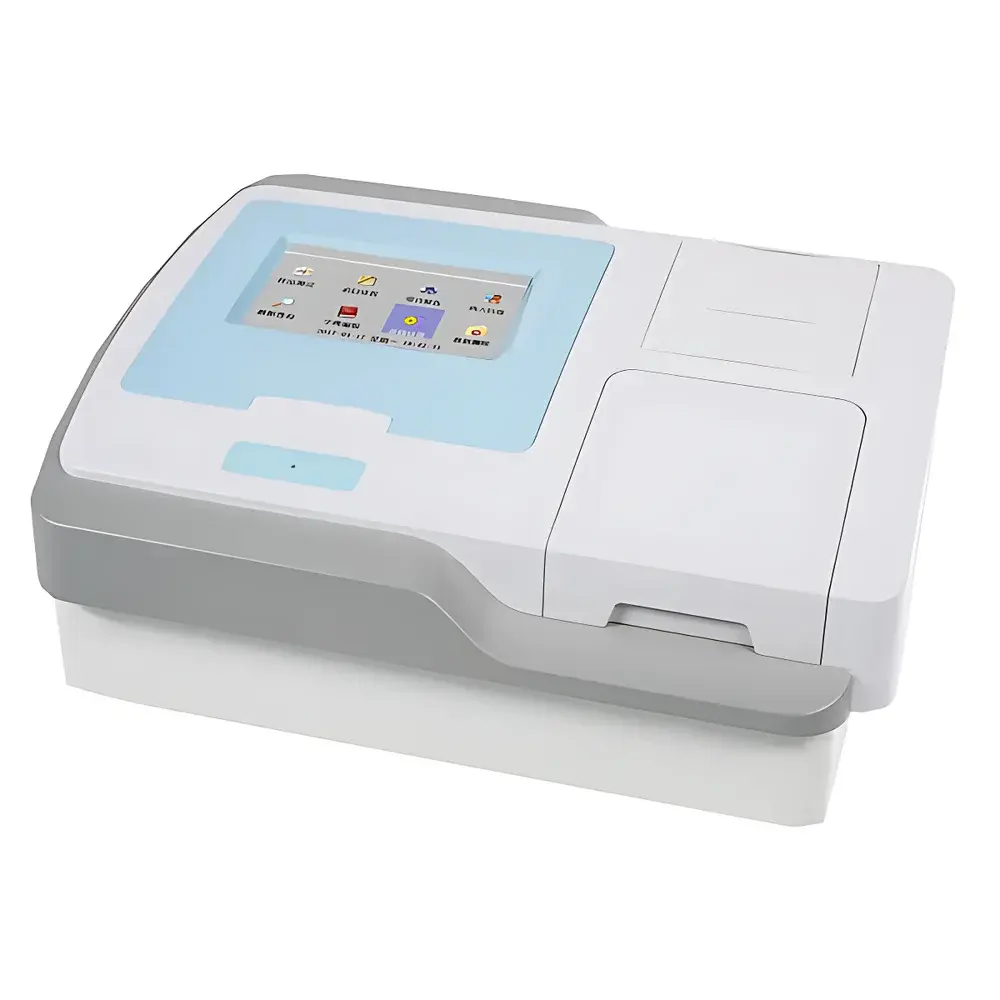
Microplate Reader 318C+
| Model | 318C+ |
|---|---|
| Price | Upon Request) |
| [Origin | Shanghai, China |
| Manufacturer Type | Authorized Distributor |
| Origin Category | Domestic |
| Model | 318C+ |
| Wavelength Range | 350–800 nm |
| Filter Positions | 10 (standard: 405, 450, 492, 630 nm |
| Absorbance Range | 0.000–4.000 A |
| Optical Channels | 8-sample + 1 optional reference channel |
| Absorbance Stability | ≤ ±0.002 A or ≤ 0.5% T / 10 min |
| Accuracy | ≤ ±0.005 A or ±0.2% T |
| CV (Repeatability) | ≤ 0.2% |
| Sensitivity | ≥ 0.01 L/mg |
| Channel Uniformity | ≤ 0.01 A |
| Wavelength Accuracy | ±1 nm |
| Bandwidth (FWHM) | ≤ 8 nm |
| Display Resolution | 0.001 A (display), 0.0001 A (internal calculation) |
| Read Time | ≤3 sec/96-well (single wavelength), ≤6 sec/96-well (dual wavelength) |
| Plate Types | Standard 96-well microplates, strips, flat/U/V-bottom wells |
| Display | 7-inch color TFT-LCD touchscreen |
| Input | Touchscreen + optional USB mouse/keyboard |
| Built-in Thermal Printer | Yes |
| Data Storage | ≥200,000 assay results, ≥500 test protocols (expandable) |
| Interfaces | USB-A, USB-B, RS-232, parallel port |
| Operating Environment | 5–40 °C, 15–80% RH |
| Power Supply | 220 V ±10%, 50/60 Hz |
| Dimensions (L×W×H) | 475 × 350 × 210 mm |
| Weight | 11.5 kg] |
Overview
The Microplate Reader 318C+ is a high-performance, standalone absorbance-based microplate reader engineered for quantitative and qualitative analysis in clinical diagnostics, pharmaceutical research, and life science laboratories. It operates on the principle of spectrophotometric absorbance measurement—detecting light attenuation at user-selected wavelengths as it passes through samples in standard 96-well microplates. Designed with an embedded Linux-based system, the instrument eliminates dependency on external PCs while maintaining full assay flexibility, data integrity, and regulatory readiness. Its optical architecture features an imported halogen tungsten lamp source, precision interference filters, and an 8-channel photometric detection path with an optional dedicated reference channel—enabling rapid, high-reproducibility measurements across diverse plate formats and well geometries (flat, U-bottom, V-bottom).
Key Features
- Integrated embedded operating system: Full instrument control, data acquisition, storage, and thermal printing without PC connectivity.
- Multi-mode detection: Supports endpoint, kinetic (rate), dual-wavelength, two-point, enzyme inhibition, and Cut-Off qualitative analysis.
- Comprehensive curve-fitting algorithms: Linear, logarithmic, exponential, power, semi-log, log-logit, four-parameter logistic (4PL), and custom regression models for ELISA and other immunoassays.
- High-throughput capability: Simultaneous multi-assay configuration—up to 12 distinct tests per plate, including mixed qualitative/quantitative workflows.
- Advanced optical performance: 350–800 nm wavelength coverage, ≤8 nm bandwidth, ±1 nm wavelength accuracy, and ≤0.01 A inter-channel uniformity ensure compliance with CLSI EP10 and ISO 15197 analytical requirements.
- Robust plate handling: Programmable shaking (adjustable speed/duration), auto-zeroing, and dynamic range optimization across 0.000–4.000 A.
Sample Compatibility & Compliance
The 318C+ accommodates all ANSI/SBS-standard 96-well microplates—including full plates, half-plates, and individual strips—as well as non-standard configurations with flat, U-shaped, or V-shaped wells. Its optical path design minimizes edge effects and meniscus-related variability. From a regulatory standpoint, the system supports audit-ready operation under GLP and GMP environments: built-in Westgard multirule QC (including 12s, 13s, 22s, R4s, 41s, 10x) and “immediate” (Youden) QC provide real-time statistical process control with configurable alarm thresholds and graphical trend reporting. While not FDA 21 CFR Part 11–certified out-of-the-box, its secure user authentication (role-based access), immutable timestamped data logs, and exportable CSV/Excel-compatible records facilitate validation against ISO/IEC 17025 and CLIA requirements.
Software & Data Management
All operational logic resides within the device’s embedded firmware—no external software installation required. The 7-inch capacitive touchscreen interface delivers intuitive navigation, protocol templating, and on-device result review. Assay parameters, calibration curves, and QC rules are stored locally with version-controlled metadata. Data capacity exceeds 200,000 individual readings and 500+ test definitions, expandable via USB-A mass storage. Raw absorbance values, calculated concentrations, QC charts, and pass/fail flags are exportable via USB-B or RS-232 to LIS/HIS systems or laboratory information management platforms. Internal thermal printing produces compliant hard-copy reports with date/time stamps, operator ID, plate map, and QC summary—critical for traceability in clinical testing labs.
Applications
- Enzyme-linked immunosorbent assays (ELISA) for infectious disease serology (e.g., HIV, HBV, HCV)
- Cell viability and cytotoxicity assays (MTT, XTT, CCK-8)
- Protein quantification (Bradford, BCA, Lowry)
- Enzyme activity profiling (e.g., LDH, ALP, AST, ALT)
- Microbial growth kinetics and antimicrobial susceptibility screening
- Food safety testing (aflatoxin, pesticide residue inhibition assays)
- Environmental toxin detection using enzymatic biosensors
FAQ
Does the 318C+ support FDA 21 CFR Part 11 compliance?
The instrument does not include electronic signature or audit trail modules required for full Part 11 compliance; however, its timestamped, user-logged data exports and locked firmware enable validation pathways when integrated into a validated IT infrastructure.
Can I upgrade filter wavelengths after purchase?
Yes—six filter positions are user-configurable; additional interference filters (e.g., 340 nm, 540 nm, 570 nm, 595 nm) can be installed by authorized service personnel.
Is kinetic mode supported with temperature control?
No—the 318C+ lacks integrated incubation or Peltier-based temperature regulation; kinetic assays require external environmental stabilization.
What file formats are supported for data export?
CSV (comma-separated values) and Excel-compatible .xls files are generated directly; no proprietary binary formats are used.
How is calibration verified and maintained?
Users perform daily photometric verification using NIST-traceable neutral density filters; wavelength accuracy is confirmed with holmium oxide or didymium reference standards per ISO 17025 guidelines.
Related Products





