
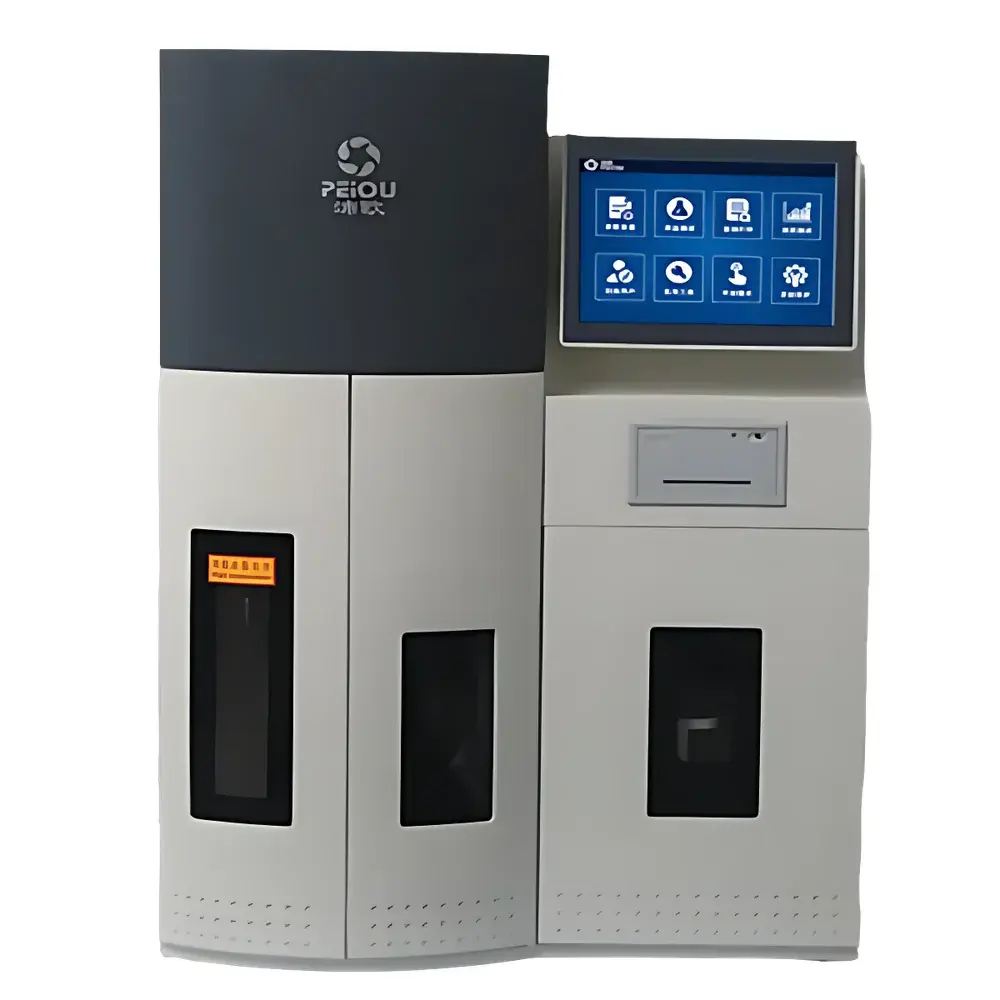
Peiou SKD-5000 Fully Automated Kjeldahl Nitrogen Determinator with CEC Measurement Capability
| Brand | Peiou |
|---|---|
| Origin | Shanghai, China |
| Model | SKD-5000 |
| Instrument Type | Fully Automated Kjeldahl Nitrogen Determinator |
| Nitrogen Range | 0.1–240 mg N |
| CEC Range | 0.07–140 cmol<sub>c</sub>/kg |
| Digestion/Steam Distillation Time | 3–8 min per sample |
| Repeatability | RSD ≤ 0.5% |
| Sample Capacity | ≤6 g (solid) or ≤16 mL (liquid) |
| Nitrogen Recovery Rate | ≥99.5% |
| Dimensions (L×W×H) | 500 × 350 × 720 mm |
Overview
The Peiou SKD-5000 Fully Automated Kjeldahl Nitrogen Determinator with CEC Measurement Capability is an integrated analytical platform engineered for precise, trace-level nitrogen quantification and soil cation exchange capacity (CEC) determination using standardized wet-chemistry principles. It operates on the classical Kjeldahl method—comprising acid digestion, alkaline distillation, and colorimetric titration—to convert organic nitrogen into ammonium sulfate, liberate ammonia under controlled alkaline steam distillation, and quantify liberated NH3 via pH-sensitive indicator-based endpoint detection. The system extends beyond conventional nitrogen analysis by incorporating validated protocols for soil CEC assessment, wherein exchangeable cations (e.g., Ca2+, Mg2+, K+, Na+, NH4+, H+, Al3+) are displaced from clay-humus colloids using standardized ammonium acetate or barium chloride extraction, followed by quantitative ammonia recovery and calculation of total exchangeable cation equivalents per kilogram of dry soil.
Key Features
- Triple-color photometric endpoint detection (RGB sensor) with real-time spectral curve visualization for robust, interference-resistant titration—eliminates subjective visual interpretation and ensures compliance with ISO 5983-1:2009 and AOAC 984.13.
- Intelligent steam power modulation: dynamically adjustable distillation energy output to optimize ammonia recovery across low-concentration (e.g., environmental soils) and high-nitrogen (e.g., fertilizers, protein-rich feedstuffs) matrices.
- Dual-mode operation: seamless switching between fully automated sequence (acid addition → digestion → alkali addition → steam distillation → titration → rinse → report generation) and manual intervention mode for method development or troubleshooting.
- Integrated safety architecture: real-time monitoring of digestion vessel temperature, distillation chamber door status, and reagent levels; automatic shutdown and alerting upon anomaly detection.
- Self-cleaning fluidic pathway: programmable post-analysis rinsing of distillation head, condenser, titration cup, and dosing lines with deionized water to prevent carryover and cross-contamination between samples.
- High-resolution 7-inch TFT color touchscreen with intuitive Chinese/English bilingual GUI, supporting method storage, user-defined calibration curves, and audit-ready operation logs.
Sample Compatibility & Compliance
The SKD-5000 accommodates diverse solid and liquid matrices without modification: agricultural soils (air-dried, sieved ≤2 mm), plant tissues, grain flours, dairy powders, animal feeds, wastewater sludges, and industrial catalysts. Its CEC workflow aligns with USDA-NRCS Soil Survey Laboratory Methods Manual (Chapter 3), ISO 11260:1994 (soil exchangeable cations), and ASTM D4647-18 (cation exchange capacity of clays). All nitrogen determinations conform to ISO 8968-1:2014 (milk), ISO 1871:2009 (cereals), and AOAC Official Method 981.10 (general foods). Full traceability supports GLP/GMP environments, with optional 21 CFR Part 11-compliant software modules available for electronic signature, audit trail, and data integrity management.
Software & Data Management
Embedded firmware records every operational parameter—including reagent volumes dispensed, steam pressure profile, distillation duration, titrant consumption, RGB intensity values at endpoint, and calculated CEC/N content—with timestamped metadata. Data export is supported in CSV, PDF, and XML formats compatible with LIMS integration. Built-in statistical tools compute mean, SD, RSD, recovery %, and control chart trends per batch. User access levels (operator, supervisor, administrator) enforce role-based permissions, while encrypted local storage prevents unauthorized data modification. Firmware updates are performed via USB or Ethernet without external PC dependency.
Applications
- Soil fertility laboratories: routine CEC mapping for agronomic recommendation systems and land-use planning.
- Feed and food quality control: protein content verification in soybean meal, fishmeal, whey powder, and infant formula per Codex Alimentarius standards.
- Environmental testing labs: nitrogen speciation in compost, biosolids, and contaminated sediments for regulatory reporting (e.g., EPA Method 350.1).
- Fertilizer certification: total N and ammoniacal-N quantification in urea, ammonium nitrate, and slow-release formulations.
- Research institutions: method validation studies requiring high-precision inter-laboratory reproducibility (Horwitz ratio < 2.0 observed in collaborative trials).
FAQ
What standards does the SKD-5000 comply with for nitrogen analysis?
It meets ISO 5983-1:2009, AOAC 984.13, and USP <467> for residual solvent nitrogen quantification.
Can the instrument perform both total nitrogen and CEC in a single run?
No—CEC requires separate extraction prior to Kjeldahl analysis; however, the SKD-5000 processes extracted CEC supernatants identically to standard nitrogen samples, enabling full workflow integration.
Is the colorimetric titration system susceptible to turbidity or colored samples?
The RGB photometric sensor employs narrow-band optical filtering and baseline correction algorithms, maintaining accuracy even with mildly pigmented digests (e.g., humic-rich soils); severe turbidity requires centrifugation or filtration per ISO 11465.
How is method validation documented for regulatory submissions?
The system generates raw sensor outputs, intermediate calculations, and final reports with embedded digital signatures and immutable timestamps—fully admissible for FDA, EFSA, or NATA audit requirements.
What maintenance intervals are recommended for long-term reliability?
Daily: rinse cycle verification and waste tank emptying. Quarterly: condenser descaling and titrant line calibration. Annually: full optical path inspection and steam generator performance validation per manufacturer’s SOP-MAINT-004.




