
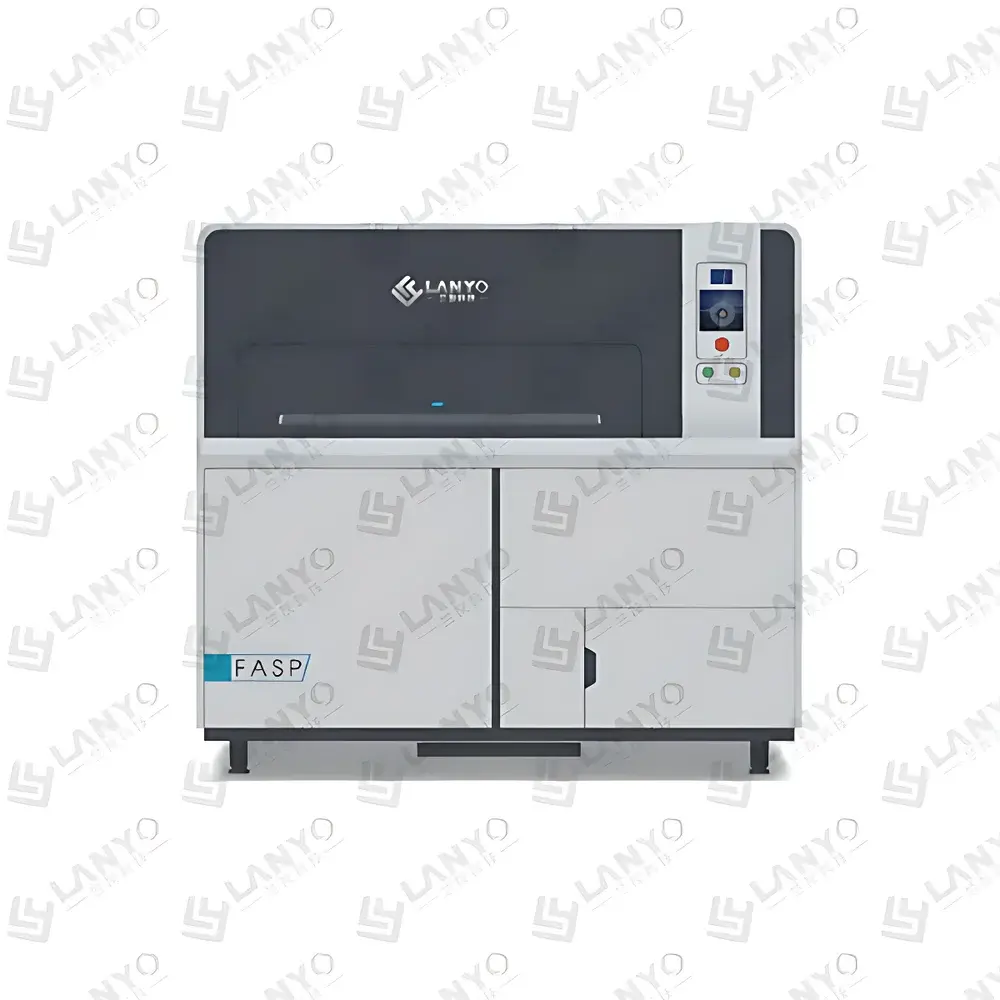
LANYO FASP-05B Fully Automated Soil Sample Preparation System
| Brand | LANYO |
|---|---|
| Origin | Beijing, China |
| Model | FASP-05B |
| Sample Capacity | 5 dry soil samples per batch |
| Sieve Sizes | 10 mesh (2 mm), 20 mesh (0.85 mm), 60 mesh (0.25 mm), 100 mesh (0.15 mm), 200 mesh (0.075 mm) |
| Compliance | HJ/T 166–2004, NY/T 395–2012, DZ/T 0130.4–2006, GB/T 6003.1–2022 |
| Automation | Dual independent robotic arms, non-metallic grinding components, integrated barcode scanning & auto-cleaning |
| Software | Audit-trail enabled sample tracking, GLP-compliant reporting, automated data export (CSV/PDF) |
Overview
The LANYO FASP-05B Fully Automated Soil Sample Preparation System is an engineered solution for standardized, contamination-controlled soil sample processing in environmental monitoring and geochemical laboratories. Designed in accordance with the procedural rigor of Chinese national standards—including HJ/T 166–2004 (Technical Specification for Soil Environmental Monitoring), NY/T 395–2012 (Technical Specification for Farmland Soil Environmental Quality Monitoring), and GB/T 6003.1–2022 (Test Sieves)—the system implements a closed-loop, metal-free workflow grounded in sequential mechanical processing principles. It performs dry-sample intake, progressive size reduction via rotational grinding, homogenization, sieve-based particle-size fractionation, quartering by the cross-splitting method, precision mass measurement, barcode-assisted sample identification, and post-run cleaning—all without manual intervention. Unlike semi-automated or operator-dependent workflows, the FASP-05B eliminates inter-operator variability and minimizes exposure to airborne particulates, directly supporting laboratory compliance with Good Laboratory Practice (GLP) and quality assurance frameworks required by third-party environmental testing accreditation bodies.
Key Features
- Dual-independent robotic arm architecture enables parallel execution of grinding, sieving, and weighing tasks—reducing cycle time while maintaining strict procedural isolation between samples.
- Non-metallic grinding assembly (ceramic and polymer composite components) ensures zero contribution of Fe, Cr, Ni, Pb, or other analyte metals during comminution—critical for trace-element analysis and regulatory compliance with EPA Method 6010D and ISO 11464.
- Integrated 5-position dry-sample carousel with programmable queue management; supports unattended overnight operation for multi-batch processing.
- Automated cross-splitting module executes ASTM D2234-compliant quartering with positional repeatability < ±0.5% mass deviation across replicates.
- Onboard analytical balance (0.001 g resolution) synchronized with robotic handling for gravimetric accuracy traceable to national metrological standards.
- Self-cleaning protocol employs compressed air purge and brush-based residue removal after each sample—validated to reduce carryover to < 0.02% residual mass (per ICH Q5C guidance).
Sample Compatibility & Compliance
The FASP-05B is validated for use with air-dried mineral soils, sediments, and weathered geological materials within moisture content ≤15% w/w. It accommodates heterogeneous matrices including clay-rich, sandy, and organic-matter-containing soils—provided they pass preliminary visual inspection for oversized debris (>2 cm). All mechanical contact surfaces are certified free of cadmium, lead, chromium, and mercury per RoHS Directive 2011/65/EU. The system’s operational log records timestamped events—including sample ID, sieve selection, mass values, cleaning cycles, and error flags—generating immutable audit trails compatible with FDA 21 CFR Part 11 requirements when deployed with validated software configuration. Documentation packages include IQ/OQ protocols aligned with CNAS-CL01:2018 and ISO/IEC 17025:2017 Annex A.2.
Software & Data Management
The embedded control interface runs LANYO SampleFlow™ v3.2 firmware, featuring role-based access control (administrator, analyst, reviewer), electronic signature support, and real-time status visualization. Each processed sample generates a structured metadata file containing raw sensor readings, calibration timestamps, sieve certification IDs, and operator-assigned project codes. Reports comply with ISO 17025 clause 7.8.2 and may be exported in CSV (for LIMS integration), PDF/A-1b (archival), or XML (for national environmental data platforms such as China’s National Soil Environment Monitoring Network). Optional API connectivity enables bidirectional synchronization with Thermo Fisher SampleManager LIMS and LabVantage 2023.
Applications
- Regulatory soil monitoring programs under China’s “Soil Pollution Prevention and Control Action Plan” (Guo Fa [2016] No. 31).
- Field-scale agricultural soil surveys requiring consistent 2-mm, 0.25-mm, and 0.075-mm fractions for nutrient and heavy metal analysis.
- Site investigation workflows for contaminated land assessment (e.g., CERCLA Phase I/II), where sample integrity and chain-of-custody documentation are legally mandated.
- Inter-laboratory proficiency testing schemes administered by CNAS or APAC, where inter-lab reproducibility hinges on identical preparation protocols.
- Long-term ecological research projects involving archived soil banks—where repeatable sub-sampling and minimal handling-induced oxidation are essential.
FAQ
Does the FASP-05B support wet or frozen soil samples?
No. The system is designed exclusively for air-dried samples with moisture content ≤15%. Wet or frozen matrices require pre-drying in accordance with HJ/T 166–2004 Section 5.2 prior to loading.
Can sieve calibration certificates be traced to national metrology institutes?
Yes. Each installed sieve set ships with a calibration certificate issued by the Beijing Institute of Metrology (BIM), accredited to ISO/IEC 17025:2017, with traceability to NIM (National Institute of Metrology, China).
Is remote diagnostic capability available?
Yes. With optional Ethernet/Wi-Fi module enabled, authorized service engineers can initiate secure remote diagnostics via TLS 1.3 encrypted session—subject to lab IT policy approval and firewall configuration.
How is software validation performed for GMP-regulated environments?
LANYO provides a complete CSV package (including URS, FRS, DQ/IQ/OQ/PQ protocols, test scripts, and summary reports) compliant with Annex 11 and ISPE GAMP 5. Validation support is delivered on-site by certified validation specialists.
What maintenance intervals are recommended for robotic arm actuators?
Lubrication and positional calibration are scheduled every 500 operational hours or biannually—whichever occurs first—as documented in the Maintenance Logbook (Revision 4.1, 2024).



