
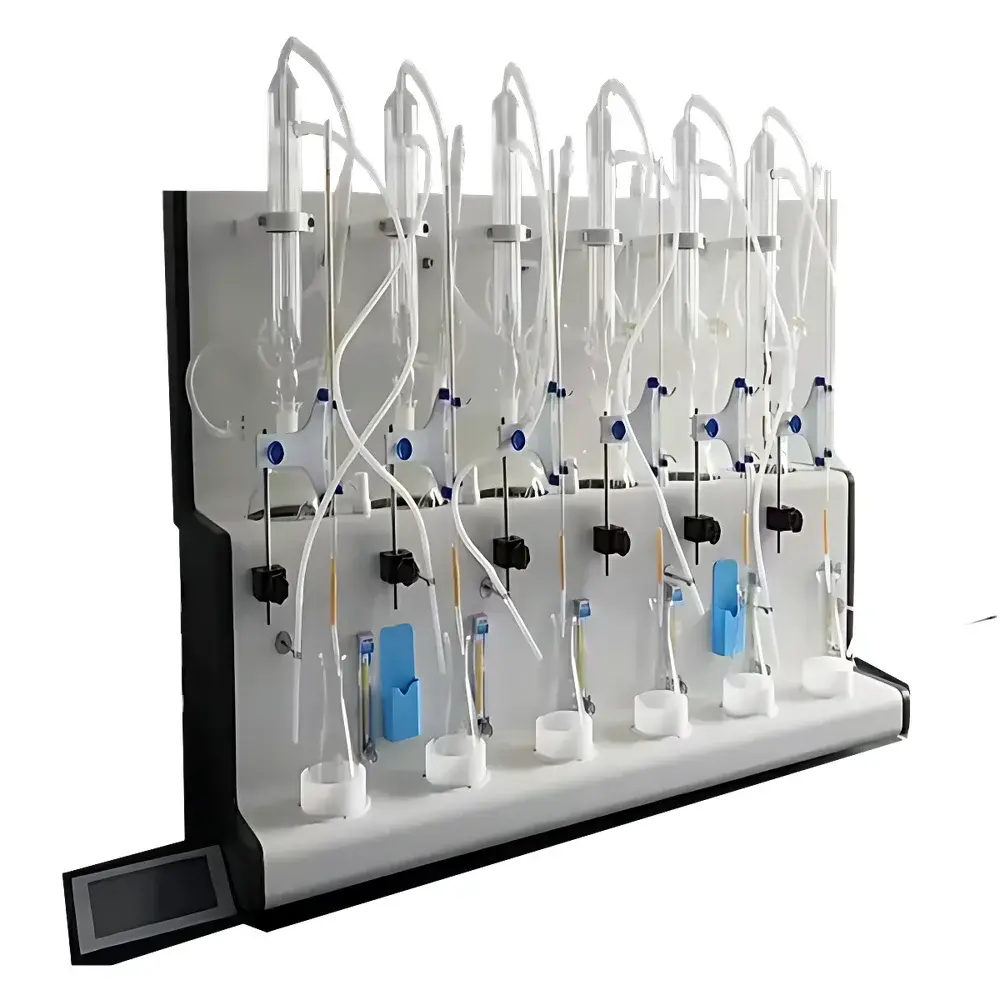
Peiou SKD-3104 / SKD-3106 Intelligent Sulfur Dioxide Distillation System
| Brand | Peiou |
|---|---|
| Origin | Shanghai, China |
| Model | SKD-3104 / SKD-3106 |
| Configuration | 4-channel or 6-channel modular distillation system |
| Detection Range | 1–600 g SO₂ (as per sample matrix and digestion protocol) |
| Control Interface | 7-inch high-resolution capacitive touchscreen |
| Heating Method | Far-infrared ceramic radiant heating (flame-free, uniform, corrosion-resistant) |
| Temperature Range | Ambient to 450 °C |
| Distillation Time Control | 1–600 min (per channel, independently programmable) |
| Cooling System | External compact compressor-based chiller with closed-loop water circulation |
| Anti-siphon Protection | Integrated one-way valve in condensate path |
| Automation Features | Independent channel control, built-in method library, programmable magnetic stirring (per receiver), automated nitrogen flow regulation, one-touch start/stop, timer-based endpoint detection |
Overview
The Peiou SKD-3104 and SKD-3106 Intelligent Sulfur Dioxide Distillation Systems are fully automated, multi-channel laboratory instruments engineered for precise, reproducible quantification of sulfur dioxide (SO₂) residues in pharmaceutical excipients, herbal materials, food matrices, and dietary supplements. These systems implement the official distillation–acid liberation–iodometric titration principle as prescribed in key regulatory standards—including the Chinese Pharmacopoeia (ChP) Volume IV General Chapter 2331 and GB 5009.34–2022 “Determination of Sulfur Dioxide in Foods.” Unlike conventional manual or semi-automated setups, the SKD series integrates thermal control, condensation management, gas-phase protection, and endpoint logic into a single coordinated platform—minimizing operator intervention while ensuring analytical consistency across batched samples.
Key Features
- Independent Channel Architecture: Each of the four (SKD-3104) or six (SKD-3106) distillation units operates with dedicated temperature, time, stirring speed, and nitrogen flow control—enabling parallel analysis of heterogeneous samples without cross-interference.
- Far-Infrared Ceramic Heating Modules: Flame-free, energy-efficient radiant heating elements deliver uniform thermal distribution across digestion flasks, reducing localized superheating and minimizing risk of bumping or foaming during acid-mediated SO₂ release.
- Closed-Loop Refrigeration System: An external, space-saving compressor chiller circulates deionized water through condenser jackets at stable sub-ambient temperatures—ensuring high-efficiency vapor condensation and eliminating reliance on tap water or ice baths.
- Integrated Anti-Siphon Mechanism: A passive one-way valve installed within each distillate delivery line prevents backflow into the distillation flask upon cooling, preserving sample integrity and eliminating post-run cleaning complications.
- Programmable Nitrogen Blanketing: Onboard mass-flow regulated nitrogen supply introduces inert atmosphere above the reaction mixture during distillation—suppressing oxidation of liberated SO₂ and improving recovery accuracy, particularly for volatile or thermally labile matrices.
- Intuitive Touch Interface & Embedded Method Library: The 7-inch capacitive touchscreen supports both preloaded standard methods (aligned with ChP 2331 and GB 5009.34–2022) and user-defined protocols—including custom ramp profiles, hold durations, and stirring parameters—with non-volatile storage for audit-ready method traceability.
Sample Compatibility & Compliance
The SKD-3104/3106 accommodates standard 500 mL round-bottom digestion flasks and 250 mL receiving flasks conforming to ISO 3696 Grade 3 water specifications. It is validated for use with acidic reagents including phosphoric acid (H₃PO₄) and hydrochloric acid (HCl), and compatible with iodine titration, formaldehyde titration, and spectrophotometric detection workflows downstream. Instrument design adheres to GLP principles: all operational parameters (temperature setpoints, run durations, nitrogen flow rates, stir speeds) are logged with timestamps and user IDs. Data export complies with FDA 21 CFR Part 11 requirements when paired with compliant LIMS or ELN software—supporting electronic signatures, audit trails, and role-based access control.
Software & Data Management
Control firmware runs on an embedded microcontroller architecture with real-time OS scheduling—ensuring deterministic response to sensor inputs and actuator commands. All method configurations, run logs, and calibration records are stored internally in encrypted binary format and exportable via USB 2.0 to CSV or PDF. No cloud dependency or proprietary drivers are required; exported files retain full metadata including channel ID, start/stop times, actual vs. setpoint temperature curves, and nitrogen flow stability metrics. Optional RS-232 or Ethernet interfaces support integration into centralized laboratory automation networks under ASTM E1384 or ISO/IEC 17025-compliant QA frameworks.
Applications
- Quantitative SO₂ residue testing in traditional Chinese medicinal herbs (e.g., dried lily bulbs, kelp, goji berries) per ChP 2331.
- Batch release testing of sulfited food additives (e.g., sodium metabisulfite, potassium bisulfite) in confectionery, wine, and dried fruit manufacturing.
- Stability-indicating assays for SO₂-scavenging excipients in oral solid dosage forms.
- Method validation studies requiring inter-channel precision assessment (RSD ≤ 2.5% for n = 6 replicates at 100 mg/kg level).
- Regulatory submission support for ANDA, NDA, and DMF dossiers where documented instrument qualification (IQ/OQ/PQ) and raw data archiving are mandatory.
FAQ
What regulatory standards does the SKD-3104/3106 directly support?
It implements the distillation procedures defined in GB 5009.34–2022 and ChP Volume IV General Chapter 2331, including specified reagent volumes, heating gradients, and condensation conditions.
Can the system interface with third-party titration modules or UV-Vis spectrophotometers?
Yes—via TTL-level digital I/O triggers or analog voltage outputs synchronized to distillation completion, enabling seamless handoff to automated titrators (e.g., Metrohm 905 Titrando) or absorbance readers.
Is temperature calibration traceable to national metrology institutes?
Each unit ships with a factory calibration certificate referencing NIM (National Institute of Metrology, China) traceable Pt100 sensors; optional on-site verification using accredited dry-block calibrators is supported.
How is data integrity maintained during power interruption?
The controller retains active method parameters and elapsed run time in non-volatile memory; upon restart, it resumes from last valid state or prompts user confirmation before continuing.
What maintenance intervals are recommended for long-term reliability?
Compressor chiller oil and refrigerant inspection every 12 months; ceramic heater surface cleaning with ethanol every 200 runs; condenser tubing descaling with 5% citric acid solution quarterly.





