
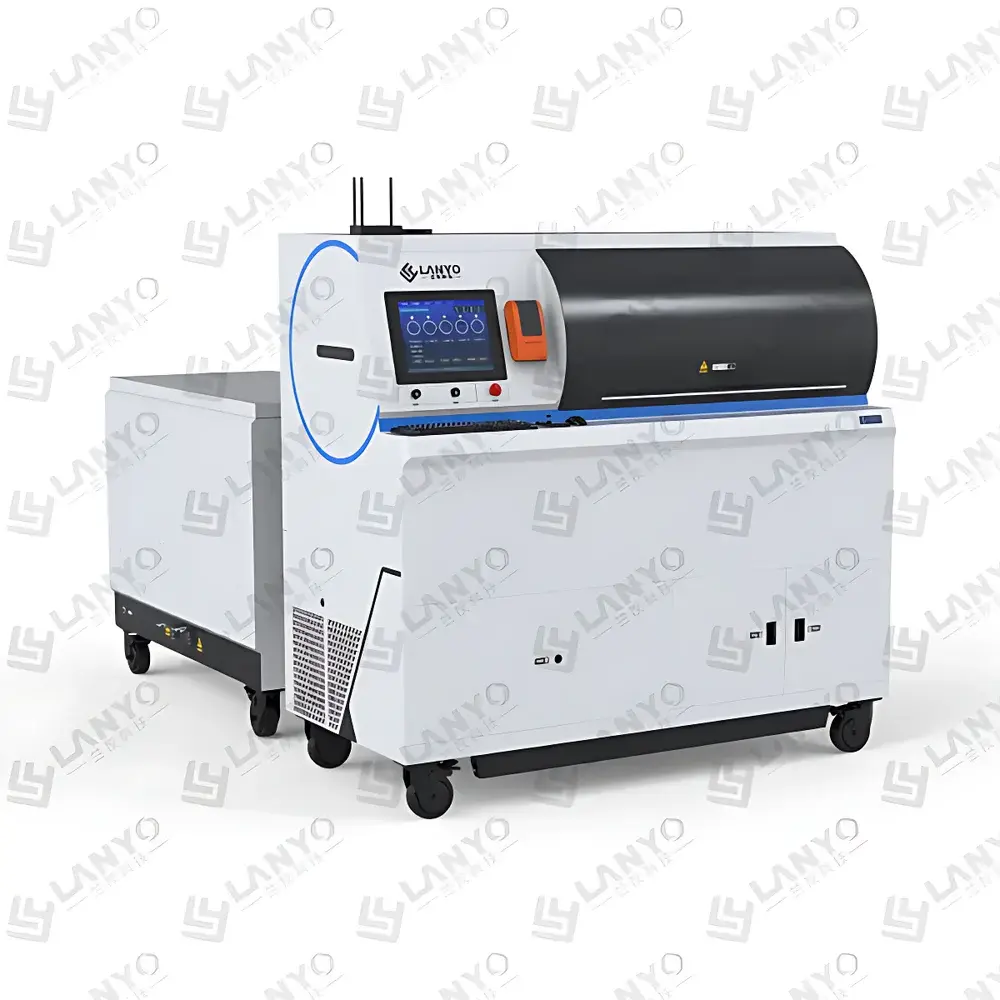
LANYO FASP-05DB Fully Automated Soil and Sediment Sample Preparation System
| Brand | LANYO |
|---|---|
| Origin | Beijing, China |
| Manufacturer Type | Authorized Distributor |
| Country of Origin | China |
| Model | FASP-05DB |
| Pricing | Available Upon Request |
Overview
The LANYO FASP-05DB Fully Automated Soil and Sediment Sample Preparation System is an integrated, GMP-aligned laboratory workstation engineered for precision, traceability, and regulatory compliance in environmental sample handling. It implements a closed-loop, hardware-isolated workflow grounded in standardized physical unit operations—low-temperature convective drying, non-metallic cryo-assisted grinding, programmable sieve fractionation (per ISO/GB standards), automated quartering via cross-splitting geometry, gravimetric dosing, 2D barcode labeling, and self-cleaning protocols. Designed explicitly for heterogeneous solid matrices—including soils, sediments, sludges, and solid waste—the system executes sequential unit processes without manual intervention, eliminating operator-dependent variability and minimizing exposure to airborne particulates or cross-contamination. Its core architecture adheres to the thermodynamic and mechanical constraints defined in HJ/T 166–2004, NY/T 395–2012, and DZ/T 0130.4–2006, ensuring that each step—from fresh sample introduction to final subsample packaging—maintains integrity under documented, auditable conditions.
Key Features
- Fully autonomous operation: One-touch initiation enables end-to-end processing—from raw field-collected samples to homogenized, size-fractionated, weighed, and barcoded subsamples.
- Thermally controlled drying: Five independent sample positions with PID-regulated drying at 35 ± 5 °C; real-time temperature logging per vial ensures thermal consistency across batches.
- Non-metallic grinding system: Dual grinding units constructed from ceramic and polymer composites—free of Fe, Cr, Ni, Pb, Cd, and other analyte-interfering elements—to prevent exogenous elemental contamination during comminution.
- Cross-splitting divider: Mechanically actuated, geometrically calibrated quartering module implementing ASTM D2234-compliant cross-split geometry for statistically representative sub-sampling.
- Modular sieve station: Optional multi-sieve carousel compliant with GB/T 6003.1–2022 (equivalent to ISO 3310-1), supporting simultaneous selection of up to four mesh sizes (10, 20, 60, 80, 100, 160, or 200 mesh) per run.
- Integrated analytical balance: High-resolution (0.1 mg) internal weighing module synchronized with robotic arm positioning for precise mass allocation and audit-ready weight records.
- Digital traceability backbone: All process parameters—including timestamps, setpoints, actual values, error codes, and operator ID—are timestamped, encrypted, and stored in a local SQLite database with export capability to CSV or PDF.
Sample Compatibility & Compliance
The FASP-05DB accommodates fresh, moist, or frozen soil and sediment samples (max. 500 g wet weight per vial) with organic content up to 35% w/w and clay fraction <40%. It supports matrix types specified in HJ/T 20–1998 (industrial solid wastes), EJ/T 428–1989 (radioactive soil matrices), and LY/T 1210–1999 (forest soils). All operational sequences align with QA/QC requirements for GLP and ISO/IEC 17025-accredited laboratories. The system’s electronic record retention complies with FDA 21 CFR Part 11 principles—including electronic signatures, audit trails, and data immutability—when deployed with validated software configuration. Full documentation packages—including IQ/OQ protocols, standard operating procedures (SOPs), and calibration certificates for all critical sensors—are provided.
Software & Data Management
The embedded control interface runs on a Linux-based RTOS with deterministic scheduling for time-critical motion control and sensor sampling. The GUI provides real-time visualization of temperature profiles, motor load feedback, sieve position status, and balance stability indicators. Data export supports structured formats (CSV, XML) compatible with LIMS integration via RESTful API or HL7-compatible middleware. Audit trail logs capture user login/logout events, parameter modifications, emergency stops, and calibration actions—with immutable hashing applied to each entry. Optional cloud sync enables remote monitoring and centralized fleet management for multi-site environmental testing networks.
Applications
- Regulatory soil monitoring programs (e.g., national soil pollution surveys, agricultural land quality assessment)
- Site-specific risk assessment workflows for brownfield redevelopment and contaminated land remediation
- Reference material preparation and homogeneity testing in certified reference material (CRM) production labs
- High-throughput sample conditioning prior to ICP-MS, XRF, AAS, or total organic carbon (TOC) analysis
- Radioecological studies requiring ultra-low background metal handling (e.g., U/Th/Pu isotopic profiling)
- Method validation studies supporting ISO 11464, ISO 11277, and EPA Method 3050B adaptation
FAQ
Does the FASP-05DB support method customization for non-standard sieve sizes or alternative splitting ratios?
Yes—via administrator-level script editing in the configuration module, users may define custom sieve sequences and adjust quartering mass thresholds within mechanical limits.
Is the system compatible with existing laboratory information management systems (LIMS)?
It provides native support for ASTM E1482 and HL7 ADT/ORM message exchange, with optional middleware for Oracle Clinical, LabWare, or Thermo Fisher SampleManager integration.
How is cleaning validation performed between sample batches?
Automated cleaning cycles include vacuum aspiration, ethanol vapor purge, and HEPA-filtered air blow-down; residue verification reports are generated per batch using blank spike recovery checks.
What maintenance intervals are recommended for the grinding and sieving modules?
Ceramic grinding elements require replacement every 1,200 operational hours; stainless-steel sieve frames (non-contact) are inspected quarterly and certified annually per ISO 8502-3.
Can the system be operated in unattended mode overnight?
Yes—full-cycle runs (up to 16 samples) can be scheduled with automatic shutdown, ambient condition monitoring, and email/SMS alerting on fault conditions.



