
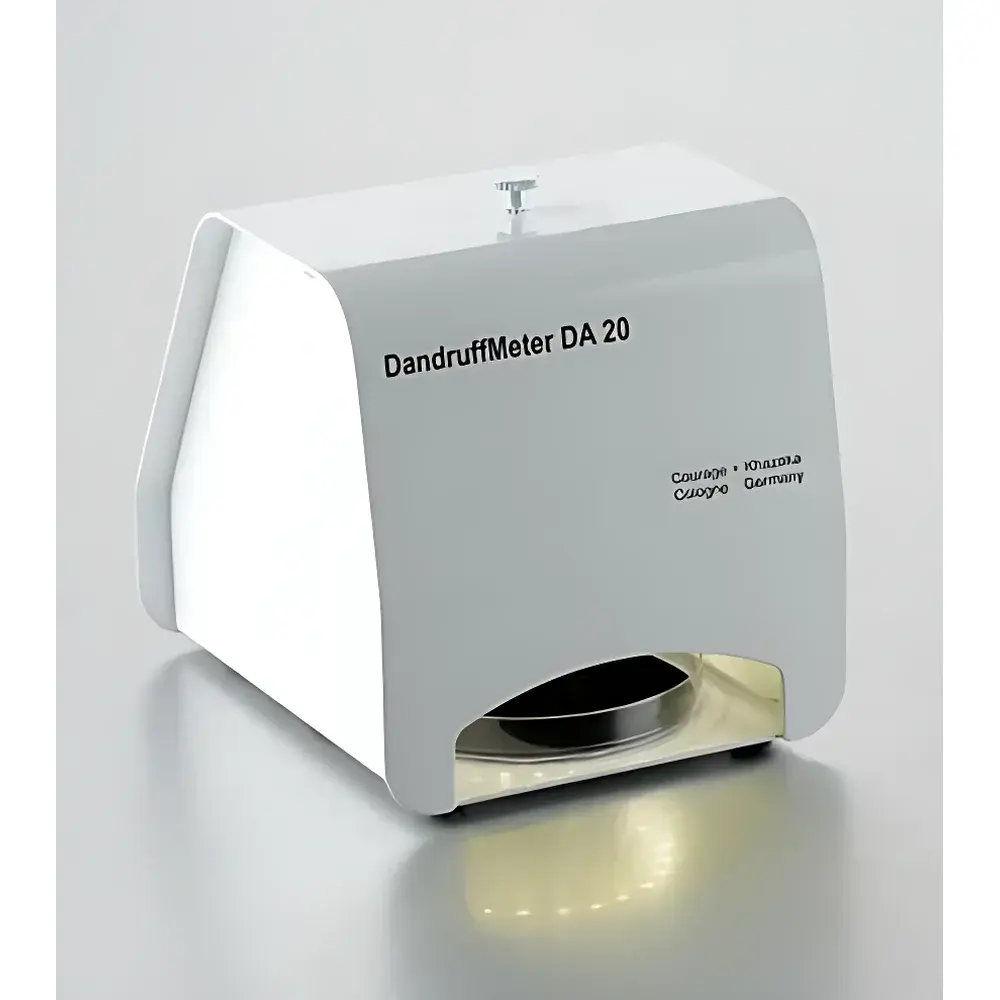
CK DA20 Dandruff Analysis System
| Brand | CK |
|---|---|
| Origin | Germany |
| Manufacturer Status | Authorized Distributor |
| Origin Category | Imported |
| Model | DA20 |
| Pricing | Upon Request |
Overview
The CK DA20 Dandruff Analysis System is a dedicated, non-invasive optical imaging instrument engineered for quantitative assessment of dandruff load on scalp surface samples. It operates on the principle of high-contrast digital image acquisition and automated morphometric classification—leveraging controlled illumination geometry and calibrated pixel-based segmentation to objectively quantify flake count, size distribution, and spatial density. Unlike subjective visual grading or manual microscopy, the DA20 delivers repeatable, operator-independent measurements aligned with standardized dermatological evaluation protocols used in cosmetic efficacy testing. Its design supports both clinical trial endpoints and routine R&D screening, providing traceable, audit-ready data for substantiating anti-dandruff claims under regulatory frameworks including ISO 16128, CTFA guidelines, and EU Cosmetics Regulation (EC) No 1223/2009.
Key Features
- Integrated coaxial ring-light illumination system ensuring uniform, shadow-free illumination of sample dishes with dark-background substrates—optimized for contrast enhancement of keratinous flakes against low-reflectance surfaces.
- High-resolution monochrome CMOS sensor (≥5 megapixels) with fixed-focus macro lens, delivering sub-10 µm effective pixel resolution at standard working distance (35 mm).
- Automated nine-tier size classification algorithm: flakes are categorized by equivalent circular diameter (ECD) into discrete bins ranging from 500 µm (macroflakes), enabling granular statistical profiling of flake morphology shifts pre- and post-treatment.
- Dedicated firmware with real-time image preview, auto-exposure adjustment, and batch processing capability for multi-sample sequences—minimizing inter-session variability.
- Robust mechanical stage with precision dish alignment guides and removable sample holder compatible with standard 60 mm Petri-style collection dishes (non-proprietary format).
- CE-marked hardware compliant with IEC 61000-6-3 (EMC) and IEC 61000-6-2 (immunity); designed for laboratory environments meeting ISO/IEC 17025 calibration traceability requirements.
Sample Compatibility & Compliance
The DA20 accepts scalp scale collections obtained via standardized adhesive tape stripping (e.g., using 3M™ Transpore™ or similar medical-grade tapes), vacuum aspiration onto dark-finish collection plates, or gentle brushing onto matte-black silicone-coated dishes. All substrates must exhibit ≥90% diffuse reflectance below 400 nm and ≤5% above 650 nm to ensure optimal contrast. The system supports GLP-aligned workflows: raw images are stored with embedded EXIF metadata (timestamp, exposure settings, device ID), and analysis logs include full parameter audit trails. Data output complies with FDA 21 CFR Part 11 requirements when deployed with validated third-party LIMS integration—supporting electronic signatures, version-controlled reports, and secure user access tiers.
Software & Data Management
The DA20 Control Suite (v3.2+) runs on Windows 10/11 x64 platforms and features dual-mode operation: standalone analysis mode for single-sample quantification, and study management mode for longitudinal cohort tracking. Each analysis generates a structured CSV report containing total flake count, size-bin frequencies, mean ECD, coefficient of variation (CV%), and density (flakes/cm²). Export options include PDF summary reports with annotated images, TIFF stacks of segmented masks, and XML files formatted for ingestion into SAS JMP, GraphPad Prism, or internal statistical pipelines. Software validation documentation (IQ/OQ/PQ protocols) is available upon request for GMP-regulated cosmetic development laboratories.
Applications
- Evaluation of active ingredient efficacy (e.g., zinc pyrithione, ketoconazole, climbazole) in rinse-off and leave-on formulations across 2–4 week clinical protocols.
- Comparative benchmarking of new anti-dandruff actives against reference standards under controlled environmental conditions (22 ± 2°C, 40 ± 5% RH).
- Supporting claim substantiation for “reduces visible flakes by X% in Y days” statements required by Advertising Standards Authorities (ASA, BBB National Programs).
- Correlative analysis with sebumetry, transepidermal water loss (TEWL), and microbial sequencing data to investigate dandruff pathophysiology mechanisms.
- Quality control of finished products during stability testing—detecting formulation-induced changes in flake aggregation behavior over accelerated aging cycles.
FAQ
Does the DA20 require calibration with certified reference standards?
Yes—annual recalibration using NIST-traceable grayscale targets and particle-size calibration slides is recommended. CK provides a certified calibration kit (Cat. No. CAL-DA20-KIT) with documented uncertainty budgets.
Can the system differentiate between dandruff and other scalp debris (e.g., hair fragments, environmental dust)?
The algorithm applies shape factor thresholds (circularity ≥0.4, solidity ≥0.6) and intensity gradient filters to suppress non-biological particulates; however, operator review of flagged outliers is advised for borderline cases.
Is the software compatible with networked lab environments and electronic lab notebooks (ELN)?
Native API support for RESTful data export enables integration with LabVantage, Benchling, and Dotmatics ELNs; SFTP and ODBC connectors are included in the Enterprise License tier.
What is the minimum detectable flake size under standard operating conditions?
Under optimal lighting and focus, the system reliably detects flakes ≥35 µm in equivalent circular diameter with ≥92% sensitivity (validated per ISO 13843:2020 Annex B).




