
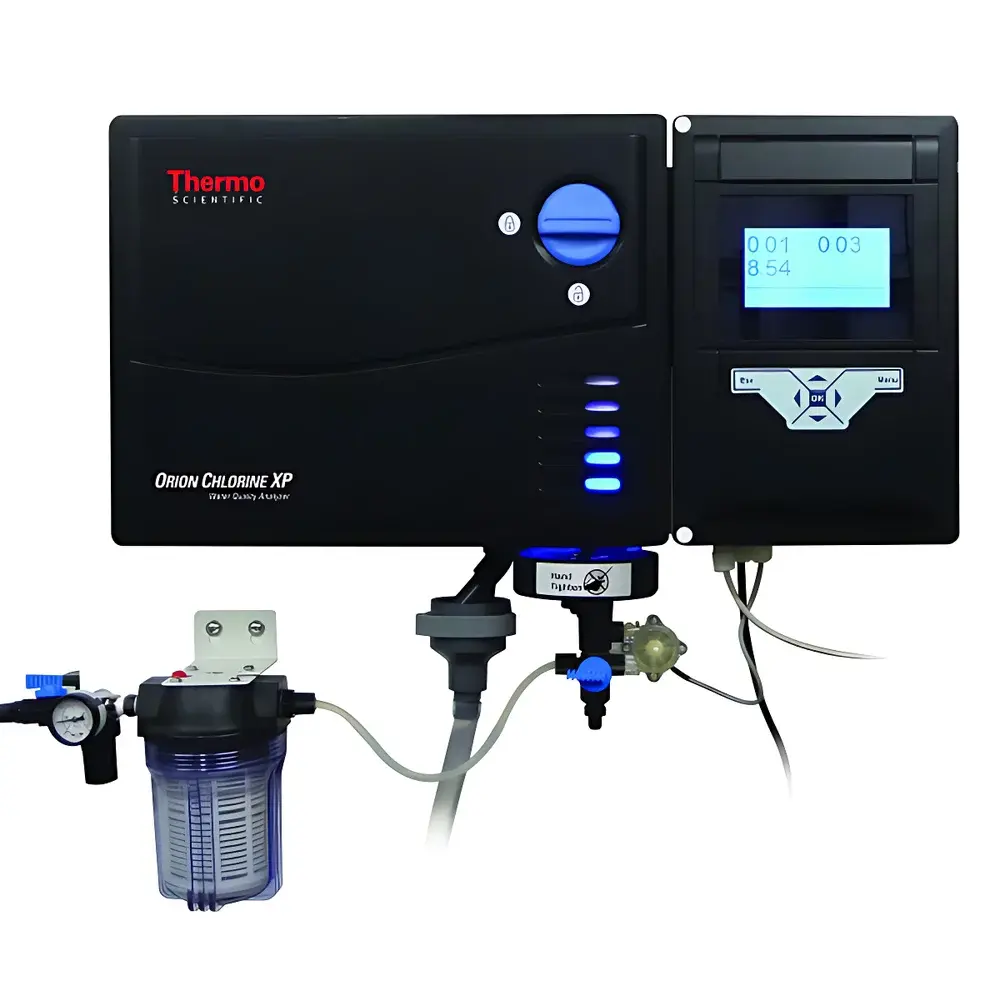
Thermo Fisher Chlorine XP Residual and Total Chlorine Analyzer
| Brand | Thermo Fisher |
|---|---|
| Origin | USA |
| Manufacturer | Thermo Fisher Scientific |
| Product Type | Imported |
| Model | Chlorine XP |
| Instrument Type | Online Analyzer |
| Measurement Principle | DPD Colorimetric Spectrophotometry |
| Measured Parameters | Free Chlorine, Total Chlorine, Combined Chlorine |
| Range | 0.01–10 ppm |
| Accuracy | ±3% of reading |
| Repeatability | ±5% |
| Resolution | 0.01 ppm |
| Detection Limit | 0.01 ppm |
| Reagent Consumption | 0.03 mL per analysis |
| Calibration | Automatic blank calibration prior to each measurement |
| Light Source Management | Auto-adjusted LED intensity for extended lifetime |
| Cell Cleaning | Integrated automatic cuvette cleaning cycle |
| Enclosure Rating | IP65 (NEMA 4) |
| Communication Interface | RS-485 |
| Certifications | EPA Compliant, CSA Certified, ISO 9001 Certified |
| Reagent Shelf Life | 24 months (unopened), 60 days (in instrument) |
| Operating Temperature Range | Compatible with sample temperatures as low as 4°C |
Overview
The Thermo Fisher Chlorine XP Residual and Total Chlorine Analyzer is an online, fully automated spectrophotometric analyzer engineered for continuous, real-time monitoring of free chlorine, total chlorine, and combined chlorine in potable water, process water, and wastewater effluents. It implements the standardized N,N-diethyl-p-phenylenediamine (DPD) colorimetric method—recognized by the U.S. Environmental Protection Agency (EPA), ASTM D1253, and ISO 7393-2—as its core analytical principle. Unlike conventional benchtop or semi-automated DPD systems, the Chlorine XP integrates optical path stabilization, dynamic light source compensation, and on-board reagent delivery within a single compact enclosure. Its design eliminates manual intervention while maintaining metrological traceability to primary standards. The system operates without external air supply, pressurized water, or complex plumbing—making it suitable for deployment in remote or space-constrained locations such as pump stations, membrane skids, or inline distribution monitoring points.
Key Features
- Ultra-low reagent consumption: Only 0.03 mL per analysis—lowest in class—reducing operational cost and waste generation over extended deployment cycles.
- Automatic blank calibration and LED intensity adjustment before every measurement cycle, ensuring long-term photometric stability and minimizing drift-related recalibration frequency.
- Self-cleaning optical flow cell with programmable purge and rinse sequence to prevent biofilm accumulation and particulate interference.
- Modular architecture enables field-replaceable components—including reagent cartridges, optical modules, and fluidic manifolds—without requiring factory-level technical support.
- Integrated diagnostics engine provides granular maintenance alerts (e.g., low reagent, clogged line, photodiode degradation) with timestamped event logging compliant with GLP/GMP audit requirements.
- IP65-rated enclosure (NEMA 4 equivalent) ensures reliable operation in humid, dusty, or splash-prone environments typical of municipal water plants and industrial cooling towers.
- RS-485 Modbus RTU interface supports seamless integration into SCADA, DCS, or PLC-based control infrastructures for centralized data aggregation and alarm management.
Sample Compatibility & Compliance
The Chlorine XP accepts raw, filtered, or clarified water samples across a broad conductivity range (up to 2,000 µS/cm) and turbidity ≤ 5 NTU without pre-filtration. It maintains measurement integrity at sample temperatures from 4°C to 40°C—a critical capability for cold-water distribution networks and chilled industrial loops. All wetted materials comply with NSF/ANSI Standard 61 for drinking water system components. The analyzer is certified to CSA C22.2 No. 61010-1 (safety), meets EPA Method 334.0 performance criteria for residual chlorine, and adheres to ISO 9001 quality management system requirements. Firmware supports configurable audit trails, user access levels, and electronic signature capability aligned with FDA 21 CFR Part 11 expectations where required.
Software & Data Management
Embedded firmware includes a web-accessible configuration interface (HTTP/HTTPS) for remote setup, calibration verification, and diagnostic review. Data output includes analog 4–20 mA outputs (isolated), digital Modbus registers, and optional SD card logging (CSV format) with configurable sampling intervals (1–60 minutes). Internal memory retains ≥30 days of high-resolution trend data (including raw absorbance, temperature, and status flags) even during network outages. Optional Thermo Fisher Connect Cloud services enable secure, encrypted data forwarding to enterprise historians or cloud-based dashboards with configurable alert thresholds and SMS/email notification rules.
Applications
- Municipal drinking water treatment: Disinfection point-of-contact monitoring, clearwell exit validation, and distribution system residual tracking.
- Food & beverage production: Rinse water verification, CIP loop residual control, and final product water safety assurance.
- Wastewater reuse facilities: Effluent compliance reporting per local discharge permits and indirect potable reuse (IPR) regulatory frameworks.
- Power generation: Condenser and cooling tower water chlorination control to mitigate biofouling on heat exchangers and condenser tubes.
- Desalination and membrane systems: RO feed and permeate monitoring to detect membrane breakthrough or biocide overdosing.
- Pharmaceutical water systems: PW and WFI loop surveillance per USP and EU Annex 1 requirements for microbial control efficacy.
FAQ
Does the Chlorine XP require daily manual intervention?
No—once commissioned, it operates unattended for up to 60 days between reagent cartridge replacements. Scheduled maintenance tasks are guided via on-screen prompts and logged automatically.
Can it distinguish between free chlorine and total chlorine in a single sample stream?
Yes—via sequential DPD1 (free chlorine) and DPD3 (total chlorine) reaction protocols executed automatically within one analysis cycle.
Is calibration traceable to NIST standards?
All factory calibrations use NIST-traceable chlorine standard solutions; users may perform field verification using certified reference materials per EPA guidance.
What happens if the sample line becomes obstructed?
The integrated flow sensor triggers an immediate fault condition, halts reagent injection, logs the event, and asserts a dry-run alarm to prevent unnecessary reagent depletion.
How is data integrity ensured during power interruption?
Non-volatile memory preserves all configuration parameters, calibration coefficients, and recent trend data. Upon reboot, the system resumes operation without manual recovery steps.
Related Products







