
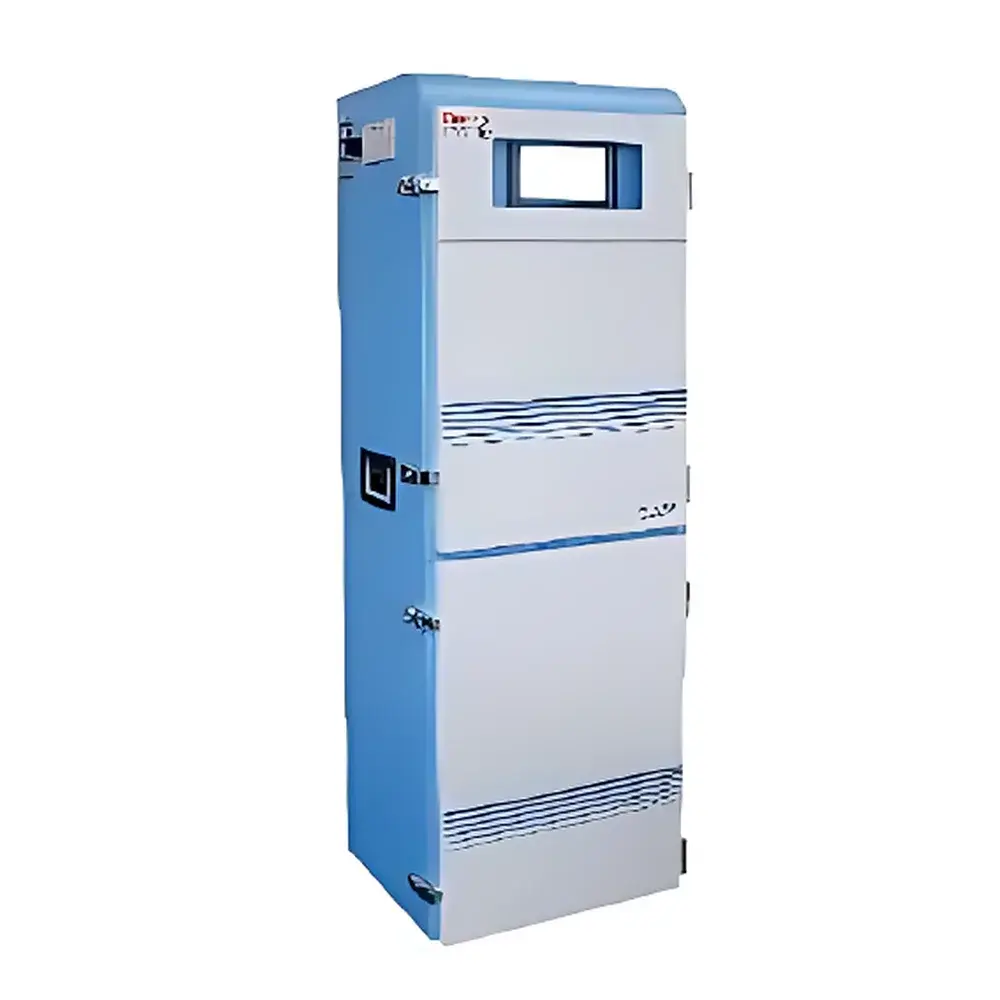
Thermo Scientific 3300 Online Heavy Metals Analyzer for Water Quality
| Brand | Thermo Fisher |
|---|---|
| Origin | USA |
| Manufacturer | Thermo Fisher Scientific |
| Product Type | Imported |
| Model | Thermo Scientific 3300 |
| Instrument Category | Online Analyzer |
| Detection Principle | Photometric Method (Colorimetric) |
| Target Metals | Dual- or Multi-Parameter (e.g., Cu, Zn, Ni, Cr, Pb, Cd, As, Mn) |
| Accuracy/Precision | ±10% of Full Scale |
| Resolution | 0.001 mg/L (ppb-level configurable per analyte) |
Overview
The Thermo Scientific 3300 Online Heavy Metals Analyzer is an industrial-grade, continuous-monitoring system engineered for regulatory-compliant, real-time quantification of dissolved heavy metal ions in aqueous matrices. It operates on standardized photometric detection principles aligned with EPA Methods 200.7, 200.8, and ISO 11969, utilizing selective colorimetric reactions between target metal ions and proprietary chelating reagents. Unlike discrete laboratory instruments, the 3300 integrates fully automated sampling, digestion (where required), reagent delivery, reaction incubation, optical measurement, and waste handling within a single compact chassis—enabling unattended operation over extended deployment cycles. Designed for harsh environmental monitoring environments—including municipal wastewater influent/effluent, industrial discharge points, surface water intakes, and groundwater remediation sites—the analyzer delivers stable, trace-level performance under variable flow, temperature, and matrix complexity conditions.
Key Features
- Auto-ranging measurement capability: Dynamically selects optimal analytical range based on real-time sample concentration to maintain linearity and minimize dilution artifacts.
- Advanced fluidic architecture: Patented positive-displacement metering eliminates volumetric drift and ensures sub-microliter precision across varying sample viscosities and particulate loads.
- Integrated digestion–detection module: On-board acid digestion (HNO₃/H₂O₂) and UV-assisted oxidation enable total recoverable metal analysis per US EPA 200.2 and ISO 15587-1 protocols—without external pretreatment units.
- High-stability optical system: Uses long-life pulsed xenon lamp (rated >10⁹ flashes) and thermally stabilized interference filters to ensure spectral fidelity and photometric repeatability over 12+ months without recalibration.
- Matrix interference mitigation: Built-in dual-wavelength correction and adaptive baseline compensation eliminate spectral overlap from natural organic matter, turbidity (>200 NTU), and chromophoric dissolved organic carbon (CDOM).
- Comprehensive QC automation: Scheduled standard addition, blank verification, and multi-point calibration validation with user-defined frequency; all QC events logged with audit-trail timestamps.
- Remote operational control: Full bidirectional communication via Modbus TCP/IP, OPC UA, or optional 4G LTE; supports remote parameter adjustment, diagnostic retrieval, and firmware updates.
Sample Compatibility & Compliance
The Thermo Scientific 3300 accepts raw, filtered (≤5 µm), or clarified water samples across pH 2–10 and conductivity up to 5,000 µS/cm. It complies with ISO/IEC 17025:2017 requirements for automated testing systems and meets data integrity criteria under FDA 21 CFR Part 11 when deployed with validated software configuration. Instrument outputs satisfy reporting thresholds defined in EU Directive 2000/60/EC (Water Framework Directive), China’s HJ 484–2009 and HJ 700–2014 standards, and U.S. Clean Water Act NPDES permit requirements. All measurement records include embedded metadata: sample ID, timestamp (UTC), operator ID, calibration status, QC flag, and environmental sensor readings (temperature, pressure, flow rate).
Software & Data Management
The analyzer runs Thermo Scientific Insight™ Embedded OS—a secure, Android-based platform certified for industrial use (IEC 62443-3-3 SL2). Its web-accessible interface supports role-based authentication (admin/operator/auditor), electronic signature workflows, and automatic export to LIMS or SCADA via TLS 1.2–encrypted RESTful API. Raw absorbance spectra, kinetic reaction curves, and calibration history are stored locally (32 GB internal eMMC) with cyclic overwrite protection for critical events. Audit logs capture every user action, configuration change, and instrument fault—retained for ≥18 months and exportable in CSV/PDF formats compliant with GLP/GMP documentation practices.
Applications
- Municipal wastewater treatment plants: Continuous monitoring of Cu, Zn, and Ni at final effluent discharge points to ensure compliance with local discharge limits.
- Industrial process outfalls: Real-time tracking of Cr(VI), Pb, and Cd from electroplating, battery manufacturing, and metal finishing facilities.
- Drinking water source protection: Early-warning detection of As and Mn in raw surface water intakes upstream of treatment facilities.
- Environmental remediation sites: Long-term trend analysis of leachate metal concentrations from landfill monitoring wells.
- Regulatory compliance reporting: Automated generation of daily/monthly summary reports aligned with national environmental monitoring network templates (e.g., China’s National Surface Water Monitoring Network, U.S. STORET).
FAQ
What heavy metals can the Thermo Scientific 3300 measure simultaneously?
It supports up to six pre-configured analytes per system (e.g., Cu, Zn, Ni, Cr, Pb, Cd); additional metals require method validation and reagent module reconfiguration.
Is digestion mandatory for all measurement modes?
Digestion is enabled only when “total recoverable” analysis is selected; “dissolved” mode bypasses digestion and measures filter-passing fractions directly.
How often does the system require maintenance or reagent replacement?
With standard usage (one measurement per hour), reagent cartridges last 30–45 days; pump tubing and optical windows are rated for ≥6 months of continuous operation.
Can the 3300 integrate with existing plant SCADA or EMS platforms?
Yes—via native Modbus TCP/IP or optional protocol converters for DNP3, BACnet MS/TP, or Profibus DP.
Does the instrument support third-party calibration verification standards?
Yes—it accepts NIST-traceable CRM solutions (e.g., SPEX CertiPrep®) and auto-validates recovery within user-defined acceptance criteria (typically 85–115%).
Related Products







