
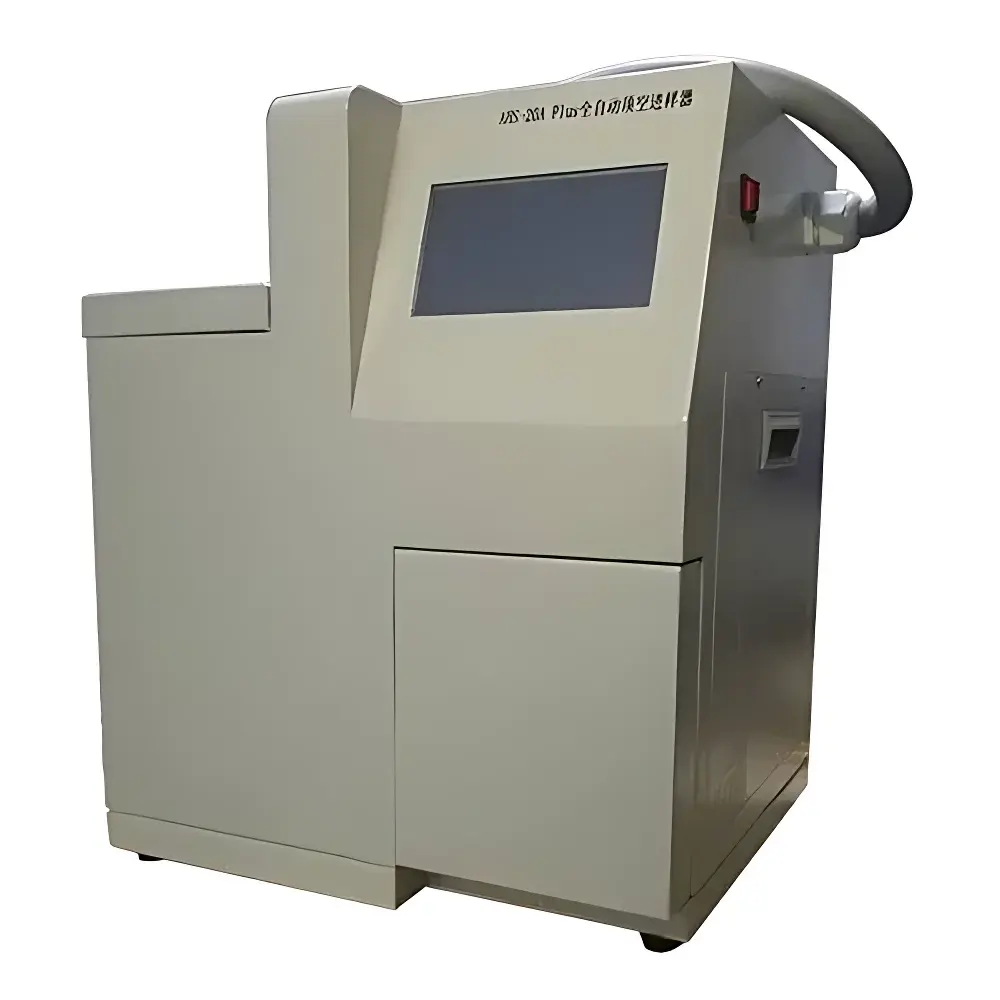
Beifen Sanpu HAHS-20A Plus Fully Automated Headspace Sampler
| [Brand | Beifen Sanpu |
|---|---|
| Origin | Beijing, China |
| Manufacturer Type | Direct Manufacturer |
| Model | HAHS-20A Plus |
| Sample Positions | 20 |
| Sample Vial Capacity | 10 mL or 20 mL (customizable up to 100 mL) |
| Quantitative Loop Volume | 1 mL (optional: 0.5 / 2 / 5 mL) |
| Sample Heating Range | 40–220 °C (extendable to 300 °C) |
| Valve & Transfer Line Heating Range | 40–220 °C (extendable to 300 °C) |
| Temperature Accuracy | ±0.5 °C |
| Temperature Stability | < ±0.5 °C |
| Pressure Control Range | 0–0.25 MPa (continuously adjustable) |
| Pressurization Time | 0–999 s |
| Sampling Time | 0–30 min |
| Injection Time | 0–999 s |
| Bake-out/Flush Time | 0–30 min |
| Minimum Time Resolution | 1 ms |
| Carrier Gas Flow Control | EPC optional |
| RSD | < 1.0% (for 100 ppm ethanol in water) |
| Backflush Flow | 0–100 mL/min (adjustable) |
| Interface | USB |
| Compliance | Designed for ISO/IEC 17025-aligned labs |
Overview
The Beifen Sanpu HAHS-20A Plus Fully Automated Headspace Sampler is an engineered solution for precise, reproducible, and unattended volatile organic compound (VOC) analysis in compliance-critical laboratories. Based on the principle of equilibrium headspace sampling—where analytes partition between a solid or liquid sample matrix and its vapor phase above—the HAHS-20A Plus thermally equilibrates sealed vials under controlled temperature and pressure conditions, then introduces the gas-phase analytes directly into the gas chromatograph (GC) via a pressurized, inert flow path. This method eliminates solvent interference, reduces column contamination, and enhances detection sensitivity for trace-level volatiles—making it indispensable for environmental testing, pharmaceutical residual solvent analysis (per USP & ICH Q2(R2)), food flavor profiling, forensic toxicology, and polymer outgassing studies.
Key Features
- 20-position auto-sampler carousel with automatic vial recognition and collision-avoidance logic—detects missing or misaligned vials and skips them without interrupting sequence execution.
- Triple-zone independent temperature control: sample incubation oven, six-port valve housing, and transfer line—all heated to 220 °C standard (upgradable to 300 °C), eliminating cold spots and ensuring quantitative transfer of high-boiling analytes.
- High-inertness fluidic path: all internal tubing, quantitative loops (1 mL standard), and sampling needles are fabricated from silanized fused silica or deactivated stainless steel, minimizing adsorption and carryover (RSD < 1.0% demonstrated with 100 ppm ethanol in aqueous matrix).
- Positive-pressure sampling architecture: delivers consistent injection volume without reliance on carrier gas pressure gradients—ensuring baseline stability and compatibility with both constant-flow and EPC-controlled GC inlets.
- Motor-driven actuation system: fully electromechanical motion control eliminates need for external compressed air or nitrogen, reducing infrastructure requirements and improving operational safety in regulated lab environments.
- Real-time system diagnostics: power-on self-test, positional encoder feedback, thermal fault detection, and hardware watchdog logic ensure robust 24/7 unattended operation with automated error logging.
- Flexible scheduling: supports single-vial multi-injection, single-injection-per-vial, and multi-vial sequential modes—enabling method-specific optimization for throughput vs. precision trade-offs.
Sample Compatibility & Compliance
The HAHS-20A Plus accommodates standard 10 mL and 20 mL crimp-top headspace vials (with optional adapters for 50 mL and 100 mL formats), supporting solid, semi-solid, and liquid matrices—including viscous polymers, biological tissues, soil slurries, and aqueous pharmaceutical formulations. Its design aligns with method validation requirements outlined in ASTM D6866, ISO 11843, and USP <467> for residual solvents. When integrated into a validated GC workflow, the system supports full 21 CFR Part 11 compliance when paired with audit-trail-enabled chromatography data systems (CDS)—including electronic signatures, user access controls, and immutable event logs for IQ/OQ/PQ documentation.
Software & Data Management
Control is implemented via native Windows-based software accessible through USB 2.0 interface, enabling full parameter configuration—including temperature ramps, pressurization profiles, timing sequences, and GC synchronization triggers. All methods are stored with metadata (date/time stamp, operator ID, instrument serial number) and exportable in CSV or XML format for LIMS integration. The embedded 7-inch TFT LCD provides real-time graphical feedback of thermal status, valve position, pressure transients, and remaining run time—allowing manual override or pause/resume capability without PC dependency. Firmware supports remote firmware updates and diagnostic telemetry for preventive maintenance planning.
Applications
- Pharmaceutical QC: Residual solvents (e.g., methylene chloride, acetone, toluene) per ICH Q3C guidelines.
- Environmental analysis: VOCs in groundwater, soil extracts, and indoor air samples (EPA Method 502.2, 624, 8260).
- Food & beverage: Ethanol quantification, off-flavor compound screening (e.g., acetaldehyde, limonene), and packaging migration studies.
- Chemical manufacturing: Monomer purity assessment, catalyst residue monitoring, and reaction byproduct profiling.
- Forensics: Blood alcohol testing, ignitable liquid residue (ILR) identification in arson investigations.
FAQ
Is the HAHS-20A Plus compatible with Agilent, Thermo, and Shimadzu GC systems?
Yes—it features universal TTL-level GC start trigger output and accepts external start signals, enabling seamless synchronization with all major GC platforms via dry-contact or voltage-triggered interfaces.
Can the system be validated for GMP environments?
Absolutely. With optional EPC module, full audit trail logging, and configurable user roles, the HAHS-20A Plus meets core requirements for computerized system validation (CSV) under Annex 11 and FDA guidance—provided it is deployed within a documented quality management system.
What maintenance intervals are recommended for routine operation?
Valve seal replacement every 10,000 injections; quantitative loop cleaning after 500 runs using certified solvent flush protocols; annual calibration verification of temperature sensors and pressure transducers against NIST-traceable standards.
Does the instrument support method transfer from legacy headspace systems?
Yes—timing parameters, temperature setpoints, and pressure profiles are fully programmable and exportable, allowing direct replication of established SOPs from PerkinElmer, Gerstel, or Shimadzu platforms with minimal re-optimization.





