
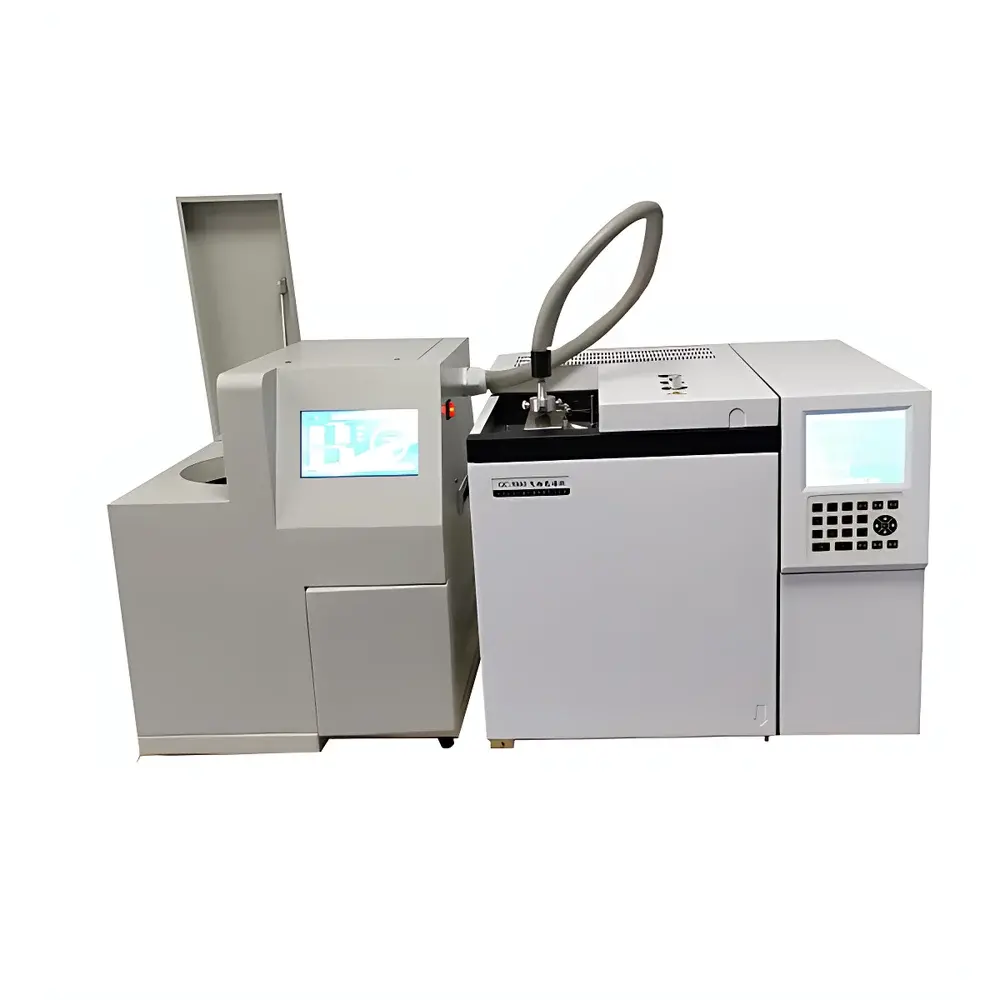
Beifen Sanpu A/HS-20A PLUS Fully Automated Static Headspace Sampler
| Brand | Beifen Sanpu |
|---|---|
| Origin | Beijing, China |
| Manufacturer Type | Manufacturer |
| Product Origin | Domestic (China) |
| Model | A/HS-20A PLUS |
| Instrument Type | Static Headspace Sampler |
| Automation Level | Fully Automatic |
| Vial Heating Range | Ambient to 200 °C (1 °C increment) |
| Valve Temperature Control Range | 40–220 °C (±1 °C accuracy) |
| Sample Loop Volume | 1 mL |
| Vial Capacity | 20 positions |
| Compatible Vial Sizes | 10 mL or 20 mL |
Overview
The Beifen Sanpu A/HS-20A PLUS is a fully automated static headspace sampler engineered for precise, reproducible quantification of volatile organic compounds (VOCs) in aqueous matrices—particularly benzene, toluene, ethylbenzene, xylenes (o-, m-, p-), isopropylbenzene, and styrene—as specified in China’s national standard HJ 1067–2019. It operates on the thermodynamic principle of phase equilibrium: when an aqueous sample is sealed in a vial and heated, VOCs partition from the liquid phase into the headspace vapor phase until dynamic equilibrium is established. At constant temperature and pressure, the concentration of each analyte in the vapor phase is directly proportional to its aqueous-phase concentration (governed by Henry’s law). The A/HS-20A PLUS precisely extracts a fixed volume (1 mL) of equilibrated headspace gas via a thermostated six-port valve and delivers it to a gas chromatograph (GC) for separation and detection—typically using flame ionization detection (FID) or mass spectrometry (MS). Its design prioritizes analytical robustness, minimal carryover, and compliance-ready operation in environmental testing laboratories performing routine regulatory monitoring of drinking water sources, surface water, groundwater, wastewater, and industrial effluents.
Key Features
- Fully automated 20-position carousel with programmable vial sequencing and priority queue handling for unattended overnight operation.
- Independent dual-zone temperature control: vial oven (ambient to 200 °C, ±0.5 °C stability) and transfer line/valve assembly (40–220 °C, ±1 °C precision), minimizing condensation and ensuring quantitative transfer.
- 1 mL fixed-volume sampling loop with inert SilcoNert®-treated stainless-steel construction to prevent adsorption or catalytic degradation of aromatic compounds.
- Integrated leak-tight sealing mechanism and pressure-balanced vial piercing system to ensure consistent equilibration pressure across all samples.
- Onboard method storage (≥100 methods), real-time status monitoring, and hardware-level error logging compatible with laboratory audit trails.
- RS-232 and USB interfaces for seamless integration with GC systems (e.g., GC-9860) and LIMS platforms.
Sample Compatibility & Compliance
The A/HS-20A PLUS accommodates standard 10 mL and 20 mL crimp-top or screw-cap headspace vials with silicone/PTFE septa. It supports matrix types including potable water, surface water, groundwater, domestic sewage, and industrial wastewater—fully aligned with HJ 1067–2019 requirements. Method validation data demonstrate method detection limits (MDLs) of 2–3 µg/L and lower limits of quantitation (LLOQs) of 8–12 µg/L for the eight target benzene-series compounds at 10.0 mL sample volume. The instrument’s thermal stability, repeatability (<3% RSD for peak area), and low blank response meet ISO/IEC 17025:2017 criteria for accredited environmental testing. Its operational parameters are traceable to NIST-traceable temperature standards, and system suitability checks align with USP and EPA Method 502.2 protocols for VOC analysis.
Software & Data Management
Controlled via Beifen Sanpu’s HS-Link software (Windows-based), the A/HS-20A PLUS supports method development with customizable equilibration time (0–999 min), agitator speed (0–500 rpm), pressurization time, and injection cycle timing. All acquisition parameters—including vial ID, temperature setpoints, valve actuation timestamps, and error flags—are embedded in raw data files (.csv or .txt) for full traceability. Audit trail functionality logs user actions, method changes, and system events with timestamps and operator IDs—supporting compliance with FDA 21 CFR Part 11 requirements when deployed in GLP/GMP-regulated environments. Exported reports include calibration curves, QC check results (e.g., continuing calibration verification, duplicate analysis), and compliance summaries per HJ 1067–2019 Annex A.
Applications
Primary applications include regulatory monitoring of benzene-series contaminants under China’s Environmental Monitoring Technical Specifications (HJ 91.1, HJ/T 91, HJ/T 164), source water protection programs, wastewater treatment plant discharge verification, and industrial effluent compliance screening. The system is routinely deployed in provincial environmental monitoring centers, third-party testing labs, and municipal water quality laboratories conducting routine VOC surveillance. Its performance has been validated for complex matrices containing humic substances, chloride, and moderate turbidity—provided sample preservation (e.g., pH adjustment, refrigeration, sodium thiosulfate addition for residual chlorine quenching) follows HJ 494 guidelines.
FAQ
What is the maximum allowable sample temperature for aqueous matrices without risking vial rupture or excessive pressure buildup?
The vial heating range extends to 200 °C; however, for aqueous samples, recommended equilibration temperatures are 60–90 °C to maintain safe headspace pressure (<30 psi) while achieving optimal partitioning efficiency for benzene-series compounds.
Can the A/HS-20A PLUS be used with GC-MS systems for confirmatory analysis?
Yes—the 1 mL loop and thermostated transfer line are compatible with both FID and MS detectors; method transfer requires only minor optimization of splitless injection parameters and dwell times.
Does the system support internal standard addition via syringe prior to vial sealing?
No—internal standard addition must be performed manually during sample preparation prior to vial loading; the A/HS-20A PLUS does not feature integrated liquid dispensing.
How is carryover minimized between high-concentration and low-concentration samples?
The system employs a three-stage purge: post-injection carrier gas flush of the loop and valve, heated transfer line bake-out (up to 220 °C), and optional inert gas pre-purge of the vial before pressurization.
Is validation documentation available for IQ/OQ/PQ protocols?
Beifen Sanpu provides a comprehensive qualification package—including test protocols, acceptance criteria, and blank templates—for installation qualification (IQ), operational qualification (OQ), and performance qualification (PQ) aligned with ISO/IEC 17025 and CNAS-CL01 requirements.





