
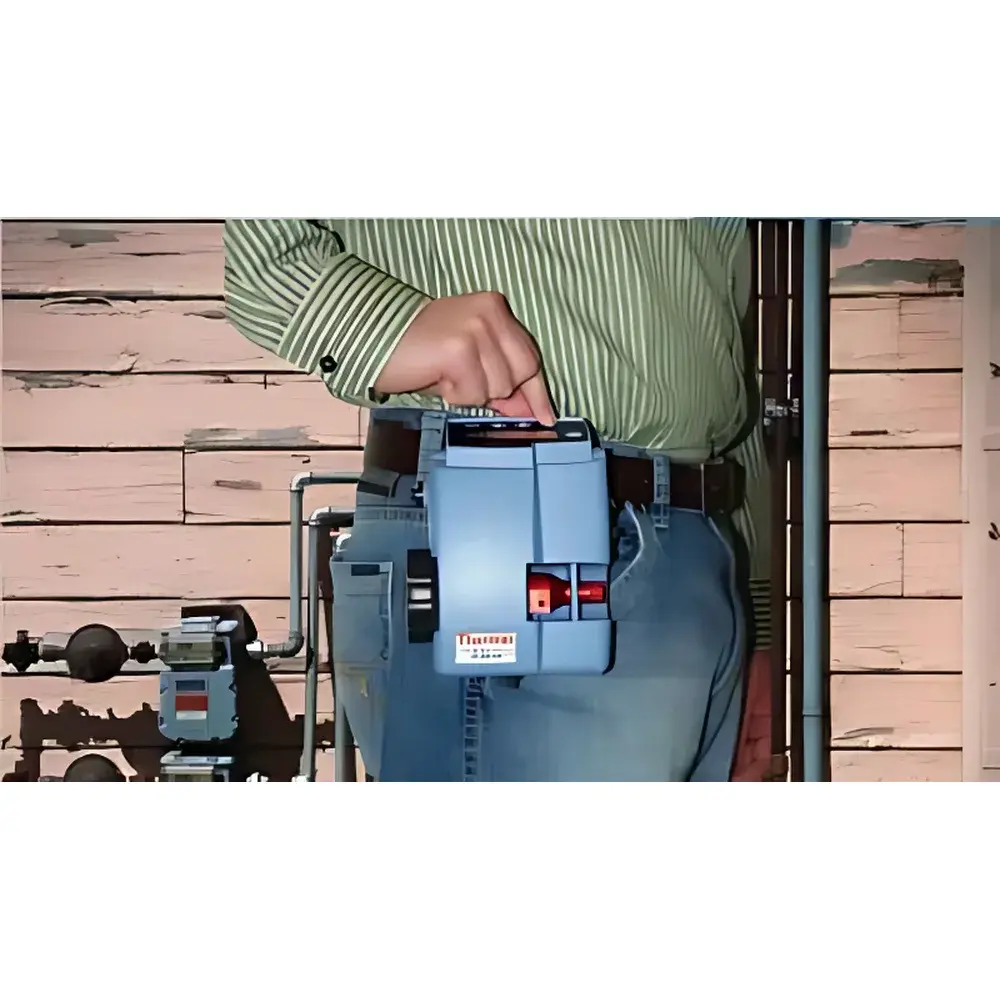
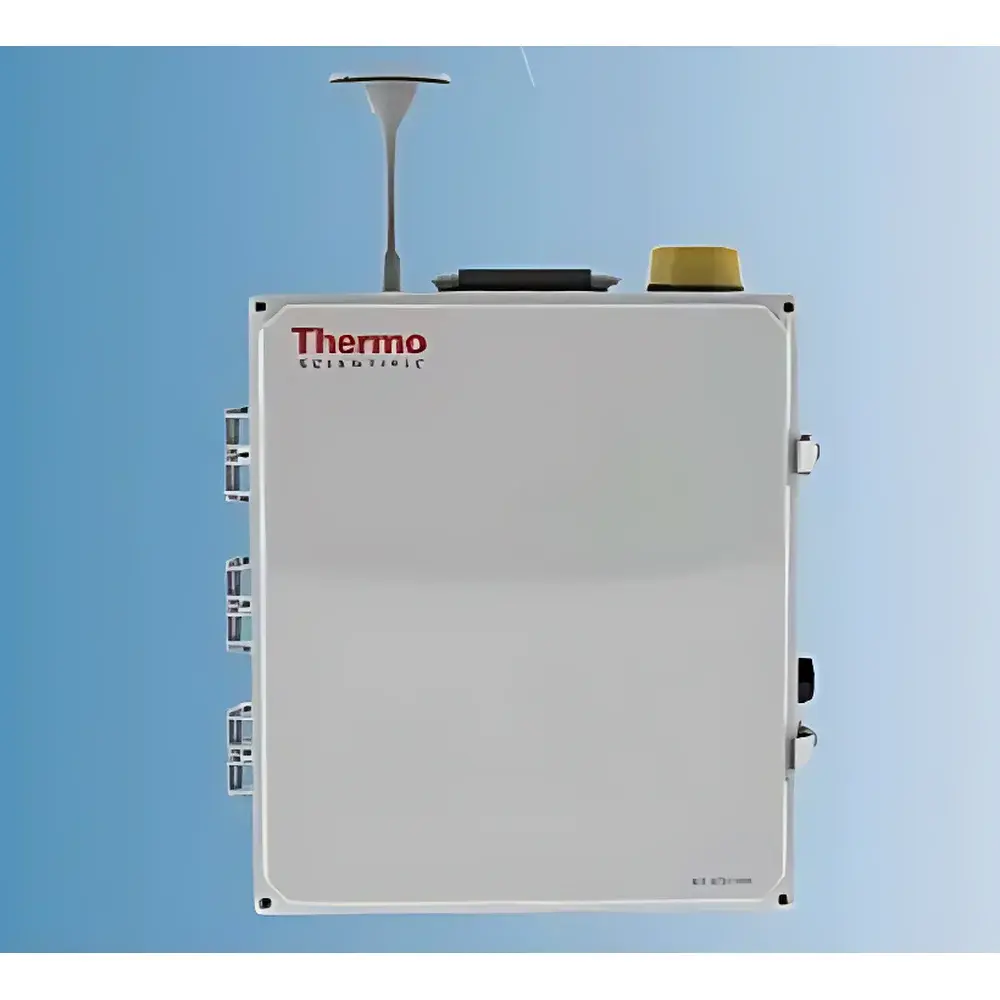
Thermo Scientific pDR/ADR-1500 Portable Personal & Area Particulate Matter Monitor
| Brand | Thermo Fisher |
|---|---|
| Origin | USA |
| Manufacturer | Thermo Fisher Scientific |
| Product Type | Imported Instrument |
| Model | pDR/ADR-1500 |
| Measurement Principle | Nephelometric Light Scattering (880 nm LED) |
| Measured Parameter | PM₂.₅ (also configurable for PM₁, PM₄, PM₁₀ via interchangeable cyclones) |
| Flow Control | True Volumetric Flow Control with Digital Pressure Feedback |
| Humidity Compensation | Integrated Heated RH Sensor & Algorithmic Correction |
| Compliance | NIOSH Methods 0500 & 0600, ACGIH-Traceable Cyclones |
| Data Storage | >500,000 records |
| Display | Dual-line LCD (16×2 characters) |
| Dimensions (pDR-1500) | 181 × 143 × 84 mm |
| Dimensions (ADR-1500) | 533 × 431 × 215 mm |
| Weight (ADR-1500) | 12.9 kg |
| IP Rating | IP65 (ADR-1500) |
| Power Options | AC, DC, or Internal Rechargeable Battery |
| Communication Interfaces | USB, RS-232, 0–2 V / 4–20 mA Analog Outputs, Optional Wireless Module |
Overview
The Thermo Scientific pDR/ADR-1500 Portable Personal & Area Particulate Matter Monitor is a dual-mode, field-deployable optical aerosol sensing platform engineered for regulatory-grade ambient and occupational exposure assessment. Operating on the principle of nephelometric light scattering at 880 nm, the instrument quantifies airborne particulate mass concentration by measuring the intensity of light scattered by suspended particles within a precisely conditioned sample volume. Unlike passive diffusion-based sensors, the pDR/ADR-1500 employs active aspiration with true volumetric flow control—enabled by real-time digital feedback from a calibrated orifice pressure differential, temperature, and barometric pressure—to ensure metrologically traceable sample volume acquisition across variable environmental conditions. This architecture supports compliant implementation of NIOSH Methods 0500 (total dust) and 0600 (respirable dust), and enables accurate size-selective measurement when paired with ACGIH-traceable cyclone inlets (e.g., GK2.05 for PM₄–PM₁₀; SCC1.062 for PM₁–PM₄). The system distinguishes between personal monitoring (pDR-1500) and fixed-site area monitoring (ADR-1500) through mechanical configuration, thermal management, and enclosure design—both sharing identical optical calibration, data processing firmware, and traceability chain.
Key Features
- True volumetric flow control with dynamic compensation for ambient temperature, relative humidity, and atmospheric pressure—ensuring consistent sample volume and reproducible aerodynamic cut-points.
- Integrated heated relative humidity sensor and algorithmic moisture correction to suppress positive bias induced by hygroscopic growth, validated per ISO 11097 and US EPA OTM-11 protocols.
- Interchangeable, NIOSH- and ACGIH-aligned cyclone inlets enabling selective measurement of PM₁, PM₂.₅, PM₄, and PM₁₀ fractions without recalibration.
- Dual-mode operation: pDR-1500 optimized for belt-worn personal exposure assessment (181 × 143 × 84 mm, <0.8 kg); ADR-1500 configured for unattended outdoor deployment (IP65-rated enclosure, 12.9 kg, 533 × 431 × 215 mm).
- High-fidelity optical path with long-life HEPA pre-filter and stable 880 nm LED source—minimizing drift and maintaining scatter coefficient linearity from 1.5 × 10⁻⁶ to 0.6 m⁻¹.
- Onboard data logging with >500,000 record capacity, storing time-stamped averages (1–3600 s), ambient T/RH/pressure, flow rate, and diagnostic flags for GLP/GMP audit readiness.
Sample Compatibility & Compliance
The pDR/ADR-1500 is validated for use with standard inhalable, thoracic, and respirable samplers per ISO 7708, EN 481, and ACGIH TLV® conventions. Its optical response is calibrated against gravimetric reference methods using NIST-traceable aerosol standards (e.g., Arizona Road Dust, NaCl, PSL). The instrument meets requirements for workplace air monitoring under OSHA 29 CFR 1910.1200 (HazCom) and EU Directive 2004/108/EC (EMC). For regulatory reporting, raw scatter data and processed mass concentrations are exportable in CSV format with embedded metadata (including instrument ID, calibration date, cyclone type, and environmental corrections applied). All firmware versions comply with FDA 21 CFR Part 11 electronic record and signature requirements when used in pharmaceutical or clinical environmental monitoring contexts.
Software & Data Management
Data retrieval and configuration are supported via Thermo Scientific AirWatch™ Desktop Software (Windows-compatible), which provides full access to logged datasets, real-time telemetry visualization, alarm threshold setup, and firmware updates. Each data record includes timestamp (UTC), averaged concentration (µg/m³), instantaneous flow (L/min), temperature (°C), RH (%), barometric pressure (kPa), and internal diagnostic codes. Exported files contain embedded audit trails showing user-initiated actions (e.g., zero calibration, range change, cyclone swap) with timestamps and operator IDs. For integration into enterprise LIMS or SCADA systems, the ADR-1500 supports Modbus RTU over RS-232 and configurable 4–20 mA analog output with selectable full-scale ranges (0.1–400 mg/m³). Wireless telemetry modules (optional) enable LTE-M or NB-IoT transmission with TLS 1.2 encryption.
Applications
- Occupational hygiene surveys: Real-time personal exposure mapping for construction, mining, foundry, and pharmaceutical manufacturing personnel.
- Ambient air quality networks: Low-cost, high-temporal-resolution PM₂.₅ monitoring at community-level sites where regulatory-grade beta-attenuation monitors are impractical.
- Indoor air quality validation: Source identification and mitigation verification in schools, hospitals, and cleanrooms per ASHRAE Standard 62.1 and ISO 16814.
- Epidemiological cohort studies: Longitudinal personal exposure assessment linked to health outcomes, supporting NIH/NIEHS research protocols.
- Regulatory compliance audits: Supporting OSHA PEL and ACGIH TLV® verification with documented traceability to NIST SRM 1691 and ISO 12103-1 A2 test dust.
- Emergency response: Rapid deployment for post-wildfire, industrial incident, or volcanic ash event characterization.
FAQ
How does the pDR/ADR-1500 achieve true volumetric flow control?
It uses a digitally regulated mass flow controller combined with real-time pressure differential measurement across a precision orifice, corrected for temperature and barometric pressure via onboard sensors—ensuring constant sample volume regardless of altitude or ambient conditions.
Can the same calibration be used across all cyclone configurations?
Yes—the optical calibration remains invariant; only the aerodynamic cut-point changes with cyclone selection. Each cyclone is supplied with its own NIST-traceable performance certificate.
Is the instrument suitable for outdoor, unattended operation?
The ADR-1500 model is rated IP65, features a heated RH sensor, wide operating temperature range (10–50 °C), and optional solar-charged battery—making it appropriate for continuous outdoor deployment up to 30 days.
Does the system support 21 CFR Part 11 compliance?
Yes—when operated with AirWatch™ Desktop Software v3.2+, it provides electronic signatures, audit trails, role-based access control, and data integrity safeguards required for FDA-regulated environments.
What is the minimum detectable concentration and its uncertainty?
The lower detection limit is 0.001 mg/m³, with combined standard uncertainty ≤ ±5% (k=2) at concentrations ≥0.01 mg/m³, as verified per ISO/IEC 17025-accredited procedures.







