
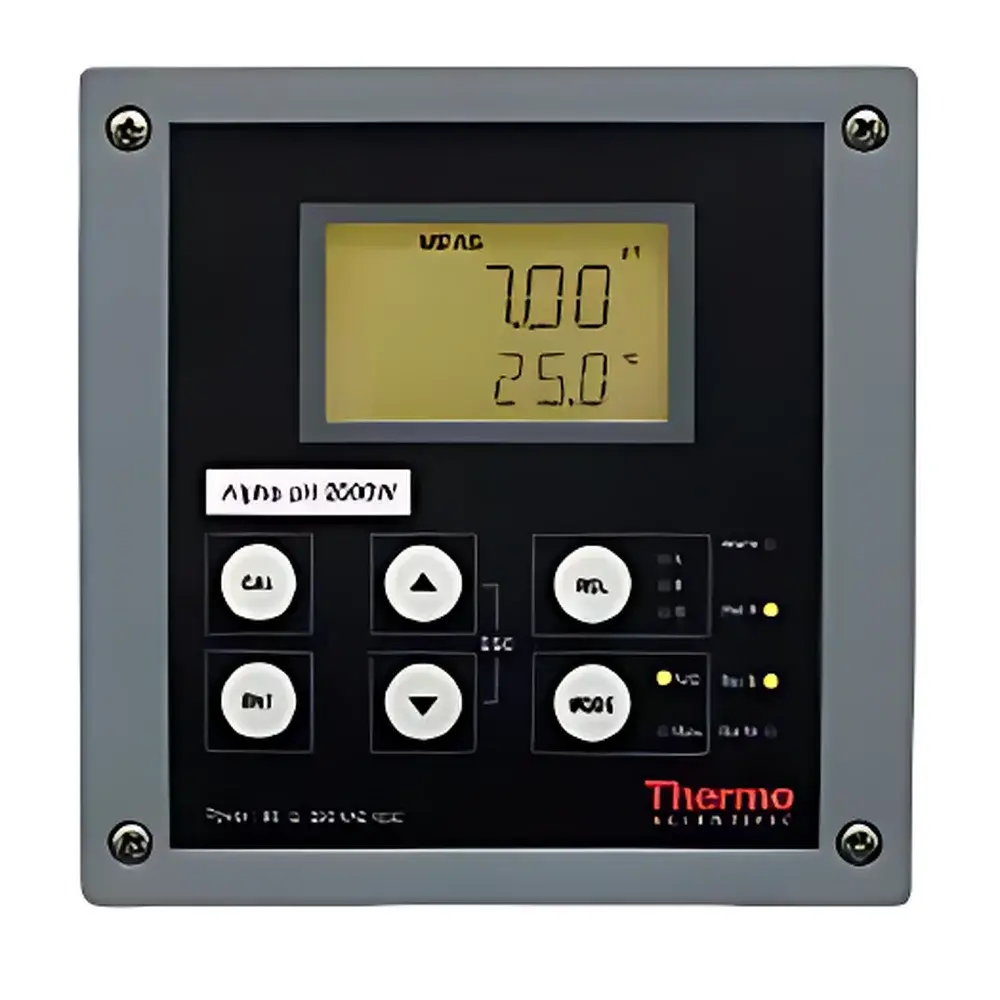
Thermo Scientific Alpha Series Online Water Quality Analyzer
| Brand | Thermo Fisher |
|---|---|
| Origin | USA |
| Manufacturer | Thermo Fisher Scientific |
| Product Type | Imported |
| Model | Thermo Scientific Alpha |
| Pricing | Upon Request |
Overview
The Thermo Scientific Alpha Series Online Water Quality Analyzer is an industrial-grade, multi-parameter continuous monitoring system engineered for real-time measurement and process control of critical water quality parameters—including pH, ORP (Oxidation-Reduction Potential), conductivity, resistivity, and dissolved oxygen (DO). Built upon a robust analog and digital sensor architecture, the Alpha platform integrates precision electrochemical sensing with embedded microprocessor-based control logic. Its core measurement principles follow standardized potentiometric (pH/ORP), conductometric (conductivity/resistivity), and amperometric (DO) methodologies aligned with ASTM D1293, ISO 7888, and USP . Designed for deployment in municipal wastewater treatment plants, industrial cooling towers, boiler feedwater systems, and pharmaceutical purified water (PW) loops, the Alpha Series delivers high reproducibility under variable flow, temperature, and fouling conditions—without requiring frequent manual intervention.
Key Features
- Modular 1/2 DIN controller design (Alpha 2000/2000W series) supporting both analog sensor inputs and digital communication protocols (4–20 mA, RS-485 Modbus RTU)
- PID control algorithm with user-configurable tuning parameters for stable, low-overshoot regulation of chemical dosing or valve actuation
- Proportional control via adjustable pulse width modulation (PWM) or pulse frequency modulation (PFM), plus hysteresis-tunable on/off relay outputs
- Auto-calibration with intelligent buffer recognition—reduces operator error and ensures traceable calibration records per GLP/GMP requirements
- Symmetrical input circuitry to suppress common-mode noise in grounded or poorly shielded piping environments
- NEMA 4X-rated enclosure (IP66 equivalent) for dust-tight, corrosion-resistant operation in outdoor or high-humidity industrial settings
- Dual independent 4–20 mA analog outputs: one dedicated to primary measurement (e.g., pH), the other to temperature—both fully scalable and isolated
- Electrode auto-cleaning relay output with programmable cycle duration (1–3600 s) and interval (1–7200 s), compatible with pneumatic or mechanical cleaning systems
- HOLD function enabling safe interlocking with external safety devices (e.g., level switches, flow monitors) to suspend control during abnormal process states
- Non-volatile memory (EEPROM) preserving all configuration, calibration history, and alarm thresholds across power loss or firmware updates
Sample Compatibility & Compliance
The Alpha Series accommodates a broad range of aqueous matrices—from raw surface water and activated sludge effluent to ultra-pure water (UPW) and aggressive industrial process streams containing fluoride, chlorides, or oxidants. Sensor compatibility includes standard glass pH electrodes, antimony-based pH sensors for HF-containing applications, and polarographic or optical DO probes. All configurations comply with IEC 61508 (SIL2-capable architecture), meet electromagnetic compatibility (EMC) requirements per EN 61326-1, and support audit-trail-enabled data logging compliant with FDA 21 CFR Part 11 when integrated with Thermo Fisher’s optional DeltaV™ or DeltaLink™ software suite. System validation documentation—including IQ/OQ templates and sensor performance verification protocols—is provided for regulated environments (e.g., pharmaceutical, food & beverage).
Software & Data Management
While the Alpha controller operates autonomously with local display and relay logic, it supports seamless integration into centralized SCADA or DCS platforms via Modbus RTU over RS-485. Optional Thermo Fisher DeltaLink™ configuration software enables remote setup, firmware updates, calibration logging, and event-driven alarm export (CSV/XML). All calibration events, relay state changes, and parameter deviations are timestamped and stored locally with configurable retention (up to 30 days). When deployed with DeltaV™ distributed control systems, the Alpha Series contributes to full lifecycle data integrity—supporting electronic signatures, role-based access control (RBAC), and automated report generation for regulatory submissions.
Applications
- Municipal drinking water treatment: pH stabilization pre- and post-chlorination, coagulant dosing control
- Wastewater biological nutrient removal (BNR): DO setpoint control in aerobic zones; ORP monitoring in anoxic denitrification basins
- Power plant cycle chemistry: Condensate polishing pH/condensate conductivity monitoring; boiler feedwater resistivity surveillance
- Pharmaceutical water systems: PW and WFI loop conductivity compliance per USP and EP 2.2.38
- Food & beverage processing: CIP rinse water pH verification; syrup dilution conductivity control
- Chemical manufacturing: Effluent neutralization tank control; scrubber solution ORP monitoring
FAQ
What sensor types are supported for pH measurement?
The Alpha Series accepts both glass-bodied pH electrodes (for general-purpose use) and antimony electrodes (for applications involving hydrofluoric acid or high-suspended-solids media).
Does the Alpha 2000W support redundant power input?
No—it features a universal single-input power supply (85–250 VAC/DC), designed for immunity to voltage sags and transients typical in industrial facilities.
Can calibration data be exported for audit purposes?
Yes—when connected to DeltaLink™ or DeltaV™, all calibrations are logged with operator ID, timestamp, buffer values, slope/mV offset, and pass/fail status—fully traceable per 21 CFR Part 11.
Is NIST-traceable calibration required before commissioning?
While factory calibration is performed using NIST-traceable standards, site-specific verification with certified buffers is recommended prior to operational handover.
How is temperature compensation handled for conductivity measurements?
Automatic temperature compensation (ATC) follows the linear or non-linear (NaCl or KCl curve) algorithms defined in ASTM D1125 and ISO 7888, with user-selectable reference temperatures (20 °C or 25 °C).
Related Products







