
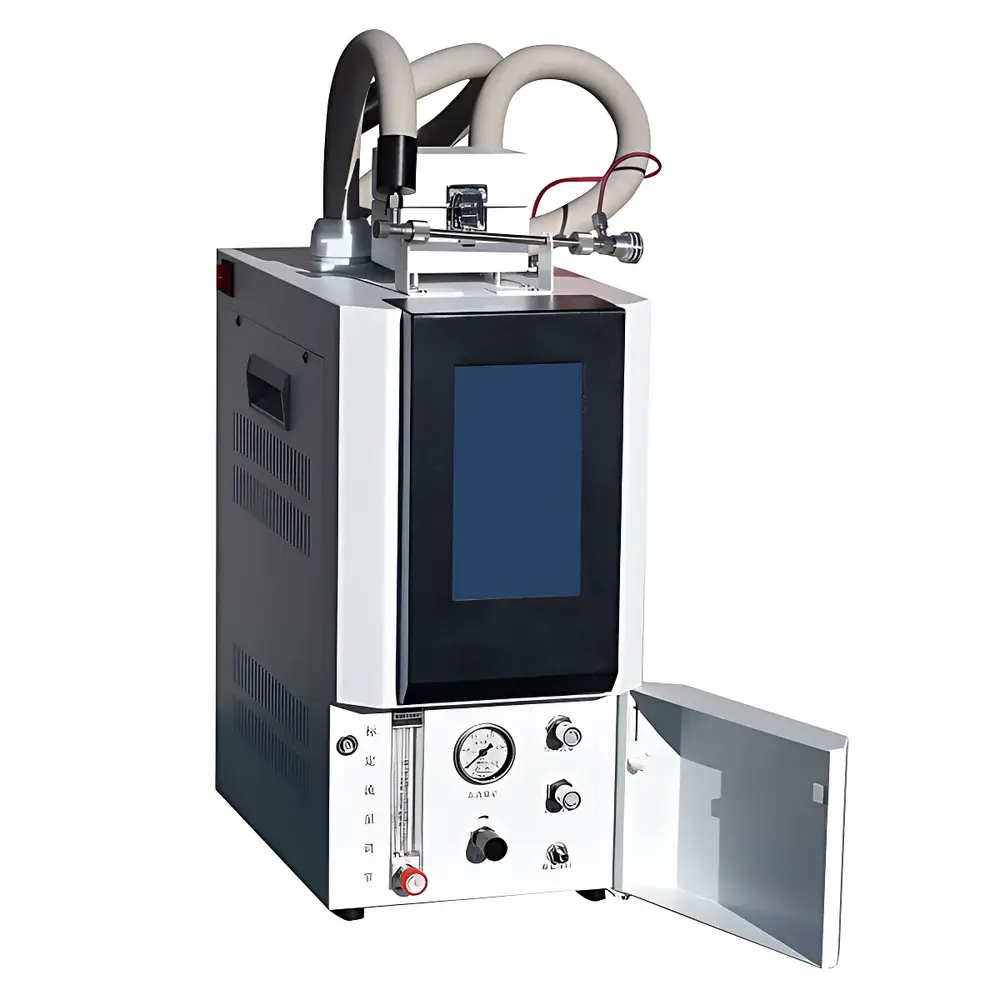
Beifen Sanpu ATDS-3430 Automated Two-Stage Thermal Desorber
| Brand | Beifen Sanpu |
|---|---|
| Origin | Beijing, China |
| Manufacturer Type | Direct Manufacturer |
| Model | ATDS-3430 |
| Instrument Type | Two-Stage Thermal Desorber |
| Desorption Temperature Range | Ambient to 450 °C |
| Cold Trap Temperature Range | −35 °C to Ambient |
| Desorption Recovery Rate | >99% (compound-dependent) |
| Sample Position Capacity | 1 tube |
| Cooling Method | Semiconductor-based Peltier cooling |
| Peak Width | <3 s |
| Second-Stage Heating Rate | >3000 °C/min |
| Valve Type | High-Temperature 6-Port Switching Valve (up to 240 °C) |
| Interface Compatibility | Universal GC/GC-MS inlet coupling (including Agilent, Thermo, Shimadzu, PerkinElmer) |
Overview
The Beifen Sanpu ATDS-3430 is an automated two-stage thermal desorber engineered for high-fidelity sample introduction in gas chromatography (GC) and gas chromatography–mass spectrometry (GC-MS) workflows. It implements a precisely controlled thermal desorption process wherein volatile and semi-volatile organic compounds (VOCs and SVOCs) are thermally released from sorbent tubes—typically Tenax®, Carbopack™, or multi-bed configurations—under inert carrier gas flow. The instrument performs primary desorption at elevated temperature, followed by cryo-focusing in a Peltier-cooled cold trap (−35 °C to ambient), and rapid secondary desorption directly into the GC inlet. This two-stage architecture minimizes band broadening, ensures sharp chromatographic peaks (99% recovery for benchmark compounds such as benzene, toluene, and naphthalene under optimized conditions). Designed for compliance with environmental analytical standards—including GB 50325–2020 (China’s Code for Indoor Environmental Pollution Control) and ASTM D6196–22—the ATDS-3430 delivers reproducible, trace-level quantitation of target analytes in air, building materials, food packaging, and indoor environment samples with boiling points up to 350 °C.
Key Features
- Two-stage thermal desorption with independent temperature control across four zones: primary desorption oven, valve oven, transfer line, and secondary desorption/cold trap assembly
- Semiconductor-based Peltier cooling system eliminates reliance on liquid nitrogen or mechanical chillers, reducing operational cost and increasing lab safety and uptime
- High-temperature 6-port switching valve rated to 240 °C, fully housed within a thermally insulated oven to eliminate cold spots and preserve analyte integrity
- Ultra-fast secondary desorption heating rate exceeding 3000 °C/min, enabling narrow peak focusing and improved sensitivity
- Entire sample pathway—including transfer lines and valve interfaces—constructed from high-inertness, silanized fused-silica or deactivated stainless-steel tubing to prevent adsorption, carryover, or catalytic degradation
- Automated back-flush function for both the transfer line and injection valve, minimizing cross-contamination between sequential analyses
- 7-inch full-color LCD touchscreen interface with intuitive Chinese/English bilingual navigation and real-time status animation
- Integrated method programming with time-segmented control of desorption, purge, refocus, reinjection, and trap bake-out sequences
- Universal GC interface design supporting direct connection to all major GC and GC-MS platforms (Agilent 7890/8890, Thermo ISQ/DFS, Shimadzu GC-2030, PerkinElmer Clarus series) via standardized ferrule-based fittings
- Onboard standard vapor generation mode for direct calibration curve construction without external dynamic dilution systems
Sample Compatibility & Compliance
The ATDS-3430 accepts standard 6 mm OD × 89 mm length sorbent tubes (e.g., SKC Ultra, Markes UNITY-type, or custom-packed beds). It supports single-tube operation with precise positional repeatability and thermal uniformity. The system meets functional requirements outlined in ISO 16000-6:2011 (Indoor air — Part 6: Determination of volatile organic compounds in indoor and test chamber air using active sampling on sorbent tubes, thermal desorption and gas chromatography), EPA TO-17 (Determination of Volatile Organic Compounds in Ambient Air Using Active Sampling Onto Sorbent Tubes), and China’s GB/T 18883–2022 and GB 50325–2020. All temperature zones are calibrated traceably to NIST-traceable references; temperature stability is maintained within ±0.5 °C over full operating range. The firmware supports audit trail logging and user-access level management—features aligned with GLP-compliant laboratory practices and preparatory alignment with FDA 21 CFR Part 11 data integrity expectations when paired with compliant chromatography data systems.
Software & Data Management
Control is executed via embedded microprocessor firmware with non-volatile memory for method storage (≥100 methods). Each method includes programmable parameters for primary desorption time/temperature, cold trap hold time, secondary desorption ramp rate and final temperature, valve timing, and post-run trap bake-out. The system outputs TTL-level trigger signals for synchronized GC start and data system acquisition initiation. While the ATDS-3430 does not include proprietary PC software, it exports ASCII-formatted log files (CSV-compatible) containing timestamps, zone temperatures, valve states, and run completion codes—enabling integration with third-party LIMS or CDS platforms via serial or USB virtual COM port. Optional RS-232/USB-to-Ethernet adapters support remote monitoring in networked lab environments.
Applications
- Indoor air quality (IAQ) monitoring per GB 50325–2020 and ISO 16000-6 for formaldehyde, benzene, TVOC, and aldehydes
- Testing of volatile emissions from construction materials (plywood, particleboard, carpets, adhesives)
- Residual solvent analysis in pharmaceutical packaging and medical devices
- Flavor and fragrance profiling in food and beverage matrices using headspace–tube extraction
- Occupational hygiene assessments for workplace VOC exposure (NIOSH/OSHA-equivalent protocols)
- Forensic analysis of ignitable liquid residues (ILR) in fire debris samples
- Method development and validation studies requiring high-precision thermal release kinetics
FAQ
What sample formats are supported by the ATDS-3430?
The instrument accepts standard 6 mm OD × 89 mm sorbent tubes. Custom tube lengths or diameters require mechanical adapter kits.
Does the ATDS-3430 support multi-tube autosampling?
No—it is a single-position thermal desorber. For unattended multi-sample analysis, integration with an external robotic autosampler is required.
Can the cold trap operate below −35 °C?
No. The Peltier-based cooling system has a minimum setpoint of −35 °C, sufficient for trapping C2–C16 hydrocarbons and most polar VOCs.
Is the firmware upgradeable in the field?
Yes—firmware updates are delivered via USB flash drive and installed through the touchscreen interface without service engineer intervention.
How is calibration verified?
Users perform temperature verification using NIST-traceable digital thermometers inserted into designated probe ports; flow calibration is conducted using a certified electronic bubble flowmeter on the carrier gas line.




